Best Crossbow for Moose Hunting
The Short Answer
The best crossbow for moose hunting is the TenPoint TRX Ultra at about $3,500. It advertises 515 fps with a 410 grain arrow, it is listed at 242 ft-lb of kinetic energy with the arrow weight unstated, it weighs 8.4 lbs, and it is only 6 inches wide when cocked. It leads this list because it carries the largest energy margin in the roundup, and margin is what matters when the animal in front of you weighs roughly 800 to 1,400 pounds, depending on region and subspecies, with thick hide, heavy bone, and a deep chest.
If you want the largest manufacturer stated energy figure on a proven platform, buy the TenPoint Nitro 505 at about $3,000, with 227 ft-lb advertised with a 400 grain arrow and 505 fps advertised with the same arrow. If your budget stops near $1,200, buy the Barnett Hyper Raptor T-REX at about $1,200, with 163 ft-lb advertised and a tested speed of 438 fps with a 401 grain arrow. Every pick in this roundup produces 163 to 242 ft-lb at the muzzle, which sits above even the highest published moose guidance figure I found, 80 ft-lb. So the question here is not whether a pick has enough energy. The question is how much margin it keeps at 40 to 50 yards with a heavy moose bolt, how accurately it shoots that bolt, and whether it keeps working in the cold.
One warning up front, because it applies to the third pick in this list. The Ravin R500 was recalled in March 2024, about 13,300 crossbows in the United States plus about 425 in Canada, serials R050 to R057, with a free repair from Ravin at 888-769-7287. Check your serial number before you buy or shoot one. I state that recall wherever the R500 is named in this article, including its section below.
No bow in this article is presented as a proven moose killer, because no published moose kill with any of these six bows was found in my research. What follows is a ranking by muzzle energy with the arrow weight next to every figure, tested speeds where a published test exists, and honest notes on what each bow gives up. For the full picture across every price band, see our top-rated crossbow roundup.
Best Crossbows for Moose Hunting: Comparison Table
| Crossbow | Speed, advertised | Speed, tested | Kinetic energy at the muzzle | Price | Weight | Width, cocked |
|---|---|---|---|---|---|---|
| TenPoint TRX Ultra | 515 fps, 410 grain arrow | No published test found with a stated arrow weight | 242 ft-lb, retailer listed only, arrow weight unstated | About $3,500, starting at $3,499.99 | 8.4 lbs | 6 in |
| TenPoint Nitro 505 | 505 fps, 400 grain arrow | 517 fps (400 grain arrow); 515 fps in the Bowhunter test, Dec 14, 2021; 509 fps in the Game and Fish test, May 16, 2022 | 227 ft-lb advertised, 400 grain arrow | About $3,000, MAP $2,999.99 Moss Green | 7.9 lbs | 6.5 in |
| Ravin R500 | 500 fps, 400 grain arrow | No published test found | 222 ft-lb retailer listed, 400 grain arrow, versus 164 ft-lb in a third party guide, conflict flagged, neither settled. March 2024 recall, serials R050 to R057, free repair, 888-769-7287 | About $2,650, manufacturer $2,649.99; retailers about $3,100 | 8.4 lbs, retailer listed only | 3.6 in |
| Ravin R470 | 470 fps, 400 grain arrow | 472 fps (Field and Stream 2025 test); 478 fps in one other publisher test | 196 ft-lb advertised, 400 grain arrow; 198 ft-lb tested (Field and Stream 2025, arrow weight unstated for the tested figure) | About $2,500 base black; manufacturer lists $2,549.99 | 8.4 lbs | 4.3 in |
| TenPoint TX Ultra 29.5 | 460 fps, 410 grain arrow | 445 fps, 440 grain arrow (Field and Stream) | 195.6 ft-lb tested, 440 grain arrow (Field and Stream) | About $2,300, sale price; MAP $2,499.99, not the MSRP | 8.0 lbs bare | 6.5 in |
| Barnett Hyper Raptor T-REX | 440 fps | 438 fps, 401 grain arrow (Shooting Sports Retailer, June 12, 2026); about 430 fps in other coverage | 163 ft-lb advertised, arrow weight unstated, versus 171.08 ft-lb calculated from the test, 401 grain arrow (Shooting Sports Retailer, June 12, 2026) | About $1,200, MSRP $1,199.99 | 8.2 lbs | 7.25 in |
Three notes on the table. First, every energy figure carries its arrow weight, or says the weight is unstated, because an energy figure without an arrow weight means nothing. A heavier bolt trades speed for energy, so these muzzle figures do not carry forward to 50 yards unchanged. Second, a 450 to 500 grain moose bolt will be slower than the advertised speed on every pick here, and it will need a re-sight. Third, bare weight is the bow without accessories, and rigged weight runs about 1.5 to 2 lbs heavier.
Best Overall for Moose: TenPoint TRX Ultra
Speed: 515 fps advertised, 410 grain arrow, no published test with a stated arrow weight | Kinetic energy: 242 ft-lb retailer listed only, arrow weight unstated | Price: About $3,500, starting at $3,499.99 | Weight: 8.4 lbs | Width cocked: 6 in
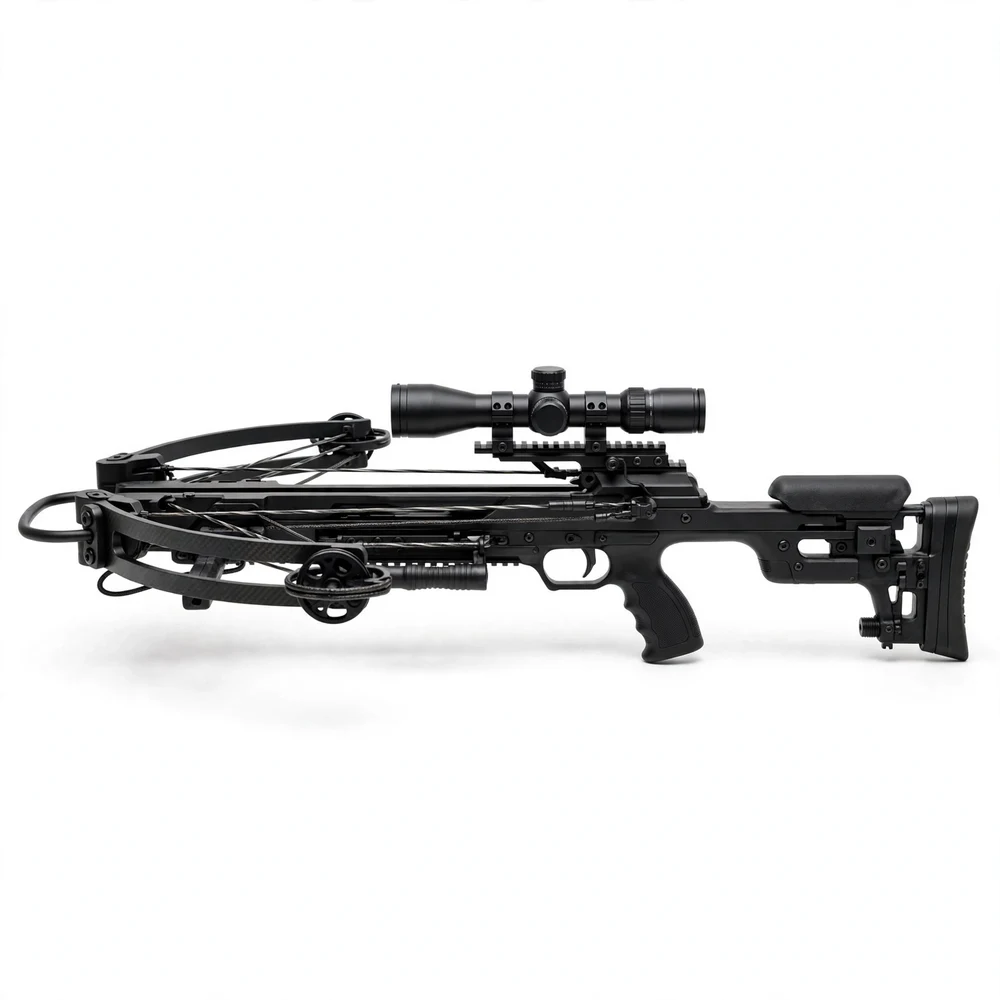
The TRX Ultra leads this list on energy margin, and I want to be exact about what that margin is built on. TenPoint advertises 515 fps with a 410 grain arrow, from a reverse draw platform with a 16.25 inch power stroke, and the bow weighs 8.4 lbs, measures 29.5 inches long, and is 6 inches wide when cocked. The 242 ft-lb figure is retailer listed only, with the arrow weight unstated in the listing, so I do not present it as a TenPoint figure and I do not attach an arrow weight to it. It still leads the roundup on paper, and it is the fastest production crossbow in this list. The ACUslide MAXX system cocks and safely de-cocks it, which matters at the end of a cold moose sit when you need to unload without firing a bolt. See the TenPoint collection reviewed for the rest of the lineup.
The honest limit is that this is a new platform, launched in January 2026 at the ATA Show, so no full season of owner history exists yet. One roundup updated October 29, 2026 notes hands on time at a pre launch event but no full season of bolts through it yet, and that is the right way to think about it. There is also no published tested speed with a stated arrow weight in the verified set, and no published tested 50 yard group with a stated arrow weight, so I do not invent either one. On price, the starting figure is $3,499.99 in the launch coverage from December 16, 2025, with an MSRP of $3,549 listed in August 2026 coverage, and a sale price of $3,299.99 at one retailer against a $3,599.99 list. Do not confuse the base price with the Oracle package at $4,499.99 or the Vision HD package at $4,299.99, which are different packages. This is the pick for the hunter who wants the largest energy margin and hunts open country where 6 inches of cocked width helps in a blind.
Pros
- Highest energy figure in the roundup at 242 ft-lb, retailer listed, and the fastest advertised speed at 515 fps with a 410 grain arrow
- Only 6 inches wide when cocked, narrow for a blind, with a 16.25 inch power stroke
- ACUslide MAXX cocking and safe de-cocking built in
- Reverse draw layout keeps a 29.5 inch bow balanced and compact
Cons
- Highest price in the roundup at about $3,500, with the Oracle and Vision HD packages higher still
- 242 ft-lb is retailer listed only, arrow weight unstated, not a TenPoint figure
- New platform launched January 2026, long term reliability still being established
- No published tested speed or tested 50 yard group with a stated arrow weight was found
Bottom line: the best overall moose crossbow on energy margin and width, if you will pay about $3,500 for a new flagship and accept that no full season of owner history exists yet.
Best Proven Power: TenPoint Nitro 505
Speed: 505 fps advertised, 400 grain arrow; 517 fps tested, 400 grain arrow | Kinetic energy: 227 ft-lb advertised, 400 grain arrow | Price: About $3,000, MAP $2,999.99 Moss Green | Weight: 7.9 lbs | Width cocked: 6.5 in
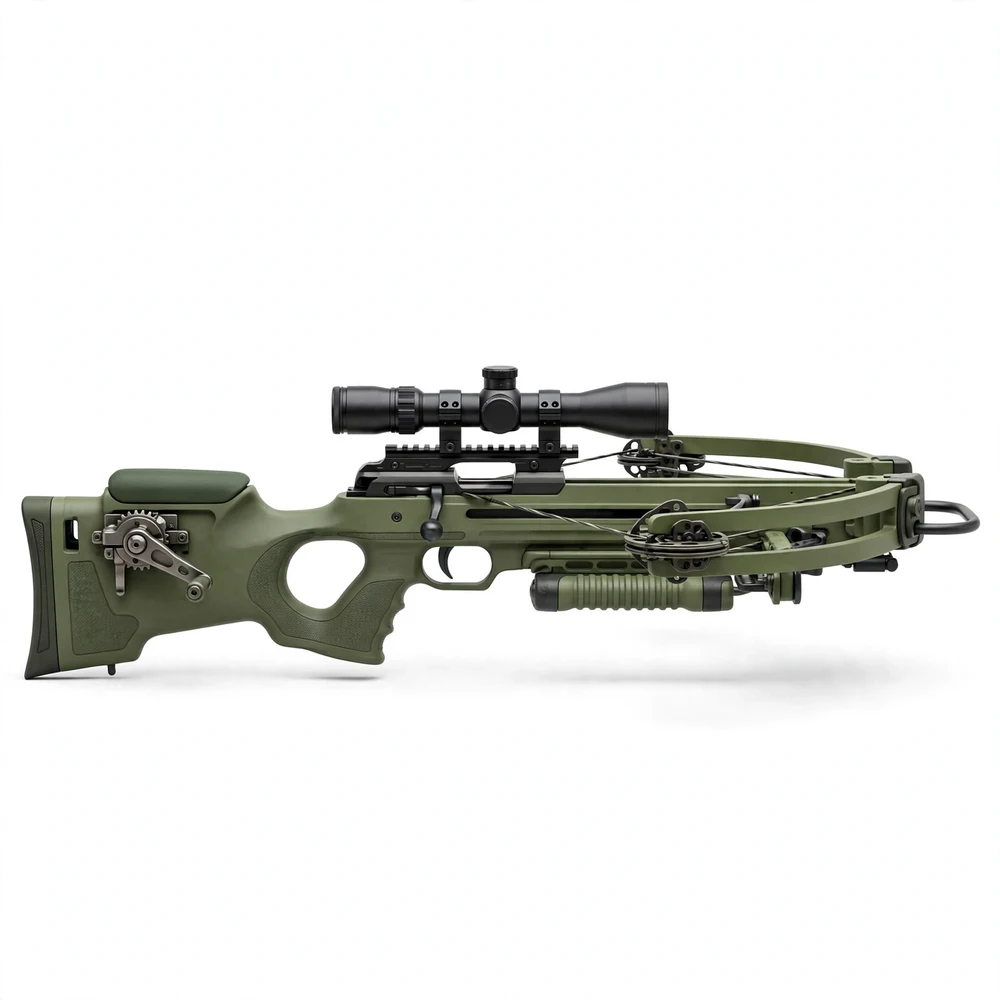
The Nitro 505 is the most proven power pick in this roundup, and it is the one I trust most on the strength of its test record. TenPoint advertises 505 fps with a 400 grain arrow and 227 ft-lb of energy with the same arrow, and the published tests beat the advertised speed. One test chronographed 517 fps with a 400 grain arrow, the Bowhunter test of December 14, 2021 averaged 515 fps over three shots of 515, 514, and 514 fps with a 400 grain bolt, and the Game and Fish test of May 16, 2022 recorded three consecutive readings of 509 fps. The same Bowhunter test shows what a heavier moose bolt does: with a 455 grain bolt the bow averaged 494 fps and 247 ft-lb of energy, so speed falls and energy rises as the bolt gets heavier. That is the trade a moose hunter actually makes, and this bow makes it well. It is a reverse draw bow with a 17 inch power stroke, a 300 lb draw weight, a 3.5 lb trigger, and ACUslide silent cocking and safe de-cocking.
Two honest costs come with it. First, the length is flagged, not settled: the verified set lists 30.5 inches, while launch coverage lists 30.7 inches without the stirrup, a 0.2 inch difference I do not resolve here. Second, it is loud. The Bowhunter test of May 2022 measured 106.5 dB of shot noise with a 420 grain bolt, the loudest measured figure in the verified set, and a moose does not jump the string the way a whitetail does, but noise still matters for a second shot and for the animals around you. The same May 2022 test measured a 0.563 inch maximum shot deviation at 35 yards, which is the closest thing to a published accuracy figure this bow has in the verified set. On price, lead with about $3,000: the MAP is $2,999.99 in Moss Green and $3,099.99 in Veil Alpine, and one retailer lists the EVO-X package at $3,099.99. Do not use the Oracle X or XERO packages at $3,699.99 as the base price, and do not use an out of stock $2,499.99 Oracle listing or a refurbished $2,200 XERO listing as the base price either. See our TenPoint crossbow reviews for the rest of the lineup.
Pros
- Largest manufacturer stated energy margin on a proven platform, 227 ft-lb advertised with a 400 grain arrow
- Tested faster than advertised in three published tests, 517, 515, and 509 fps with a 400 grain arrow
- Heavier 455 grain bolt tested at 494 fps and 247 ft-lb, a real heavy bolt data point for moose
- ACUslide silent cocking and safe de-cocking, 3.5 lb trigger
Cons
- About $3,000, the highest base price here after the TRX Ultra
- 106.5 dB shot noise with a 420 grain bolt in the Bowhunter May 2022 test, the loudest measured figure in the verified set
- 300 lb draw weight means crank only, no rope cocking
- Length is flagged at 30.5 versus 30.7 inches, neither figure asserted as settled
Bottom line: the best proven power pick for moose, because three published tests beat its advertised speed and one test proves the heavy bolt trade works in your favor.
Best Ravin Power, Narrowest for a Blind: Ravin R500
Speed: 500 fps advertised, 400 grain arrow, no published test found | Kinetic energy: 222 ft-lb retailer listed, 400 grain arrow, versus 164 ft-lb in a third party guide, conflict flagged | Price: About $2,650, manufacturer $2,649.99; retailers about $3,100 | Weight: 8.4 lbs, retailer listed only | Width cocked: 3.6 in
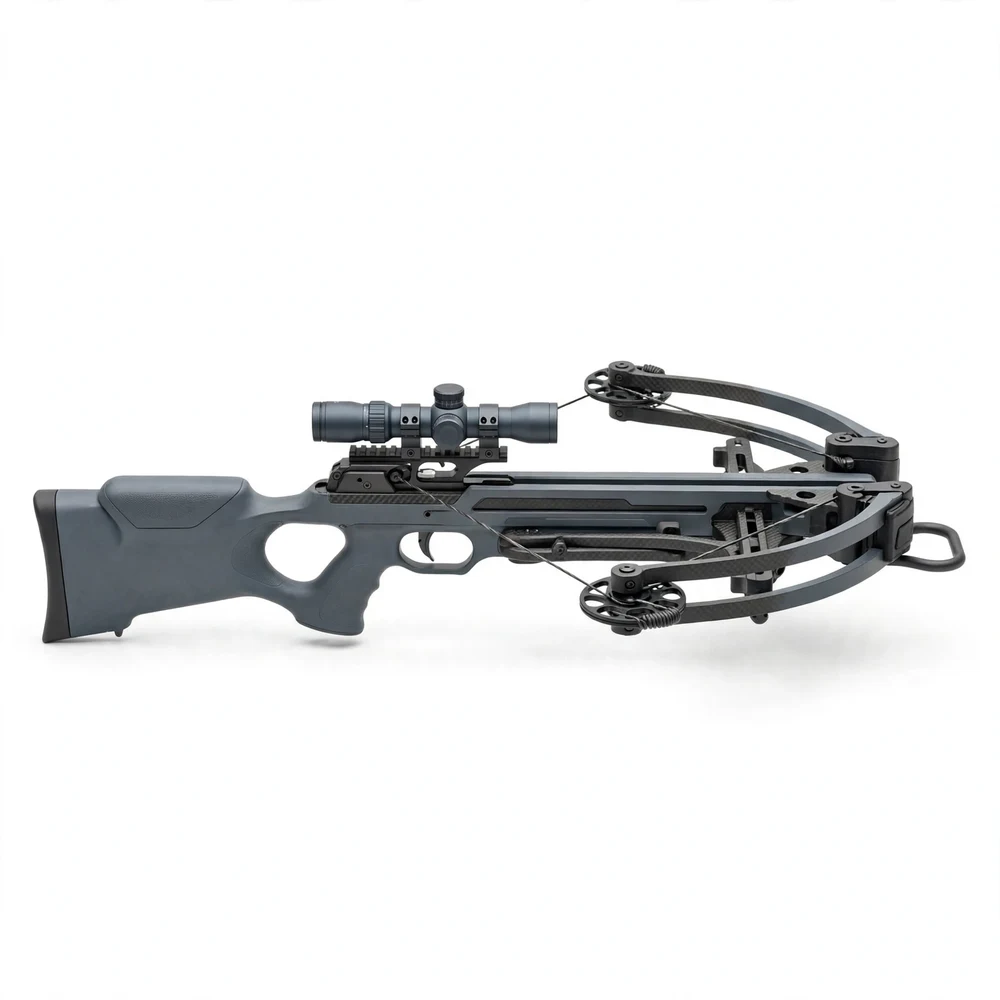
The Ravin R500 is the narrowest bow in this roundup by a wide margin, and that is its real moose argument. At 3.6 inches wide when cocked and 28 inches long, not 28.5 inches, it swings inside a ground blind where every other pick here feels wide. It advertises 500 fps with a 400 grain arrow from the HexCoil cam system, with silent cocking that can be reversed, and an electric cocking option on the E variant. The weight of 8.4 lbs is retailer listed only, not a manufacturer figure in the verified set, so I label it that way. The cocking effort is 17 lb, not the 12 lb figure that circulates for the wider Ravin family, and that 12 lb figure belongs to the Versa-Draw family, not this bow. Ravin makes 500 grain HD arrows for a heavy moose setup, but a heavy arrow drops speed and no tested energy figure with a 500 grain arrow was verified, so I do not state one. See our in-depth Ravin reviews for the rest of the lineup.
Now the two conflicts you must know before you buy, and the recall. First, the energy conflict: one retailer listing puts the R500 at 222 ft-lb with a 400 grain arrow, while a third party big game guide lists 164 ft-lb at the muzzle. Those two figures cannot both be the same muzzle energy with the same arrow, so I flag both and settle neither, and I present neither one as a Ravin manufacturer figure. Second, the price conflict: the manufacturer lists the R500 at $2,649.99, while retailers list it at $3,024.99 to $3,099.99. I lead with about $2,650 and state the about $3,100 retailer alternative, and I do not present one figure as settled. The XK7 variant at $2,849.99 and the R500E XK7 at $2,949.99 are different variants. Third, the recall, stated here in full because it must be stated wherever the R500 is named: in March 2024 the R500 series was recalled, about 13,300 crossbows in the United States plus about 425 in Canada, serials R050 to R057, because a nearly but not fully cocked bow could discharge unexpectedly while being cocked or uncocked. The remedy is a free repair from Ravin, toll free at 888-769-7287 or by email at [email protected]. Check the serial number on the left side of the rail above the trigger before you buy or shoot one. Launch coverage also noted that broadheads rated for over 500 fps were hard to find, and that is a real moose problem, because a 500 fps bow narrows your head choice at the exact moment you need a heavy fixed blade to fly true.
Pros
- Narrowest bow here at 3.6 inches when cocked, the best blind fit in the roundup
- 500 fps advertised with a 400 grain arrow, the fastest Ravin in the list
- Silent cocking that can be reversed, with an electric cocking option on the E variant
- 500 grain HD arrows exist for a heavy moose setup
Cons
- Energy conflict: 222 ft-lb retailer listed versus 164 ft-lb in a third party guide, neither settled
- Price conflict: manufacturer $2,649.99 versus retailers about $3,100
- March 2024 recall, about 13,300 in the US plus 425 in Canada, serials R050 to R057, free repair at 888-769-7287
- Broadheads rated for over 500 fps are harder to find, and the 8.4 lb weight is retailer listed only
Bottom line: the best Ravin for a ground blind moose hunt, because nothing else here is 3.6 inches wide when cocked, provided you check the March 2024 recall serials first and accept that its energy figure is genuinely disputed.
Best Ravin Value for Moose: Ravin R470
Speed: 470 fps advertised, 400 grain arrow; 472 fps tested (Field and Stream 2025 test) | Kinetic energy: 196 ft-lb advertised, 400 grain arrow; 198 ft-lb tested (Field and Stream 2025, arrow weight unstated for the tested figure) | Price: About $2,500 base black; manufacturer lists $2,549.99 | Weight: 8.4 lbs | Width cocked: 4.3 in
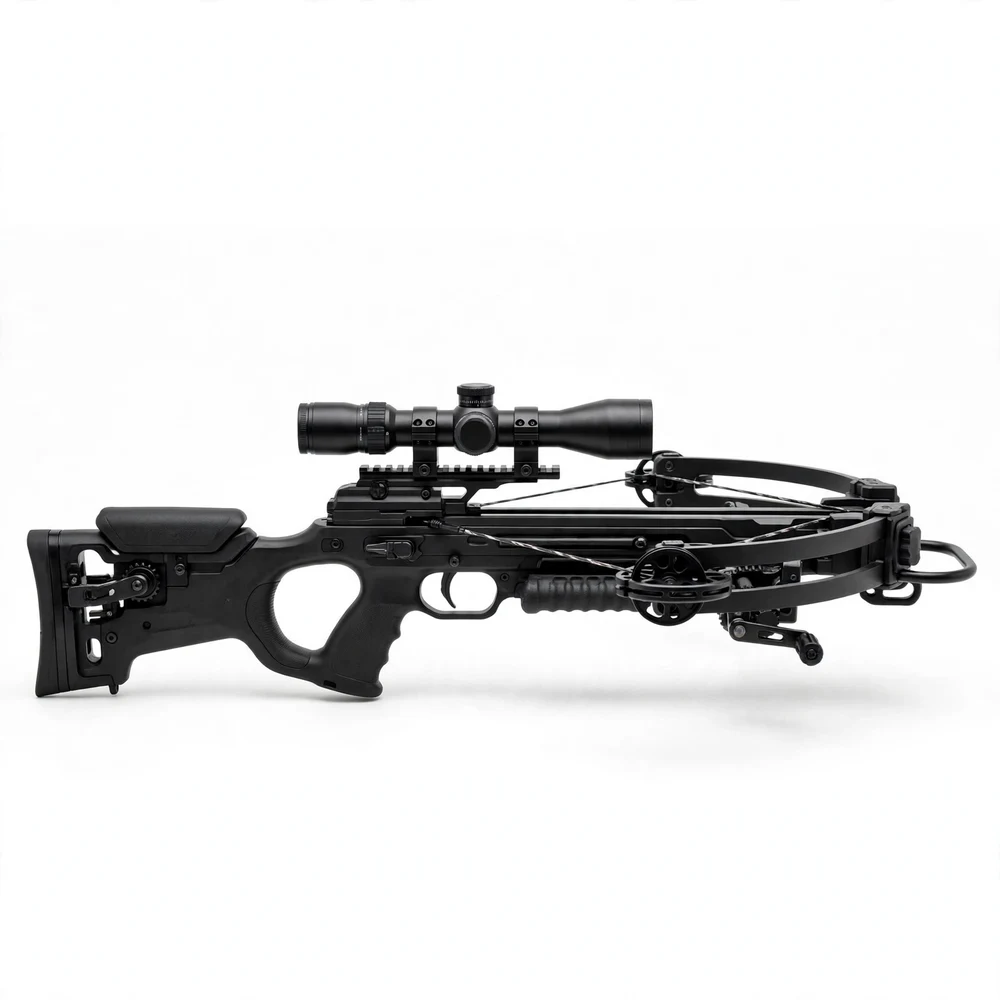
The R470 is the Ravin for the moose hunter who wants near 500 fps energy without the dearer Ravin price and without a recall hanging over it. It advertises 470 fps with a 400 grain arrow and 196 ft-lb with the same arrow, and the Field and Stream 2025 test, published October 7, 2025 and updated March 11, 2026, named it the fastest and hardest hitting crossbow in that test, clocking 472 fps with strong field point accuracy at 50 yards and 198 ft-lb tested. I do not attach an arrow weight to the 198 ft-lb tested figure, because the weight was not stated in the verified set for that figure. One other publisher test measured up to 478 fps, which I label as that publisher’s figure. The bow is 26.75 inches long, 4.3 inches wide when cocked, with a 13 inch power stroke, 8.4 lbs of weight, and 17 lb of draw force. At 26.75 inches it is the most compact bow in this roundup, and in a blind that compactness is worth more than the 30 fps gap to the R500. See the Ravin collection reviewed for the rest of the lineup.
The warning that matters most for moose is the broadhead warning. Field and Stream 2025 says the R470 is picky about broadheads, and its test found fixed three blade heads landed 3 inches off the field point zero, while mechanicals hit right with field points. For a moose hunt that means you test the exact fixed blade you will hunt with at 40 and 50 yards, and you do not assume a field point zero carries over. That warning carries into the broadhead section below. On price, lead with about $2,500 for the base black model, which lists at $2,499.99 at two retailers, while the manufacturer lists $2,549.99 and Field and Stream lists $2,550. The XK7 Camo version is $2,699.99 and the R470E XK7 is $2,849.99, so do not present a camo price as the base price.
Pros
- Fastest and hardest hitting bow in the Field and Stream 2025 test, 472 fps and 198 ft-lb tested
- Near 500 fps energy at about $2,500, with no recall attached to this model
- Most compact bow here at 26.75 inches, 4.3 inches wide when cocked
- Strong field point accuracy at 50 yards in the Field and Stream 2025 test
Cons
- Picky about broadheads in the Field and Stream 2025 test, fixed three blade heads landed 3 inches off the field point zero
- Premium price for a non flagship Ravin, with the camo version at $2,699.99
- 8.4 lbs, heavy for its compact size
- Arrow weight unstated for the 198 ft-lb tested figure, so do not carry it to a different arrow
Bottom line: the best Ravin value for moose, because it tested as the hardest hitter in its test at a lower price than the flagship Ravin, provided you prove your fixed blade at 40 and 50 yards before you hunt.
Best Forward Draw for Moose: TenPoint TX Ultra 29.5
Speed: 460 fps advertised, 410 grain arrow; 445 fps tested, 440 grain arrow (Field and Stream) | Kinetic energy: 195.6 ft-lb tested, 440 grain arrow (Field and Stream) | Price: About $2,300, sale price; MAP $2,499.99 | Weight: 8.0 lbs bare | Width cocked: 6.5 in
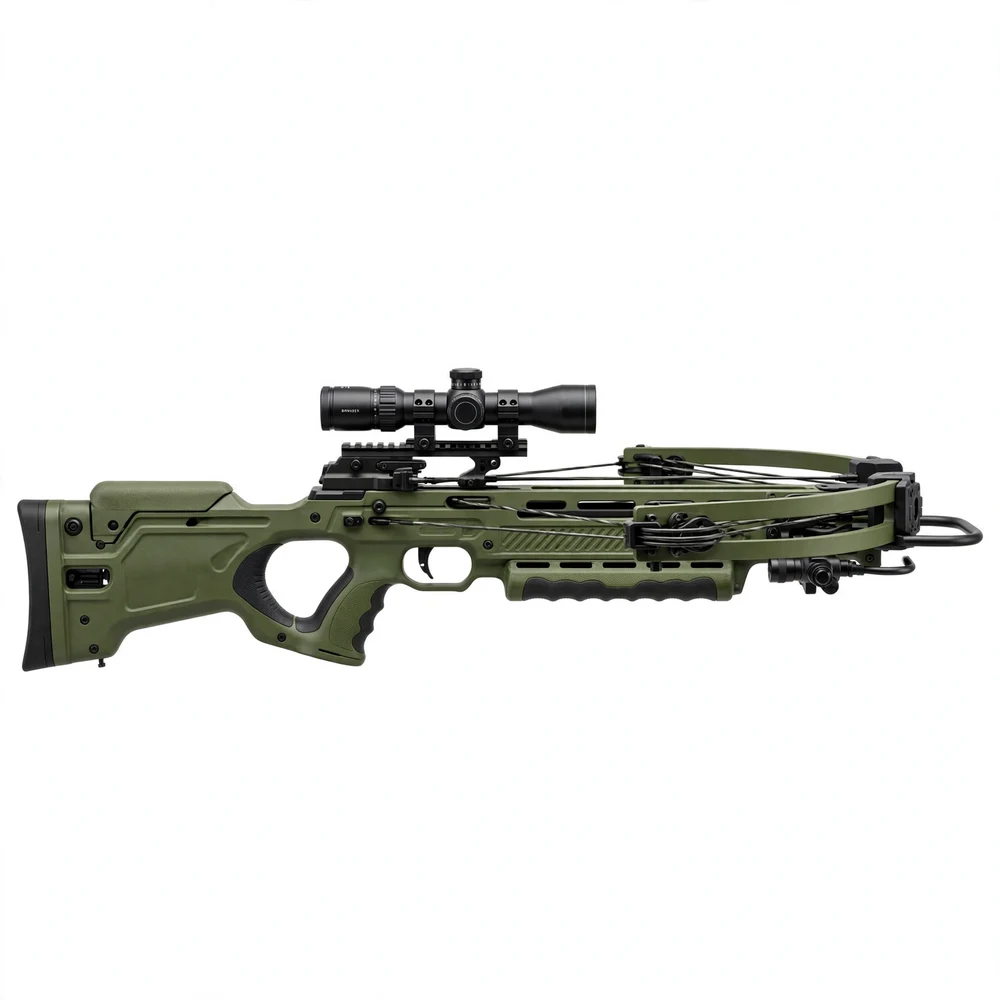
The TX Ultra 29.5 is the pick for the moose hunter who does not want a reverse draw bow, and it is the only pick here whose tested energy figure comes from a heavy arrow. This is a forward draw bow, not a reverse draw bow, and that layout matters if you prefer the balance and feel of a conventional front end. It advertises 460 fps with a 410 grain arrow, and the Field and Stream test measured 445 fps with a 440 grain arrow and 195.6 ft-lb tested with that same 440 grain arrow. I use the 195.6 ft-lb figure exactly as tested and I do not recalculate it, even though the standard formula gives about 193 ft-lb for that speed and weight, because the tested figure implies a slightly different speed or weight in the original test. The bow is 29.5 inches long, 6.5 inches wide when cocked, with a 13.5 inch power stroke, 8.0 lbs bare, and the ACUslide MAXX system, whose cocking effort tested at 13.3 lb in the Bowhunter review of June 6, 2026. Do not use a 5 lb figure for this system, because 5 lb belongs to the older ACUslide, not the MAXX. It was named the Field and Stream 2026 Best Crossbow and the Outdoor Life 2026 Best Premium Crossbow, and one guide repeats a tested 1.125 inch 50 yard group for this bow. See our TenPoint buying guide for the rest of the lineup.
The honest limits are weight, length, and the arrow behind the tested figure. At 8.0 lbs bare it is heavy for long carries, and at 29.5 inches it is the longest bow in the roundup alongside the TRX Ultra, so it is the open country pick, not the tight blind pick. The tested 195.6 ft-lb figure belongs to a 440 grain arrow, not to the advertised 410 grain arrow, so a lighter 400 grain arrow will give a different energy figure, and I do not carry the 195.6 ft-lb figure to a different arrow weight. On price, lead with about $2,300: one retailer lists the EVO-X Elite Moss Green package at $2,299.99 on sale against a $2,499.99 list, the MAP is $2,499.99, and the Vektra version is $2,599.99. Do not call $2,300 the MSRP, because it is a sale price, and do not use the Oracle package at $3,499.99 as the base price. The TX Ultra 26.5 is a different model at 410 fps advertised with a $1,999.99 MAP, so never give the 26.5 the 29.5 price, width, or energy.
Pros
- Only tested energy figure here from a heavy 440 grain arrow, 195.6 ft-lb tested in Field and Stream
- Forward draw layout for hunters who do not want a reverse draw bow
- Tested 1.125 inch 50 yard group, the only published 50 yard group size in this roundup
- Named Field and Stream 2026 Best Crossbow and Outdoor Life 2026 Best Premium Crossbow
Cons
- 8.0 lbs bare is heavy for long carries, and 29.5 inches is the longest bow here
- Premium price, about $2,300 on sale with a $2,499.99 MAP behind it
- Tested energy belongs to a 440 grain arrow, so do not carry it to a lighter arrow
- ACUslide MAXX effort tested at 13.3 lb, not the 5 lb figure some listings imply
Bottom line: the best forward draw moose crossbow, because its tested energy comes from a heavy arrow and its tested 50 yard group is the strongest accuracy evidence in this list.
Best Value Power Pick: Barnett Hyper Raptor T-REX
Speed: 440 fps advertised; 438 fps tested, 401 grain arrow (Shooting Sports Retailer, June 12, 2026) | Kinetic energy: 163 ft-lb advertised, arrow weight unstated, versus 171.08 ft-lb calculated from the test, 401 grain arrow | Price: About $1,200, MSRP $1,199.99 | Weight: 8.2 lbs | Width cocked: 7.25 in
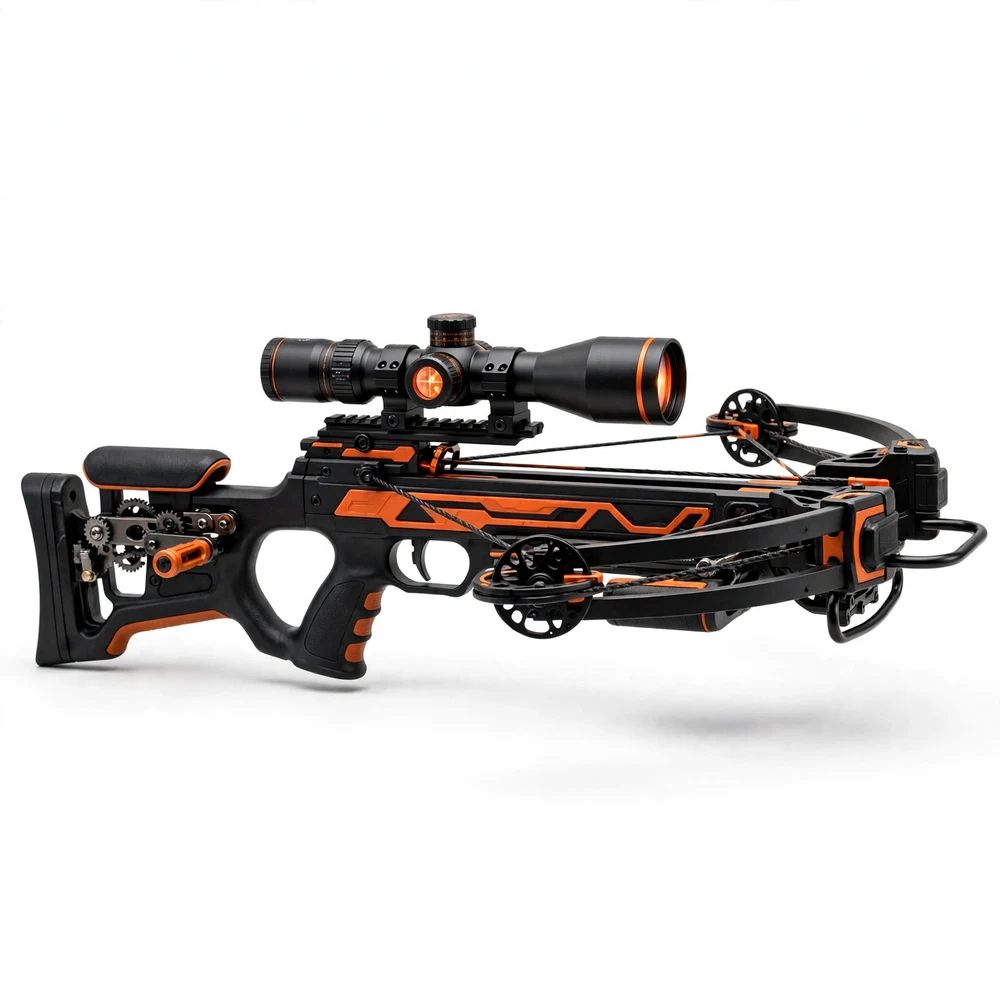
The T-REX is the value story of this roundup, because it puts near flagship energy in your hands for about half the flagship price. Barnett advertises 440 fps and 163 ft-lb, with the arrow weight unstated for the advertised energy figure, so I do not attach a weight to it. The test record is unusually honest for a value bow. Shooting Sports Retailer chronographed 438 fps with a 401 grain arrow on June 12, 2026, essentially matching the advertised figure, and calculated 171.08 ft-lb from that test. Other coverage verified about 430 fps, and I do not use the 423 fps figure, because it was not re-verified. The bow is 32 inches long, 7.25 inches wide when cocked, 8.2 lbs without accessories, with a 220 lb draw weight and a 16 inch power stroke, an integrated cocking and de-cocking system, a 2 to 7×36 mm illuminated multi reticle scope, three 22 inch HyperFlite arrows, and a three arrow side mount quiver in the package. The same June 12, 2026 test says the bow smooths out the cocking experience, shoots deadly accurate, and is priced right, and that a customer gets high performance at half or a third of the price of some other options. See our full Barnett lineup review for the rest of the lineup.
The real cost is the arrow ecosystem. HyperFlite arrows are small diameter shafts, which limits your broadhead and bolt choice against standard diameter shafts, and that matters for a moose setup where you want a heavy 450 to 500 grain bolt with a 125 grain fixed blade. The bow is also 8.2 lbs, so it is not light, and no published noise figure was found. On price, the MSRP is $1,199.99, confirmed by Shooting Sports Retailer on June 12, 2026 and again on October 19, 2026, so I headline about $1,200. Do not use a used listing at $825 as the headline price, because a used price is not a current new bow price. This is the pick for a first moose bow that does not require a $2,500 plus spend, and for the hunter who wants to put the saved money into a good fixed blade, heavy bolts, and practice time.
Pros
- Near flagship energy for about $1,200, half or a third of the flagship price
- Tested speed of 438 fps with a 401 grain arrow essentially matches the 440 fps advertised figure
- Integrated cocking and de-cocking system, illuminated 2 to 7×36 mm scope, three HyperFlite arrows and quiver included
- 7.25 inches wide when cocked, narrow enough for a blind at this price
Cons
- HyperFlite small diameter arrows limit broadhead and bolt choice for a heavy moose setup
- Advertised 163 ft-lb carries no stated arrow weight, and the 171.08 ft-lb figure is a test calculation, not a Barnett figure
- 8.2 lbs, heavy for a value bow
- No published noise figure was found
Bottom line: the best value power pick for moose, because it tests within 2 fps of its advertised speed and costs about $1,200, provided you accept the HyperFlite arrow ecosystem.
How Much Kinetic Energy Does a Moose Hunt Actually Need?
Start with what the law actually sets, because no state agency kinetic energy minimum for moose was found in my research, and I do not invent one here. In Alaska, under 5 AAC 92.085, taking big game with a crossbow is unlawful unless the bow has a peak draw weight of 100 pounds or more, the bolt is tipped with a broadhead, is at least 16 inches long overall, and weighs at least 300 grains, the crossbow has no attached electronic devices except for a scope or electronic sight that does not project light externally, and it is a shoulder mounted crossbow. Crossbows are not legal archery equipment in Alaska and may not be used in any hunt or area restricted to bow and arrow only. Certification is required for hunters born on or after January 1, 1986 and for every hunter participating in a crossbow only hunt. In Maine, a legal hunting crossbow must have a shoulder type stock, at least 100 pounds of draw weight, and a working mechanical trigger safety, and for deer, bear, and moose, broadheads, including mechanical broadheads when open, must be at least 7/8 inch wide. An archery license covers crossbow hunting and a separate crossbow permit is no longer required. Secondary sources conflict on whether Maine crossbows are allowed during the general archery season or only during firearms seasons, so I do not state Maine season eligibility as settled, and you should check the current Maine hunting digest. In Canada, moose hunting with a crossbow exists in parts of the country under provincial rules, and I do not list provinces as legal or illegal, because no province by province legality was verified from a primary source. Check the current provincial regulations for the province and unit you will hunt. Every pick in this roundup clears both the Alaska and Maine draw weight minimums by a wide margin, and every pick shoots a bolt well over 300 grains.
The published energy guidance conflicts with itself, so here it is labelled, with no single number presented as the rule. A 2016 bowhunting energy guide puts 55 ft-lb as the sweet spot for most North American bowhunting and calls around 65 ft-lb adequate for moose, elk, and bear. The widely repeated Easton style grouping puts the toughest game, including moose, at 65 ft-lb or more, while warning that a launch number says nothing about broadhead choice or arrow balance. One calculator page puts big game at 42 to 65 ft-lb, with 65 ft-lb recommended, and notes that energy is lost from the moment the arrow leaves the bow, so a muzzle figure is not an impact figure. One big game guide gives three figures of its own: at least 65 ft-lb at the target, 75 ft-lb in its moose table with a 425 to 500 grain bolt and a fixed blade, and over 100 ft-lb at the muzzle so the bolt retains about 65 ft-lb at impact, with a 400 grain bolt losing about 25 percent of its energy by 50 yards. The same publisher family says in a different guide that larger game like elk or moose wants 80 ft-lb or more, which is a fourth figure from the same source family and shows why no single number is settled. A broadhead maker recommends 55 plus ft-lb for deer sized game, 70 plus ft-lb for elk and moose sized game, and 90 plus ft-lb for large dangerous game, which I label as a maker’s recommendation, not an agency rule. An Ashby derived paper recommends a 600 grain arrow and 70 ft-lb for moose and bison with a heavy fixed blade or compact cut on contact head, and says plainly that these are not strict minimums or maximums. Bison field results in that paper are not moose results, so I do not transfer them to moose.
The practical consequence is simple. Every pick here produces 163 to 242 ft-lb at the muzzle, which is above even the highest published moose figure found, 80 ft-lb. The differentiator is not enough energy or not, it is margin at distance, heavy bolt handling, accuracy at 40 to 60 yards, cold weather reliability, width, weight, and price. Energy falls with distance, so a muzzle figure is a starting point, not a downrange promise. One more conflict to carry honestly: the Ravin R500 energy figure is disputed, with one retailer listing at 222 ft-lb with a 400 grain arrow against 164 ft-lb at the muzzle in a third party guide, and I flag both without settling either. And wherever the R500 is named, the March 2024 recall applies: about 13,300 in the United States plus about 425 in Canada, serials R050 to R057, free repair, 888-769-7287.
Fixed Blade or Mechanical: Which Broadhead for Moose?
For moose, the default is a heavy fixed blade, and the reason is penetration. A fixed blade has no moving parts and nothing to fail on impact, so the maximum energy goes forward into deep penetration through thick hide, heavy muscle, fat, and bone, including a scapula hit. Cut on contact fixed blades are the heavy bone choice in the heavy arrow guidance. The trade off is a smaller cutting diameter than a wide mechanical, typically 1 to 1.5 inches, and exposed blades can plane in flight at high speed, so tuning matters more and accuracy must be confirmed with the actual broadhead, not with field points only. The standard heavy moose setup in the sources found is a 125 grain fixed blade on a 450 plus grain bolt, and a heavier head also raises front of center balance. See our hunting broadhead roundup for models, and our best bolt roundup for bolt weight and re-sighting after a change.
A mechanical is a conditional choice only, never the default moose recommendation. It flies like a field point, sits low profile in flight, and cuts a wider wound channel, often 1.5 to 2.25 inches, with better blood trails on soft tissue hits. The cost is energy lost to blade deployment, which one guide puts at 10 to 15 percent, and a head that can open prematurely at 500 fps in poor quality heads, and a head that needs enough energy to open reliably. The same guide puts the reliable mechanical threshold at 65 ft-lb at impact and says it will not recommend a mechanical for elk or moose unless it is a heavy duty model, because higher bone density can prevent blades from deploying on a shoulder hit. Another synthesis puts the workable floor for a 2 inch class mechanical at roughly 65 plus ft-lb and 0.40 slug feet per second of momentum, and says below that, or on a shot angle likely to contact heavy bone, the data points to a fixed blade. Use only a heavy duty mechanical rated for crossbow speeds, and only on the higher energy picks. Do not name a specific mechanical as moose proven without a published test or a manufacturer moose rating, and I do not do so here.
Cut diameter and bolt weight close the section. The legal floor in Maine is 7/8 inch for deer, bear, and moose, including mechanical broadheads when open, while Alaska requires a broadhead with no cut diameter stated in the code text found. The practical moose recommendation is 1 and 1/8 inch plus, and a wide 2 inch plus mechanical cut is not a substitute for penetration. For bolt weight, the published consensus for moose is 425 to 500 grains total, and I recommend a 450 to 500 grain total bolt weight as the starting point with a 125 grain fixed blade, with 125 to 150 grain heads as the standard heavy range. A heavier bolt will be slower than the advertised speed and will need a re-sight, and one guide notes point of impact can shift 4 to 6 inches at 40 yards after a bolt weight change. Shot placement is a broadside heart and lung shot, aiming at the lower third of the chest cavity behind the shoulder. Head and neck shots are not recommended because of the thick skull and heavy bone. One hunter writing about his own big game crossbow hunts reports that a moose does not jump the string the way a whitetail does, but that does not make a long shot ethical, because arrow drop, wind drift, and animal movement still apply, and energy falls with distance.
How Do You Keep a Crossbow Running in the Cold?
Moose season is cold weather hunting, and no ranking page I found gives cold weather notes for a moose crossbow hunt, so here is the section that was missing. This is general crossbow guidance from published sources, not a test of any pick here, and I do not claim any pick was cold tested. Modern limbs and risers are temperature stable, and performance drops in the cold are almost always due to lubricant failure or accessory issues, not the bow itself. Cold thickens grease and makes strings contract, which can slow cam rotation and shift point of impact by an inch or two at 40 yards. Swap to a cold weather specific lubricant, light lithium grease, for temperatures below 20F, and in extreme cold some experienced hunters run the rail nearly dry to avoid gumming. One temperature guide gives a single publisher example, a bow zeroed at 40 yards in 70 degree weather whose first shot in 15 degree cold landed 1.5 inches high, and I label that as that publisher’s example, not a test of mine.
The biggest failure point in the cold is electronic accessories. A rangefinder battery at 20F holds less than half its room temperature charge, and a CR2032 cell at 0F delivers approximately 60 to 70 percent of its room temperature capacity, while a battery that tests good at room temperature before a cold hunt may fail after an hour of cold exposure. Put fresh, name brand batteries in the rangefinder and scope, carry spares in a warm pocket, and store electronics in an inner pocket until use. Lithium cells are the most cold resistant and alkaline the least. This matters for the electronic scopes in this roundup, because the rangefinding scope packages on the Nitro 505 and the Oracle options on the TRX Ultra and TX Ultra are battery dependent, while a traditional illuminated scope with a simple reticle has less to fail. I do not claim a specific scope failed in the cold, because no source says one did. I only say that battery dependent scopes need fresh batteries and warm spares, and that you should confirm the reticle is still visible with a dead battery before relying on it. Good quality optics should not fog internally as long as the nitrogen seal holds, and internal fog means the seal is compromised and the optic should go back to the manufacturer. Taking a cold optic to a warm face can fog the eye lens, so use scope covers in the field when walking through snow covered brush, preferably flip ups, and make sure power rings and focus wheels turn easily in very cold temperatures, because some greases thicken and make movement sluggish.
The cold weather checklist is short. Re-sight in cold conditions, not just at 70 degrees. Wax the string and check the rail lube before the hunt. Keep the bow out of a warm truck and then back into cold air where condensation can form, or dry it after the hunt. Carry spare batteries warm. Confirm the cocking crank turns freely with gloves on. Practice with the gloves and layers you will actually wear. A 50 yard group on a bench is not a 50 yard moose group in cold wind with gloves on, and you should verify your own group at 40 and 50 yards with the actual hunting bolt and broadhead.
How Far Is Too Far for a Moose Shot?
The published sources converge on 40 yards as the ethical maximum for most hunters, with 50 yards for very skilled hunters with a verified group. I set 40 to 50 yards as the recommended moose range, with 60 yards only for a practiced hunter with a verified 50 and 60 yard group using the actual hunting bolt and broadhead. One hunter writing about his own crossbow hunts reports about 100 ft-lb at 60 yards with a 425 grain arrow at 350 fps, which is a single hunter’s figure, not a recommendation to shoot moose at 60 yards. A scope calibrated to 100 yards does not make a 100 yard moose shot ethical, and I explicitly reject 100 yard and 135 yard scope ratings as moose hunting ranges. I left out a long range model rated to 135 yards for exactly this reason: a bow rated to 135 yards does not make a 135 yard moose shot ethical. The tested accuracy that actually exists in this roundup is the TX Ultra 29.5 with a tested 1.125 inch 50 yard group, the R470 with strong field point accuracy at 50 yards in Field and Stream 2025 with no group size stated, and the Nitro 505 with a 0.563 inch maximum shot deviation at 35 yards in the Bowhunter May 2022 test. No published tested 50 yard group was found for the TRX Ultra, the R500 (March 2024 recall, serials R050 to R057, free repair, 888-769-7287), or the T-REX, and I do not invent a group size for any of those three.
What you give up against a rifle is the honest second half of this question. A rifle gives a flat trajectory to 200 yards plus, a much larger wound channel, and a far larger margin for a less than perfect shot. A crossbow gives a short range archery season opportunity, a quieter shot, and a much smaller margin: the bolt must hit the heart and lung window, must penetrate thick hide and heavy bone, and must do it at 40 to 50 yards. A crossbow moose hunt is a close range, high discipline hunt, not a rifle hunt with a shorter barrel, and a hunter who is not comfortable waiting for a broadside shot inside 50 yards should not take the shot. One hunter writing about his own hunts puts it the other way and says 350 to 400 fps arrow speed and energy is all he needs for black bear, deer, elk, and moose, with heavier 500 to 600 grain arrows for really big boned game like moose and buffalo. That is one hunter’s experience, not a test, and he reports two black bears taken with mechanical broadheads, not a moose. It is useful as a counterweight to the speed race, because it says you do not need 500 fps, and the T-REX at 440 fps advertised proves the same point from the other side.
Tracking deserves a paragraph, because a moose is a large animal that can travel a long way after a hit, even a good one, and a blood trail in snow, brush, and cold can be hard to follow. Wait, mark the shot location, and follow the same tracking discipline as any big game bow hunt. Have a plan for field dressing and packing out a very large animal in cold weather before you take the shot, not after. I do not invent a tracking time or distance, because none was published. Moose size varies too: Alaska Yukon moose are larger than eastern moose, and a mature bull runs roughly 800 to 1,400 pounds depending on region and subspecies, so a setup that is ample for a smaller eastern moose is not automatically ample for a large Alaska Yukon bull. Check the specific unit rules and the outfitter’s equipment requirements where they apply.
Which Pick for Which Hunter?
Buy the TRX Ultra if you want the largest energy margin and the narrowest flagship, and you hunt open country where 6 inches of cocked width helps in a blind. Buy the Nitro 505 if you want the largest manufacturer stated energy figure on a proven platform with three published tests behind it, and you will accept 106.5 dB of shot noise and a crank only 300 lb draw weight. Buy the Ravin R500 if you hunt from a ground blind where 3.6 inches of cocked width matters most, and you have checked the March 2024 recall first, about 13,300 in the United States plus about 425 in Canada, serials R050 to R057, free repair at 888-769-7287, and you accept that its energy figure is disputed between 222 ft-lb retailer listed and 164 ft-lb in a third party guide. Buy the R470 if you want near 500 fps energy without the R500 price or recall, in the most compact bow here, and you will test your exact fixed blade at 40 and 50 yards. Buy the TX Ultra 29.5 if you want a forward draw bow with a tested heavy arrow energy figure and a tested 50 yard group, and you hunt open country where 29.5 inches of length is no problem. Buy the T-REX if your budget stops near $1,200 and you want near flagship energy for about half the flagship price, and you will accept the HyperFlite arrow ecosystem. If you want the full price ladder, see our best crossbows roundup, and if you want the broadhead and bolt detail, see our best crossbow broadheads and best crossbow bolts roundups.
Frequently Asked Questions
What is the best crossbow for moose hunting?
The TenPoint TRX Ultra at about $3,500. It advertises 515 fps with a 410 grain arrow, it is listed at 242 ft-lb of kinetic energy with the arrow weight unstated, it weighs 8.4 lbs, and it is 6 inches wide when cocked. It leads on energy margin, which is what matters on an animal of roughly 800 to 1,400 pounds with thick hide and heavy bone.
How much kinetic energy do you need for moose?
No state agency kinetic energy minimum for moose exists, so there is no legal energy number to meet. The published guidance conflicts: 65 ft-lb appears most often, a broadhead maker recommends 70 plus ft-lb for elk and moose sized game, one guide lists moose at 75 ft-lb, and the same publisher family says 80 ft-lb or more elsewhere. Every pick in this roundup produces 163 to 242 ft-lb at the muzzle, which is above even the highest published figure of 80 ft-lb. The law sets draw weight and broadhead size instead: Alaska requires 100 lb of draw and a bolt of at least 300 grains, and Maine requires 100 lb of draw and a broadhead of at least 7/8 inch.
Is the Ravin R500 safe to buy after the recall?
Check the serial number first. In March 2024 the R500 series was recalled, about 13,300 crossbows in the United States plus about 425 in Canada, serials R050 to R057, because a nearly but not fully cocked bow could discharge unexpectedly while being cocked or uncocked. The remedy is a free repair from Ravin, toll free at 888-769-7287 or by email at [email protected], and the serial number sits on the left side of the rail above the trigger. Do not buy or shoot an affected bow until the repair is done. The R500 is otherwise the narrowest bow here at 3.6 inches when cocked, with 500 fps advertised and a disputed energy figure of 222 ft-lb retailer listed against 164 ft-lb in a third party guide.
What is the best crossbow for moose hunting under $1,500?
The Barnett Hyper Raptor T-REX at about $1,200, MSRP $1,199.99. It advertises 440 fps and 163 ft-lb, and it tested at 438 fps with a 401 grain arrow in the Shooting Sports Retailer test of June 12, 2026, which calculated 171.08 ft-lb from that test. It is 7.25 inches wide when cocked, it has an integrated cocking and de-cocking system, and it is the only pick here near $1,200. The trade off is the HyperFlite small diameter arrow system, which limits your broadhead and bolt choice for a heavy moose setup.
What broadhead should I use for moose?
A heavy fixed blade is the default. Use a 125 grain fixed blade on a 450 to 500 grain total bolt, with a cut of 1 to 1.5 inches, and confirm accuracy with the actual broadhead at 40 and 50 yards, not with field points only. The legal floor in Maine is 7/8 inch for deer, bear, and moose, and the practical moose recommendation is 1 and 1/8 inch plus. A mechanical is a conditional choice only: a heavy duty model rated for crossbow speeds, on the higher energy picks, never as the default. See our best crossbow broadheads roundup for models.
How far can you shoot a moose with a crossbow?
Keep it to 40 to 50 yards, with 60 yards only for a practiced hunter with a verified 50 and 60 yard group using the actual hunting bolt and broadhead. Energy falls with distance, arrow drop and wind drift grow, and a scope calibrated to 100 yards does not make a 100 yard moose shot ethical. I explicitly reject 100 yard and 135 yard scope ratings as moose hunting ranges, and I left a long range model rated to 135 yards out of this roundup for that reason.
Can I hunt moose with a crossbow in Alaska?
Yes, in general seasons, with conditions. Under 5 AAC 92.085 the crossbow must have a peak draw weight of 100 pounds or more, the bolt must be tipped with a broadhead, be at least 16 inches long, and weigh at least 300 grains, and the crossbow must be shoulder mounted with no attached electronic devices except for a scope or electronic sight that does not project light externally. Crossbows are not legal archery equipment in Alaska and may not be used in hunts restricted to bow and arrow only. Certification is required for hunters born on or after January 1, 1986 and for every hunter in a crossbow only hunt. Check the current Alaska hunting regulations for your unit before you hunt, because rules change by unit and season.
Is a mechanical broadhead OK for moose?
Only as a conditional choice, never as the default. A mechanical loses energy to blade deployment, which one guide puts at 10 to 15 percent, it can open prematurely at 500 fps in poor quality heads, and it needs enough energy to open reliably, with one guide putting that threshold at 65 ft-lb at impact. The same guide says it will not recommend a mechanical for elk or moose unless it is a heavy duty model, because higher bone density can prevent blades from deploying on a shoulder hit. If you use one, use only a heavy duty mechanical rated for crossbow speeds, on a higher energy pick, and test it at 40 and 50 yards. The fixed blade default is the safer moose choice.
Do I need 500 fps for moose?
No. Every pick here produces 163 to 242 ft-lb at the muzzle, which is above even the highest published moose guidance figure of 80 ft-lb, and the slowest pick here advertises 440 fps. One hunter writing about his own big game crossbow hunts reports about 100 ft-lb at 60 yards with a 425 grain arrow at 350 fps and says 350 to 400 fps is all he needs for black bear, deer, elk, and moose, with heavier 500 to 600 grain arrows for really big boned game. That is one hunter’s experience, not a test, and it does not report a moose taken with a crossbow. The honest answer is that placement and penetration at 40 to 50 yards matter more than a headline speed number, and a heavy bolt with a fixed blade matters more than 30 extra fps.
Keep reading: our flagship-to-budget crossbow roundup ranks the full price ladder, our top broadhead roundup covers the fixed blade and mechanical models for a heavy moose setup, and our hunting bolt roundup covers bolt weight and re-sighting after a change. Check the current hunting digest for your state or province and unit before you hunt, because legality varies by season, unit, and province, and no rule in this article replaces the current regulations.