Best Youth Crossbow: Safe Starter Picks for Young Hunters
Affiliate Disclosure: ProCrossbow.com is reader-supported. When you buy through links on this page, we may earn a commission at no extra cost to you. Our rankings cannot be bought. Read our full disclosure and how we research and test.
I am still a beginner myself. I finished my first season as a hunter last fall, and I am learning as I go, which is exactly why I wanted to write this one. When my 13-year-old cousin told me he wanted to start shooting with me, I had to figure out the youth crossbow question from scratch: what actually fits a younger shooter, what is safe, and what will not turn them off the sport in week one. This guide is everything I learned, organized so you do not have to learn it the hard way.
The Short Answer
The best youth crossbow is one a young shooter can carry, cock with a crank or rope device, and hold steady under close adult supervision. My top pick for 2026 is the Barnett Recruit Terrain: 330 fps, 6.4 lbs, and a complete hunting kit that usually sells for $220–300. Start on targets at 20 yards, never hunt unsupervised, and only consider hunting when the young shooter is boringly consistent on the range.
Is a Crossbow Right for Your Young Hunter?
Before we talk models, let us talk honestly about readiness, because this matters more than any spec sheet. A crossbow is a real hunting weapon, not a toy, and the right age to start depends on two things: your state’s laws and the young person’s maturity. Some states set minimum ages for hunting with a crossbow, and almost all require a hunter education course for youth hunters. Complete the course together before you buy anything.
In my experience, most kids are ready to begin supervised target shooting around ages 10 to 12, and some start as young as 8 or 9 with a smaller bow and very close supervision. The adult decides when the young shooter is ready, not the calendar. Ask yourself: does the young hunter follow rules without being reminded? Can they stay calm and focused for a full practice session? If the answer to either is no, wait a season. There is no rush, and hunting will still be there.
For younger kids who are not ready for a full-size crossbow, a self-cocking pistol crossbow like the Bear X Desire XL (175 fps, 60 lb draw, roughly $75) can be a fun backyard introduction with targets, as long as the same supervision rules apply. It is not a hunting bow, and it should never be treated like one. Think of it as a training-wheels step toward the real thing.
Youth Crossbow Safety: The Rules That Are Never Optional
I am going to be direct here, because getting this wrong is not an option. If you are buying a youth crossbow, you are the safety officer, and that job starts before the bow ever leaves the box.
- Adult supervision is absolute. No young shooter handles, loads, or fires a crossbow without an adult right there. Every time. No exceptions.
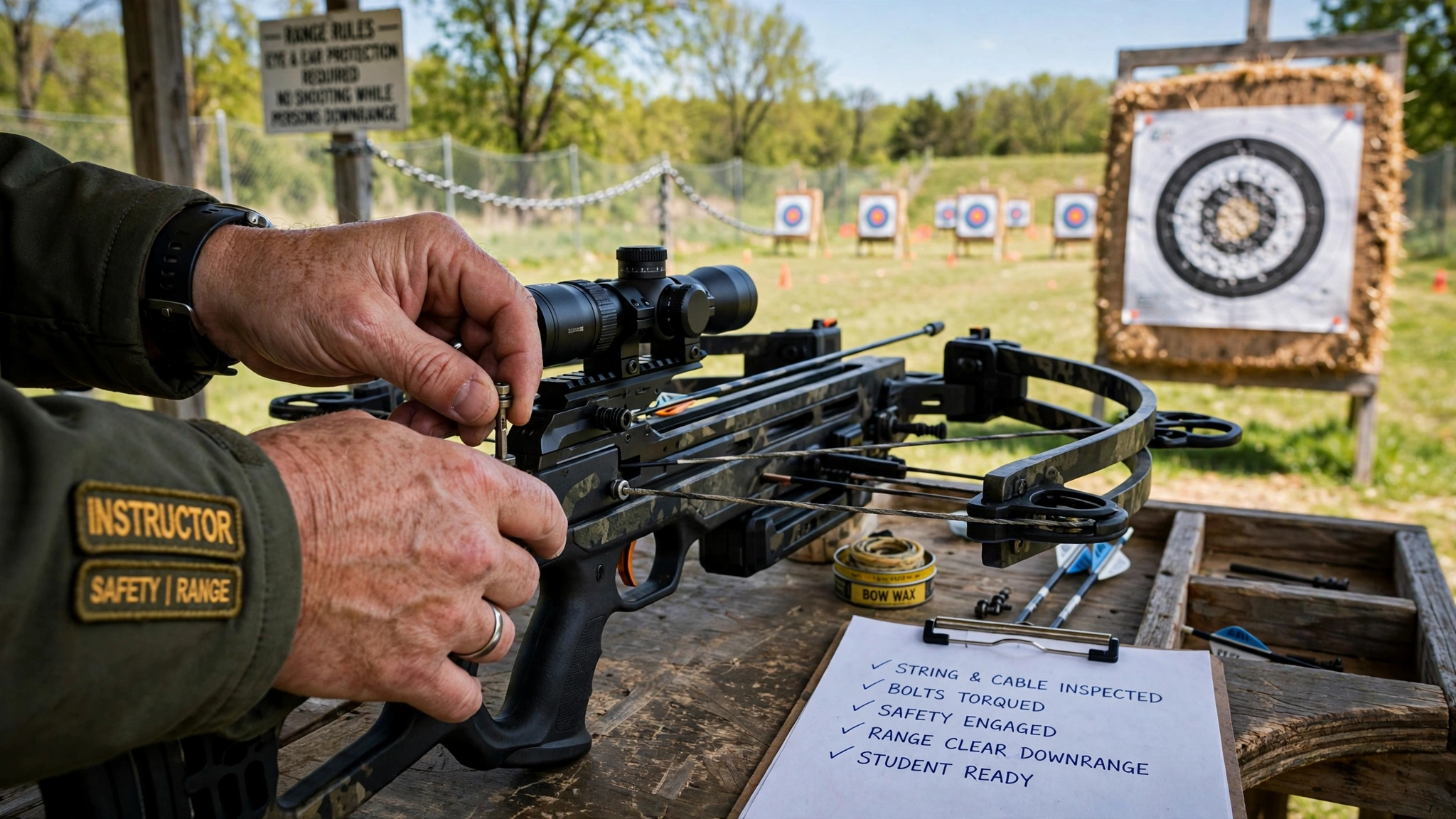
- The adult owns the cocking process at first. You learn to cock the bow correctly first, following our guide on how to cock a crossbow, and you teach the young shooter step by step until the motion is second nature. With a crank device, most teens can handle it themselves within a few sessions, but you verify every step.
- Start on the range, not in the woods. Plan on months of target practice before any hunt is discussed. The standard I was taught: when every bolt lands inside a paper plate at 20 yards, every time, from a bench and then from field positions, then we talk about hunting.
- Anti-dry-fire protection is mandatory. Only buy a bow with an anti-dry-fire safety, and teach the rule behind it anyway: never release the trigger without a bolt properly loaded. Every bow on this list has it.
- Keep fingers below the rail. The bowstring travels the full length of the rail when fired, and a hand in that path gets badly hurt. Teach hand placement before the first shot, and repeat it every session.
- Check your state’s youth regulations. Minimum hunting ages, mentor programs, and hunter education rules vary widely. Read our full crossbow safety guide together as a family before the first range day.
What Actually Matters When Buying a Youth Crossbow
When I started comparing youth crossbows, I realized the shopping list is completely different from buying for myself. Here is what experienced hunters told me to prioritize, in order.
Fit and weight beat speed, every time
A young shooter with a bow that is too long or too heavy will develop a flinch, lean back off balance, and miss. Then they quit. Shorter, lighter bows that a kid can hold steady for a full practice session beat faster bows they cannot control. For learning, 240–330 fps is plenty. Chasing 400 fps for a first bow is a mistake.
Cocking they can actually do
Most youth crossbows have draw weights of 140–195 lbs, which no kid should be hand-cocking with a rope cocker at first. A crank cocking device changes the equation completely, dropping the effort to about 5 lbs, and it cocks the string perfectly centered, which improves accuracy too. When a bow ships with or accepts a crank, buy it. It is the single best accessory for a young shooter.
Simple, forgiving, and complete
Fewer gadgets, clearer safeties, and a crisp trigger build good habits. And since the money should go toward bolts, targets, and range time, complete packages (bow, scope, quiver, bolts, cocking device in one box) are the smart buy. Every pick below is a complete kit.
Recurve or compound?
Recurve crossbows like the Wildcat CRX and Tyro 4X are simpler: no cams to tune, and you can restring them yourself. Compound crossbows like the Recruit Terrain and Ranger X2 are narrower and more efficient. For a young hunter, either works. Pick by weight and fit, not by limb style.
The 5 Best Youth Crossbows of 2026
| Bow | Speed | Draw Weight | Weight | Street Price* | Best For |
|---|---|---|---|---|---|
| Barnett Recruit Terrain | 330 fps | 140 lbs | 6.4 lbs | $220–300 | Best overall youth pick |
| Wicked Ridge Ranger X2 | 330 fps | 150 lbs | 5.9 lbs | $450–500 | Best safety-designed youth bow |
| Barnett Wildcat CRX | 280 fps | 195 lbs | 6.1 lbs | ~$230 | Best budget recurve |
| CenterPoint Tyro 4X | 245 fps | 175 lbs | 5.0 lbs | $150–200 | Lightest, best for smaller kids |
| Barnett Whitetail Hunter II | 350 fps | 150 lbs | 6.4 lbs | ~$340 | Best full-size starter |
* Prices are typical US street ranges per late 2026 listings and they fluctuate. Check the live price before you buy. All specs per manufacturer listings.
Best Overall: Barnett Recruit Terrain
Speed: 330 fps | Price: ~$220-$300 | Draw Weight: 140 lbs
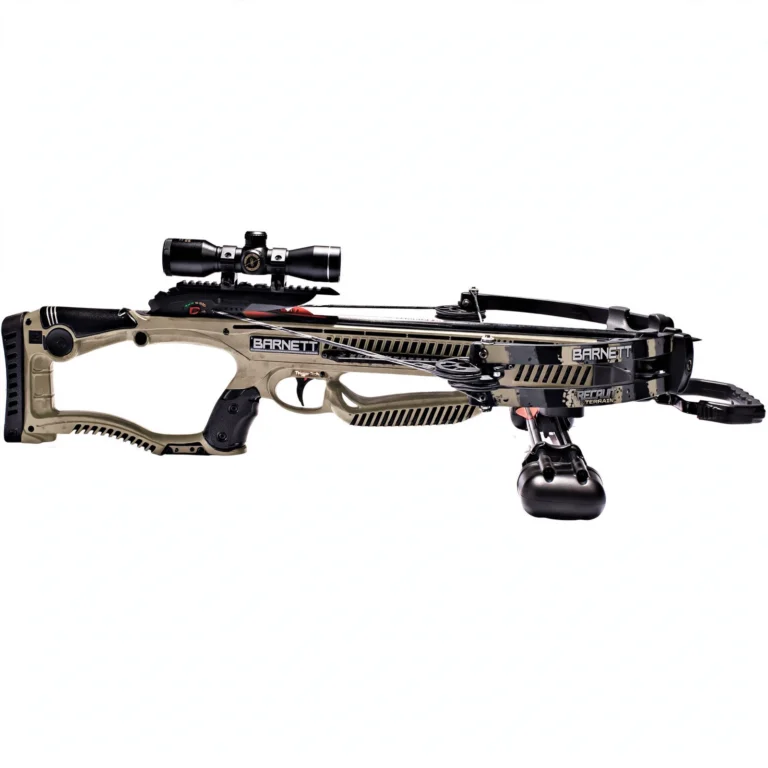
If I had to recommend one youth crossbow and walk away, this would be it. Barnett lists the Recruit Terrain at 330 fps with a 140-lb draw weight and just 6.4 lbs of weight, and it ships as a complete package: 4×32 scope, quiver, bolts, rope cocker, and lube wax. It also comes with Barnett’s TriggerTech trigger, a genuine three-pound, zero-creep release that makes clean shots easier for beginners who are still learning trigger control.
What sold me is the value curve. Under $300 usually gets you a training-wheel bow the kid outgrows in a season. The Recruit Terrain at 330 fps is a legitimate hunting crossbow with 91.9 ft-lbs of kinetic energy, so when the young hunter earns a first season in the woods under adult supervision, the bow is already up to the task. That is one purchase instead of two, which parents appreciate.
The supervision note I put on every youth bow: the adult handles cocking at first, because this ships with a rope cocker rather than a crank, and every shot happens with an adult present until the young hunter has proven safe handling over many sessions. The scope is not illuminated, which is fine for learning and keeps the price down. See how it stacks up in our under $500 guide.
One more thing parents ask about: growth room. The Recruit Terrain’s adjustable stock and full-size feel mean it fits a growing shooter for years, not months. I have seen young hunters take their first deer with bows in this class and still be shooting them three seasons later. That longevity is what separates it from the trainer bows that get outgrown by Christmas.
Pros
- complete kit at a budget price
- real hunting performance (330 fps, 91.9 ft-lbs)
- light 3-lb TriggerTech trigger
- proven platform with a huge owner community
- one purchase that lasts
Cons
- rope cocker means the adult handles cocking at first
- no illuminated scope
- still requires full adult supervision
Bottom line: The one-bow answer for youth crossbows. Learn on it, hunt with it, and skip the trainer-bow phase entirely.
Best Safety-Designed: Wicked Ridge Ranger X2
Speed: 330 fps | Price: ~$450-$500 | Draw Weight: 150 lbs
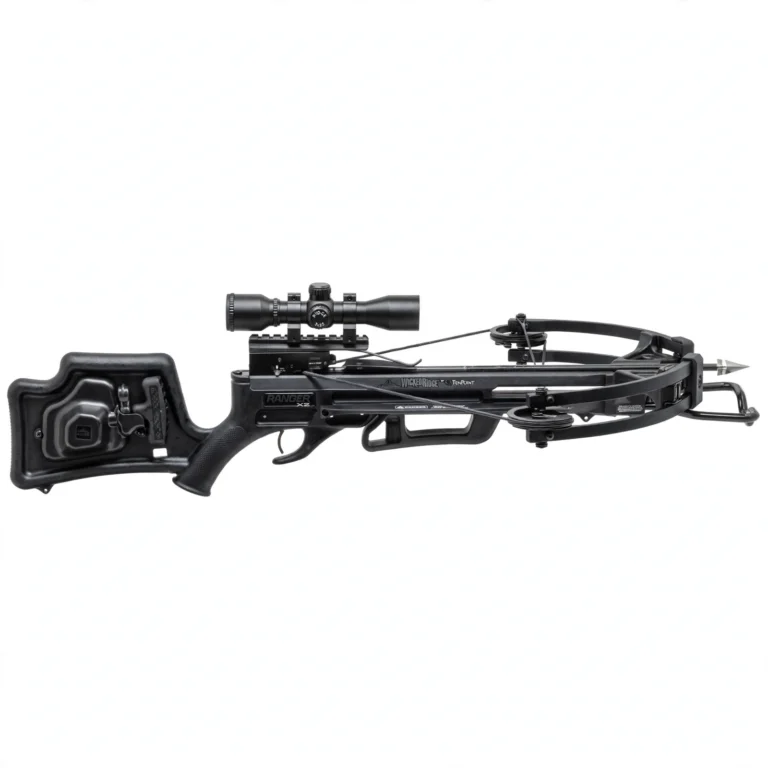
This is the only bow on this list engineered from the ground up for youth and small-framed hunters, and it shows in the safety design. Wicked Ridge (TenPoint’s youth line) rates the Ranger X2 at 330 fps with a 150 lb draw weight and 5.9 lbs of weight. It has a pass-through foregrip and nylon safety wings that physically block the young shooter’s hand from creeping into the string path, plus TenPoint’s dry-fire inhibitor and a 3.5 lb auto-engaging safety trigger. For parents who lose sleep over safety, this is the one.
The integrated ACU-52 self-retracting rope cocking device reduces draw effort by half and retracts itself so it cannot dangle near the string. The package ships fully assembled with a multi-line scope, quiver, and three 18-inch bolts. It is the priciest pick here, but also the most complete answer to the question “what is the safest way to start a kid?”
Pros
- safety wings and pass-through foregrip designed for young shooters
- integrated ACU-52 cocking system
- TenPoint dry-fire inhibitor
- 85 ft-lbs of energy is real hunting power
Cons
- the most expensive pick here
- 18-inch proprietary bolts
- MSRP was $479.99, so street deals matter
Who it is for: parents who want the most safety engineering money can buy for a young hunter, and families planning to hunt together soon. Read our full crossbow safety guide before the first range day.
Best Budget Recurve: Barnett Wildcat CRX
Speed: 280 fps | Price: ~$230 | Draw Weight: 195 lbs
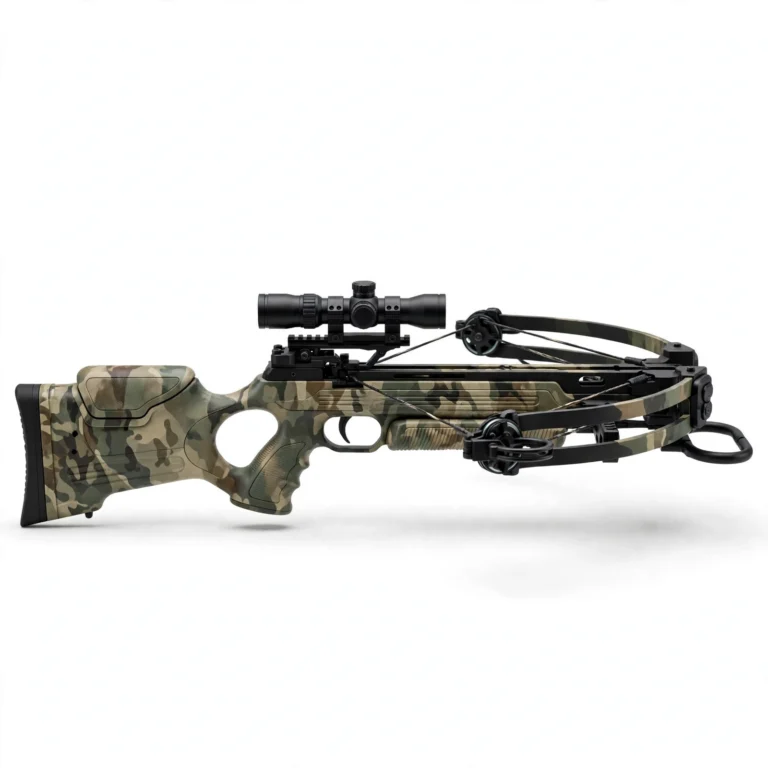
The Wildcat CRX is Barnett’s simple, tough recurve, and for a young shooter, simple is a feature. Barnett lists 280 fps, a 195-lb draw weight, and 6.1 lbs of weight, with anti-dry-fire protection, a red dot sight, quiver, and rope cocker in the box. Independent chronograph tests I have read showed about 275 fps in real life, which matches the advertised 280 fps closely, and that kind of honesty is worth noting.
Why a recurve for a kid? There are no cams to time and no complex limb system, so maintenance is basically string wax and a visual check, things a young hunter can learn to do themselves under guidance. That ownership of maintenance builds good habits early. The recurve design keeps the price low while still delivering 66 ft-lbs of kinetic energy, plenty for deer at typical youth hunting ranges under close supervision.
The 195-lb draw weight is the highest on this list, so plan on the adult doing the cocking for the first season or two; treat that as a safety feature, not a flaw, since it enforces adult involvement. The red dot sight is fine for targets but basic for hunting in low light. Pair it with a quality target from our crossbow target guide and let the young shooter burn through bolts learning form.
The recurve design pays one more dividend: string changes. When the string eventually wears, a recurve string can be swapped with a simple stringer tool and no bow press, which means less shop time and less money over the bow’s life. For a family bow that will see thousands of shots, that simplicity compounds into real savings and less downtime.
Pros
- simple recurve design is easy to maintain
- honest 275-280 fps performance
- lowest maintenance burden for young owners
- great price
- anti-dry-fire protection
Cons
- 195-lb draw means adult-assisted cocking at first
- red dot is basic for hunting
- heavier draw than the other youth picks
Bottom line: The tough, no-fuss youth bow. Simple to own, honest in performance, and priced for families.
Lightest: CenterPoint Tyro 4X
Speed: 245 fps | Price: ~$150-$200 | Draw Weight: 175 lbs
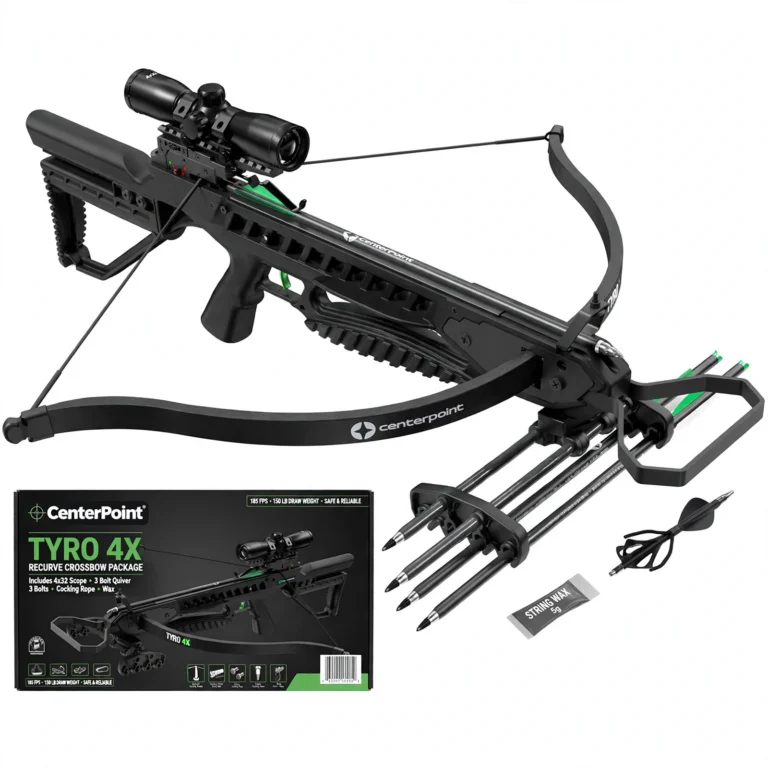
If the young shooter is on the smaller side, start with the lightest full bow you can find, and the Tyro 4X at 5.0 lbs is the lightest here. CenterPoint rates it at 245 fps with a 175-lb draw weight, and it ships as a complete package: 4×32 scope, quiver, four 16-inch aluminum bolts, rope cocker, and rail lube, all for roughly $150-200. For a first bow, light matters more than fast; a kid who can hold steady will outshoot a kid fighting the bow’s weight every time.
The safety features are well thought out for beginners: an auto-engaging safety, anti-dry-fire protection, and an adjustable stock that helps the bow fit growing shooters over several seasons. At 245 fps it will not win speed contests, but for learning fundamentals at 20-30 yards, it is exactly right. Every session should still have an adult present and handling the cocking until the shooter is ready.
Be honest about its limits. This is a target and small-game bow, not a deer bow, and the 16-inch bolts are a less common size, so stock up when you find them. When the kid is consistently stacking bolts at 25 yards and asking for more, step up to the Recruit Terrain or Ranger X2 above. Start with our beginner’s guide before the first session.
When is it time to move up? The signs are consistent grouping at 25 yards, the shooter asking for more distance, and the bow starting to feel small in their hands. Do not rush it; an extra season on the Tyro building perfect form beats an early jump to a bow they cannot cock or hold steady. The fundamentals learned here transfer directly to every bow they will ever shoot.
Pros
- lightest at 5.0 lbs, easy for smaller kids to hold steady
- complete kit under $200
- adjustable stock fits growing shooters
- good safety features
Cons
- 245 fps limits it to targets and small game
- 16-inch bolts are a less common size
- the young shooter will outgrow its performance
Bottom line: The right first bow for smaller kids. Light, safe, affordable, and honest about what it is.
Best Full-Size Starter: Barnett Whitetail Hunter II
Speed: 350 fps | Price: ~$340 | Draw Weight: 150 lbs
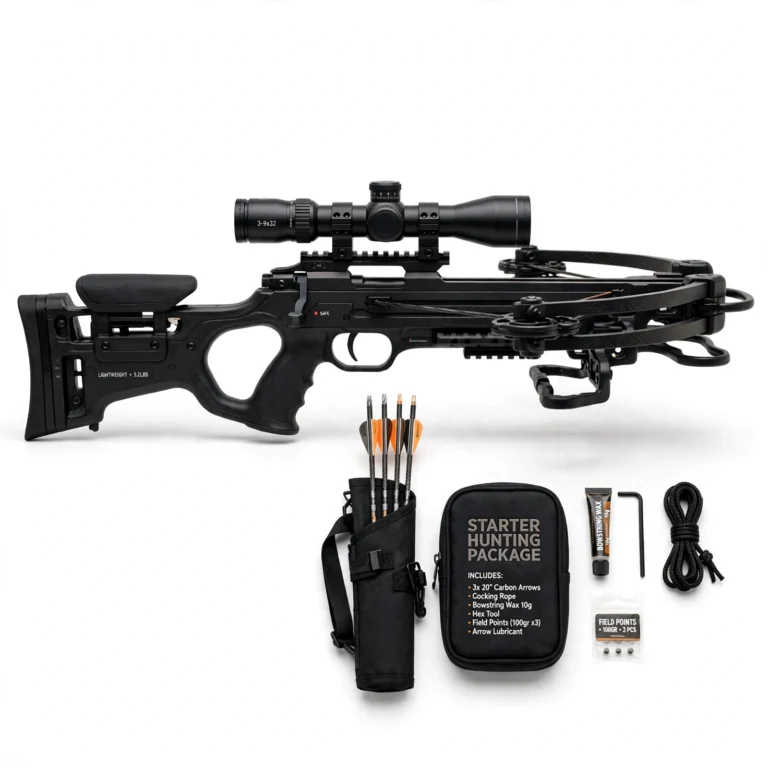
This is the bow that keeps showing up in my other guides, and for good reason. Barnett lists the Whitetail Hunter II at 350 fps with a 150-lb draw weight and 6.4 lbs of weight, and it is one of the most popular beginner crossbows ever sold, which means every setup question has already been answered by somebody online. For an older youth hunter, say 14 and up, who has outgrown the trainer phase, this is a full-size hunting bow at a starter price.
The trigger is predictable, and 350 fps gives it headroom to stay relevant as the young hunter’s skills grow over several seasons. It is light enough at 6.4 lbs to carry on a first hunt without tiring out, which is a real factor nobody talks about enough; a tired young hunter is an unsafe young hunter. The huge owner community means tuning help is always a search away.
The caveat is fit, not quality. This is more bow than a young beginner needs, so save it for ages 14 and up or experienced younger shooters who have proven safe handling. It ships with a rope cocker as standard, so the adult handles cocking until the shooter is strong and practiced enough. See how to choose a crossbow for fit and setup tips before buying.
The transition plan matters. Move the young hunter to this bow only after they have demonstrated consistent safe handling on a lighter trainer: muzzle discipline, safety engagement, and calm cocking under supervision. The jump from 245 fps to 350 fps is significant, and the adult should shoot it first to confirm the setup. Done right, this is the bow they will remember taking their first deer with.
Pros
- true 350 fps hunting performance
- huge owner community means endless help
- light 6.4-lb carry weight
- proven reliability
- grows with the shooter
Cons
- more bow than a young beginner needs (14+ recommended)
- rope cocker standard
- full-size feel can overwhelm smaller shooters
Bottom line: The graduation bow. When the trainer phase is over, this is the full-size starter that lasts for years.
What Draw Weight Can a Young Shooter Handle?
This is the question parents ask me most, and the honest answer is: the number on the box matters less than the cocking device. Most youth-suitable crossbows run 140–195 lbs of draw weight, which sounds terrifying until you understand that nobody expects a kid to muscle through it. With a crank cocking device, the effort drops to about 5 lbs. With a rope cocker, the effort roughly halves, so a 150 lb bow feels like 75 lbs, still too much for a younger kid.
- Ages 8–11: stick to bows 175 lbs and under, with the adult doing all the cocking. Focus on form, safety, and fun.
- Ages 12–14: most can manage a rope cocker on a 140–150 lb bow with coaching, or cock independently with a crank device.
- Ages 15 and up: treat them like any adult beginner. Fit and supervision still matter, but strength stops being the limiting factor.
When in doubt, buy the crank device as an accessory if the package does not include one. It is the best $80–120 you will spend on the whole setup. Here is the full walkthrough on how to cock a crossbow safely before you teach the young shooter.
The Learning Path: From the Box to the First Hunt
Here is the progression I worked out with my cousin, and I recommend it to any family. Do not rush it. The boring parts are the point.
Month 1: rules and dry handling. Unbox together. Read the safety rules out loud. Practice loading, aiming, and unloading with no bolts. The young shooter learns where their hands go and where they never go.
Month 2: first shots. Sight in at 20 yards together, adult shooting first to set the example. Shoot groups, not bullseyes. Celebrate tight groups anywhere on the target, because consistency is the actual skill.
Month 3 and beyond: field positions. Move from the bench to kneeling, sitting, and standing. Practice from a ground blind or stand setup so nothing is new on hunt day.
The hunt test: the young hunter is ready when every bolt lands inside a paper plate at 20 yards, every time, from hunting positions, and they can recite the safety rules without thinking. Then the adult mentors them through their first hunt, close, calm, and with low expectations. The first season is about the experience, not the harvest.
Range Gear: Bolts, Targets, and the Rest
The bow is half the equation. Budget for the rest up front: a dozen quality bolts (bent shafts wreck groups), a crossbow-rated target matched to your bow’s speed, and a simple quiver if the package skimped. Our crossbow target guide breaks down the best options by speed rating.
Bottom Line: The Best Youth Crossbow for 2026
For most families, the Barnett Recruit Terrain is the youth crossbow to buy in 2026. It is a complete 330 fps hunting kit at $220–300, light enough for a young shooter to carry, with a trigger good enough to teach real marksmanship. If safety engineering is your top priority, the Wicked Ridge Ranger X2 earns its $450–500 price. Whatever you choose, the adult is the safety system, the range is the classroom, and patience is the whole curriculum.
Frequently Asked Questions
What age can a kid start shooting a crossbow?
It depends on maturity more than age, and on your state’s laws, which set minimums for hunting. Most kids start supervised target shooting around ages 10 to 12, and some start as young as 8 or 9 with a smaller bow. The adult decides when the young shooter is ready, not the calendar. Complete a hunter education course together before buying.
What draw weight is safe for youth?
Focus less on the draw weight number and more on the cocking device. With a crank cocking device, effort drops to about 5 lbs, so a 140–150 lb bow is manageable for most teens. With a rope cocker, the adult should handle cocking for younger shooters. Overall bow weight and fit matter more than draw weight for safety and accuracy.
Should a young hunter use a crank cocking device?
Yes. It is the single best accessory for a young shooter. It drops cocking effort to about 5 lbs, centers the string for better accuracy, and removes strength as a barrier. If the bow does not ship with one, budget $80–120 for it.
Can a youth crossbow be used for deer hunting?
Yes, if it is powerful enough and your state allows it. Bows like the Barnett Recruit Terrain and Wicked Ridge Ranger X2 at 330 fps produce 85–92 ft-lbs of kinetic energy, which is plenty for deer at typical ranges under adult supervision. Lighter trainers like the CenterPoint Tyro 4X at 245 fps are for targets and small game only.
Recurve or compound crossbow for a beginner kid?
Either works. Recurve bows (Wildcat CRX, Tyro 4X) are simpler to maintain with no cams to tune, which is nice for young owners learning upkeep. Compound bows (Recruit Terrain, Ranger X2) are narrower and more efficient. Pick by weight and fit, not by limb style.
How much should I spend on a youth crossbow?
Plan on $150–500 for the bow package, plus $80–120 for a crank device if it is not included, and another $50–100 for extra bolts and a crossbow-rated target. The money is better spent on range time and targets than on a faster bow, so do not stretch for flagship speed on a first bow.
What is the most important safety feature on a youth crossbow?
Anti-dry-fire protection, which every bow on this list has. After that, look for an auto-engaging safety trigger and, on bows designed for youth like the Ranger X2, physical guards like safety wings and a pass-through foregrip that keep fingers below the rail. No feature replaces adult supervision.
When is a young hunter ready for their first hunt?
When every bolt lands inside a paper plate at 20 yards, every time, from hunting positions (not just the bench), and the young shooter handles the bow safely without reminders. Then the adult mentors them through the first hunt, close and calm. The first season is about the experience, not the harvest.