How to Choose a Crossbow: A Beginner’s Buying Guide
When I bought my first crossbow, I did what almost every beginner does: I walked in, asked for the fastest one I could afford, and walked out with a bow I could barely cock. David took one look at it, laughed, and spent the next hour teaching me everything I had ignored on the box. This is the guide I wish I had read before I spent that money.
If you are buying your first crossbow, this guide walks you through the decisions in the order that actually matters. By the end, you will know exactly what to look for, what to skip, and how much to spend for the kind of hunting you want to do, and what the sport gives back beyond the deer is worth weighing before you spend anything. If you want our shortcut list of ready-to-buy picks instead, head straight to our best crossbows for beginners after reading this.
Step 1: Set Your Budget First, Not Last
I used to think a bigger budget was just about getting a faster bow. It is not. Budget decides the whole experience: how smooth the trigger feels, how quiet the shot is, whether the scope holds zero through a cold morning, and how long the strings last. That said, you absolutely do not need to spend a fortune to kill deer ethically. Many of the bows in our best crossbows roundup shoot well under the top price tiers.
Here is how the market breaks down in 2026, and what you can honestly expect in each tier:
| Budget Tier | What You Get | Best For |
|---|---|---|
| Under $300 | Entry-level packages, usually recurve or basic compound designs, 300–330 fps, simple multi-reticle scope, rope cocker often included | Target shooting, figuring out if you even like the sport. See best crossbows under $300. |
| $300–$600 | The beginner sweet spot: solid compound packages, 330–380 fps, better triggers and scopes, good for deer at ethical ranges. See crossbows under $500. | Most first-time hunters. This is where David told me to land. |
| $600–$1,200 | Premium mid-range: narrower axle-to-axle designs, 380–440 fps, integrated cranks, quieter shots, better glass. See best crossbow for the money. | Hunters who want a bow they will keep for years. |
| $1,200+ | Flagship models: 440–500+ fps, ultra-compact reverse-draw designs, top-tier triggers and optics, premium materials | Serious hunters and anyone hunting bigger game like elk. |
My rule of thumb: spend $300–$600 on your first hunting crossbow and put any leftover money toward good bolts and broadheads. A $400 bow shooting quality bolts will outperform a $900 bow shooting the cheapest ones in the store. If that sounds backwards, it is the most common thing beginners get wrong, myself included.
Step 2: Pick Recurve or Compound (and Be Honest About What You Want)
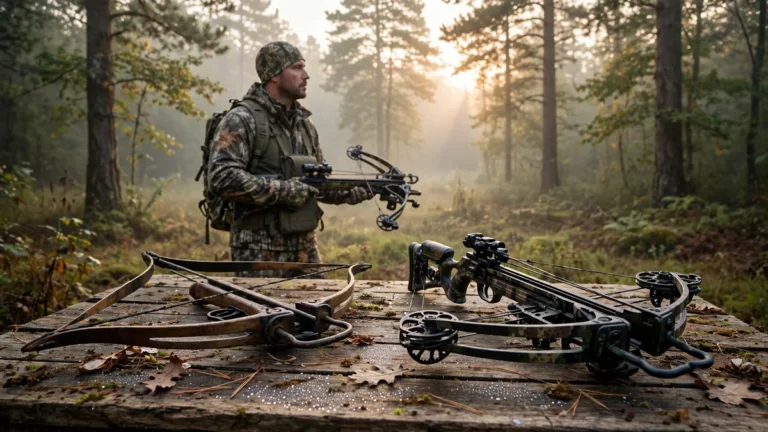
This is the first fork in the road, and both paths are fine. A recurve crossbow uses simple curved limbs and one string: no cams, no cables. A compound crossbow uses cams and cables to generate more speed in a narrower frame. If you want the full head-to-head breakdown, read our crossbow vs compound bow comparison, but here is the short version from someone who has shot both:
| Factor | Recurve | Compound |
|---|---|---|
| Maintenance | Dead simple. You can change a string in the field with a basic stringer. | Strings and cables need a bow press, so major service goes to a shop. |
| Size and width | Wider limb tips, can snag in tight treestands | Narrower and more compact, easier to maneuver |
| Speed | Moderate, usually 300–350 fps | Higher for the same draw weight, up to 450+ fps |
| Cocking effort | Often heavier for the same performance | Cams make cocking smoother and more manageable |
| Price | Excellent value, great entry points | Wide range, generally costs more |
| Reliability | Fewer parts to fail in the field | More moving parts, but modern ones are very dependable |
My honest take: if you are a beginner hunting whitetails from a treestand or blind, a compound package in the $300–$600 range is the easiest path. I started wanting the speed, David talked me into focusing on reliability, and the recurve I kept as a backup has honestly been the bow I reach for when something needs to work no matter what.
Step 3: Understand Speed (and What You Actually Need)
FPS, feet per second, is the number on the box and the most over-marketed spec in crossbow hunting. Here is what I learned after shooting a bunch of different bows: a 350 fps crossbow you can shoot accurately is better than a 430 fps bow that intimidates you.
What speed do you actually need? The widely used rule of thumb: a whitetail deer needs about 40 foot-pounds of kinetic energy at impact, and elk need roughly 65 foot-pounds. A typical 400-grain bolt from a 350 fps crossbow carries around 110 foot-pounds at the muzzle, which is far more than enough for deer at ethical ranges (40 yards and under for most beginners).
A few things the box will not tell you:
- Advertised speeds use the lightest bolt the bow can shoot. With standard-weight hunting bolts and broadheads, real-world speeds are lower. Always assume the advertised number is the ceiling, not the average.
- Faster is not more accurate. Some of the most accurate bows David and I have shot were middle-of-the-road on speed. Accuracy comes from a clean trigger, consistent cocking, and matched bolts.
- Faster means more wear. High-speed bows stress strings, cables, and limbs harder. They need more maintenance and more frequent string replacement.
For a first bow, look for 330–380 fps. It is plenty for deer, forgiving to shoot, and easy on strings. If elk are in your plans, step up toward 380 fps and heavier bolts, and read our best crossbows for elk guide before you buy.
Step 4: Size, Width, and Weight: Where You Hunt Decides
This is the spec I ignored completely, and it bit me on my third hunt. My first bow was wide, and climbing into a treestand with a 20-plus-inch cocked width felt like carrying a canoe ladder through the woods.
Axle-to-axle width when cocked is the number that matters. Uncocked width is what you see in product photos; cocked width is what you live with in a treestand or ground blind. Narrower bows (14–16 inches cocked) shine in tight spots. Wider bows are fine from a ground blind or for target shooting.
Weight matters more than you expect because you carry it cocked and ready for hours. Most hunting crossbows weigh 6–8.5 pounds before accessories. Add a scope, quiver, and bolts and you are over 9 pounds. David told me to shoulder every bow I was considering and hold it at aim for 30 seconds. If your arms shake, keep looking.
Think about it this way:
- Treestand hunter: prioritize narrow cocked width and lighter weight. See best hunting crossbows.
- Ground blind hunter: width matters less, balance and a smooth trigger matter more.
- Still hunting or stalking: lighter weight wins, and you will thank yourself for a good carrying sling.
Step 5: Cocking Devices, Rope vs Crank
Nobody told me this was a decision at all. I assumed you just pulled the string back. You can, technically, but hand-cocking a 175-pound crossbow is an exercise in back pain and inconsistent string alignment, and uneven alignment wrecks your accuracy.
There are three real options:
- Hand-cocking: works only for low draw-weight bows. Inconsistent, tiring, and the fastest way to derail a string. Skip it if you can.
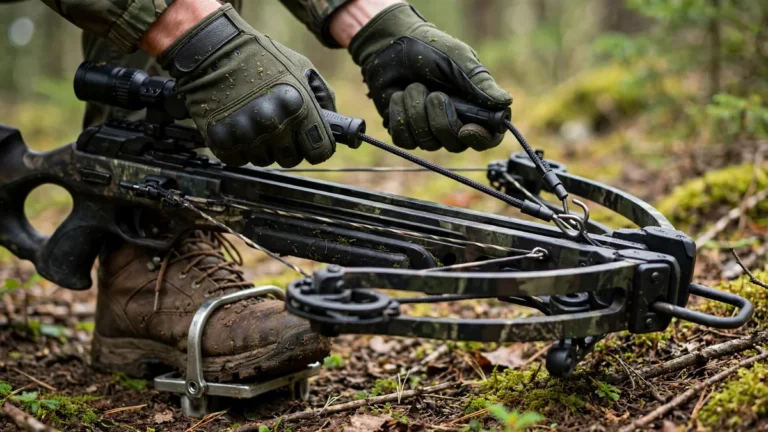
- Rope cocker: a simple strap-and-handle device that cuts the effective draw weight roughly in half, so a 175-pound bow feels like about 85 pounds. Lightweight, cheap, fits in a pocket, and it helps you draw the string evenly every time. This is what comes with most beginner packages and it is what I use.
- Crank device: mounts to the stock and cocks the bow by turning a handle. Least physical effort, most consistent draw, but adds weight and takes longer. Many crank systems are removable or integrated. If you have shoulder issues or hunt with cold, tired arms, a crank is worth every penny.
David’s line that stuck with me: buy the bow you can cock the same way every single time. Consistency in cocking is consistency in shot placement. We have a full walkthrough in how to cock a crossbow if you want to see the technique before you buy.
Step 6: Scope and Package Contents: Know What You Are Really Getting
Most beginner crossbows are sold as packages: bow, scope, quiver, bolts, sometimes a cocking device and wax. Packages are a great deal for beginners, but check what you are actually getting:
- Scope: the most common weak point in a package. Most include a basic multi-reticle scope good enough to start. If the package has an illuminated reticle, test it in low light before the season; cheap illuminated scopes can tint your whole field of view and ruin dawn and dusk clarity. If you outgrow your package scope, our best crossbow scope guide covers the upgrade path.
- Bolts: packages usually include 3–4 bolts, often field-point only. You will want more, matched to your bow, and proper hunting broadheads. Budget for these. See best crossbow bolts and best crossbow broadheads.
- Quiver: usually included, and usually fine.
- Cocking device: some packages include a rope cocker, some do not. Factor it into the price if it is missing.
- Wax and rail lube: cheap, but essential. Dry strings and rails wear out fast and cost real money to replace.
Step 7: Safety Features to Demand
A crossbow stores enough energy to be genuinely dangerous, so treat safety features as non-negotiable, not extras. Every bow I would recommend a beginner has these:
- Anti-dry-fire mechanism: prevents the bow from firing without a bolt loaded. Dry-firing can destroy limbs, strings, and cables in one shot and injure you. Never buy a hunting crossbow without this.
- Automatic safety: the safety should engage on its own the moment the bow is cocked. You flip it off only when you are ready to shoot, and you re-engage it the moment the moment passes.
- Finger guards or flared foregrip: keeps your fingers below the rail and out of the string’s path. The string moves with enough force to seriously injure fingers that creep above the rail.
For the full breakdown, including the habits that keep you safe in the stand, read our crossbow safety guide. I read it twice before my first season and I am not embarrassed to say so.
5 Mistakes I Made Buying My First Crossbow
I learned these the expensive way so you do not have to:
- I chased FPS instead of fit. The speed number got me, and I ended up with a bow I dreaded cocking. Fit beats speed every time. Shoulder the bow before you buy it if you possibly can.
- I bought the cheapest bolts on the shelf. Then I spent a week wondering why my groups were terrible. Bolt quality matters as much as the bow for accuracy. Matched, quality bolts are a performance upgrade you can feel.
- I skipped practicing with broadheads. Field points and broadheads fly differently, and the drift shows up exactly when you cannot afford it. Sight in with the broadheads you will hunt with.
- I never checked my state’s minimum draw weight. Most states set a legal minimum, commonly around 125 pounds, and some also regulate width or overall length. Check your state’s wildlife agency before you shop, because a bow that does not meet the minimum is not legal for hunting no matter how well it shoots.
- I tried to learn everything alone. The single best thing I did was ask someone experienced to check my setup. Find a mentor, a local shop, or an archery club. David still checks my string alignment every preseason, and I will never stop letting him.
Where to Go From Here
If you are ready to look at actual bows, start with our best crossbows for beginners for the shortlist built around everything in this guide. If you want the widest view of the market, our best crossbows of 2026 ranks the top picks across every budget. And if you are still torn between a crossbow and a vertical bow, crossbow vs compound bow lays out the real trade-offs.
Whatever you choose, practice from the position you will hunt from, know your personal maximum ethical range (for most beginners, 30–40 yards), and take care of your strings, as full walkthrough of hunting with a crossbow explains. Welcome to the season.
Frequently Asked Questions
How much should a beginner spend on a first crossbow?
Plan on $300–$600 for the bow package itself. That range buys a reliable compound crossbow package with enough speed and accuracy for deer. If your budget is tighter, solid options under $300 exist for target shooting and learning the fundamentals. Reserve another $50–$100 for extra bolts, broadheads, and maintenance supplies.
Is 350 fps enough for deer?
Yes, comfortably. A 400-grain bolt at 350 fps carries roughly 110 foot-pounds of energy at the muzzle, well above the ~40 foot-pounds considered the minimum for an ethical shot on whitetail at normal hunting ranges. Shot placement and bolt quality matter far more than the last 30 fps on the box.
Recurve or compound for a beginner?
Both work. Choose a compound if you want a compact, easy-cocking bow for a treestand or blind and do not mind taking it to a shop for string and cable service. Choose a recurve if you value dead-simple maintenance, field-repairability, and lower cost. Neither choice is wrong; it comes down to your priorities.
Do I need a cocking device?
For any hunting crossbow, yes. A rope cocker roughly halves the effective draw weight and, more importantly, helps you draw the string evenly, which directly affects accuracy. If cocking by rope is still difficult, a crank device removes almost all the physical effort. Hand-cocking is inconsistent and the fastest way to hurt your accuracy or your back.
What draw weight do I need for deer hunting?
Most hunters use 150–175 pounds for whitetail, which pairs well with 330–380 fps speeds, and how those pounds turn into bolt speed is the part most buyers misunderstand. Check your state’s legal minimum first, since many states require at least 125 pounds for hunting. If elk are on the list, step up toward 175 pounds or more with heavier bolts to ensure enough penetration.
Can I hunt elk with the same crossbow I use for deer?
Often, yes, if the bow is powerful enough. Elk need more energy at impact (roughly 65 foot-pounds) and heavier bolts (450+ grains). Many mid-range and flagship bows meet this comfortably; entry-level bows may fall short. Check our best crossbows for elk guide before planning an elk hunt.
What does a crossbow package usually include, and what else do I need?
A package typically includes the bow, scope, quiver, a few bolts, and sometimes a rope cocker. Plan to buy extra matched bolts, hunting broadheads, rail lube and string wax, and possibly a better target. If you transport your bow often, add a crossbow case to the list.
What is the biggest mistake beginners make when choosing a crossbow?
Buying for the advertised speed number instead of fit. A bow that is too heavy, too wide, or too hard to cock will not get practiced with, and an unpracticed bow is a liability in the field. Choose the bow you can cock consistently, hold steady, and shoot comfortably for an hour at the range.