Best Crossbow Broadheads 2026: Fixed vs Mechanical
Affiliate Disclosure: ProCrossbow is reader-supported. When you buy through links on this page, we may earn a commission at no extra cost to you. Our rankings cannot be bought, and every spec below is taken from the manufacturer’s own listing and verified against it. Prices shift constantly, so the ranges shown are honest estimates, not live quotes.
The broadhead is the only part of your setup that actually touches the deer. Your crossbow, your bolts, your scope: all of that exists to deliver one sharp head to the right spot. After eight seasons of deer hunting, I have strong opinions about broadheads, and the first one is this: there is no universally best broadhead, only the best match for your bow’s speed and your hunting style. Here is the honest breakdown, plus six heads I would trust in my own quiver.
Fixed-Blade vs Mechanical: The Real Trade-Off
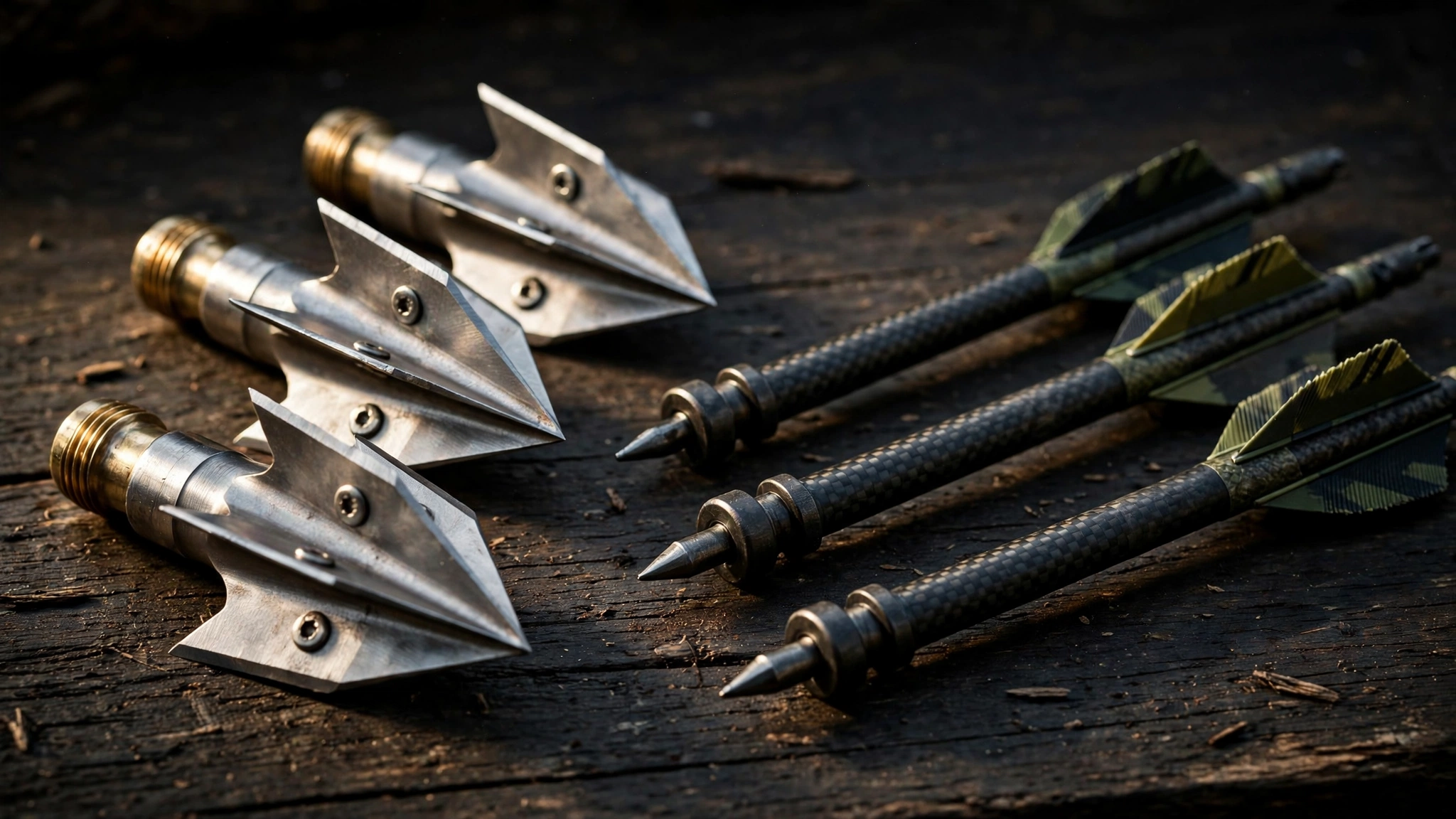
Every broadhead conversation starts here. Fixed blades have their edges exposed at all times. Mechanicals keep their blades folded in flight and deploy them on impact. Neither is cheating, and neither is magic. They solve different problems.
| Fixed-Blade | Mechanical | |
|---|---|---|
| How it works | Blades always exposed | Blades deploy on impact |
| Flight | Can plane at high speed; needs tuning | Flies like a field point |
| Wound channel | Smaller, but reliable | Larger, and devastating when it opens |
| Penetration | Excellent, even through bone | Good, but needs speed to drive through |
| Forgiveness | Zero moving parts to fail | Must have enough kinetic energy to open |
| Best for | Slower bows, tough angles, reliability-first hunters | Fast bows (400+ fps), long shots, big cut diameters |
With a modern 400+ fps bow, a quality mechanical is devastating and flies exactly like your field points, which means your practice translates directly to the hunt. Below roughly 350 fps, or for quartering shots where you might meet a shoulder blade, fixed blades penetrate more reliably. Match your bolts to whatever head weight you choose, and see our crossbow safety guide before you head out with any new setup; our guide to arrow length, weight and spine explains how to match them.
The 65 ft-lbs rule of thumb: mechanical broadheads need real energy to open and drive through. As a rough guide, if your setup produces less than about 65 foot-pounds of kinetic energy, fixed blades are the safer choice. Above that line, quality mechanicals open reliably. If you do not know your bow’s energy, pick your head from the fixed-blade side of this list. A head that opens halfway is worse than a head with a smaller cut.
What Actually Matters When You Shop
Grain weight: 100 vs 125
Heavier heads add momentum and quiet the bow slightly. Lighter heads fly flatter. Most crossbow hunters I know shoot 100 grain, and every head in this roundup comes in 100 grain, with several offering 125. Pick one weight and practice with that exact weight, because point of impact shifts between them. This is the most common mistake I see from beginners: sighting in with 100 grain field points, then hunting with 125 grain heads.
Cutting diameter
Bigger cuts mean bigger blood trails, but they demand more energy to push through. On deer-sized game with a 400 fps bow, 1.5 to 2 inch mechanicals are proven killers. Do not chase 3 inch cuts with a slow bow. On elk, the math flips: penetration beats diameter, and most elk hunters I respect hunt with fixed blades.
Practice heads and sharpness
Never dull your hunting heads on a target if you can avoid it. Use the manufacturer’s practice head or identical-weight field points. And before the season, check every head you will hunt with: spin-test for wobble, check blade sharpness, check ferrule straightness. A sharp head kills quickly and humanely, and sharpness matters more than brand.
Check your state’s rules
This one gets people in trouble. Most states require a minimum cutting diameter for big game, commonly around 7/8 to 1 inch, and some states restrict or prohibit mechanical broadheads outright, sometimes only during certain seasons or for certain weapon classes. Regulations vary by state and change, so confirm with your state wildlife agency before you buy, not after.
The 6 Best Crossbow Broadheads for 2026
These are the heads that show up season after season because they work: a mix of fixed and mechanical, covering fast bows, slow bows, tight budgets, and tough game. Specs are manufacturer-listed and verified.
| Pick | Type | Blades | Cut | Weight | Street price |
|---|---|---|---|---|---|
| Rage Crossbow X Best overall | Mechanical | 2 | 2 in | 100 gr | ~$40 / 3 |
| Muzzy Trocar Best value fixed | Fixed | 3 | 1-3/16 in | 100 gr | ~$36 / 3 |
| NAP Spitfire for Crossbow Most accurate | Mechanical | 3 | 1-1/2 in | 100 gr | ~$37-45 / 3 |
| Grim Reaper Razortip Best penetration mechanical | Mechanical | 3 | 1-3/8 in | 100 gr | ~$35-45 / 3 |
| QAD Exodus Best for tough game | Fixed | 3 | 1-1/4 in | 100 gr | ~$45-48 / 3 |
| Slick Trick ViperTrick Best for fast bows | Fixed | 4 | 1-15/16 in total | 100 gr | ~$45-50 / 4 |
Best Overall: Rage Crossbow X
Cut: 2 in | Price: ~$40 per 3-pack | Blades: 2
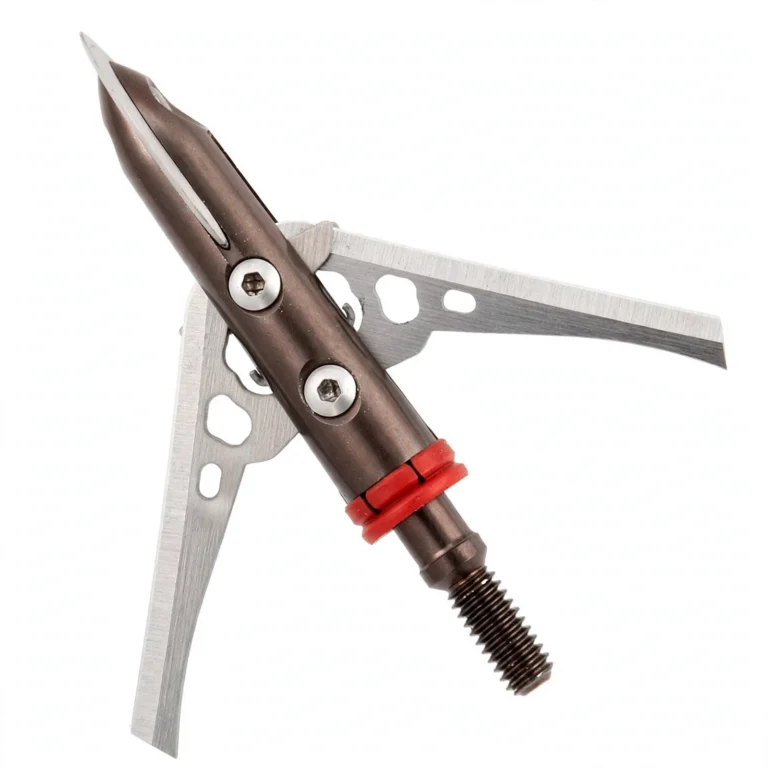
- Type: Mechanical, rear-deploying SlipCam blades
- Cutting diameter: 2 inches
- Blade count: 2, .035 inch stainless steel
- Weight: 100 grains (125 grain also available)
- Blade retention: Shock Collar on the classic version; No Collar (NC) on the current version
- Extras: Cut-on-contact tip, Ferrule Alignment Technology for field-point flight
The Rage Crossbow X is the best-selling crossbow broadhead in America, and the reason fits in two words: two inches. The rear-deploying SlipCam blades open to a 2-inch cutting diameter, which leaves the most forgiving blood trails in this roundup. When the shot is an inch off perfect, that extra cut is the difference between a short track and a long one.
It flies like a field point out of fast crossbows thanks to the Ferrule Alignment Technology and the cut-on-contact tip, so most hunters can screw it on and hunt without re-tuning. The current No Collar (NC) blade retention removes the old O-ring and Shock Collar headache entirely: no rubber to dry out, no collar to fumble with cold fingers.
Like all wide-cut mechanicals, it wants a fast bow, 400 fps territory, to guarantee full penetration on less-than-perfect angles. On a slower bow or a heavy quartering shot, that big cut costs energy. And replacement blades add up if you shoot a lot, though the heads themselves are durable.
If you shoot one of the faster bows on our best hunting crossbow list and want the biggest margin for error on the blood trail, this is where the smart money goes.
Pros
- 2-inch cut leaves the most forgiving blood trails here
- Field-point flight out of fast crossbows
- No Collar retention: no O-rings or rubber to fail
- Cut-on-contact tip starts the wound immediately
- Widely available everywhere broadheads are sold
Cons
- Wants a 400 fps bow for full penetration on tough angles
- Replacement blades add up with heavy shooting
- Wide cut costs energy on marginal hits
- Mechanical complexity versus a fixed blade
Street price is roughly $40 for a 3-pack; prices fluctuate.
Best Value Fixed Blade: Muzzy Trocar
Cut: 1-3/16 in | Price: ~$36 per 3-pack | Blades: 3
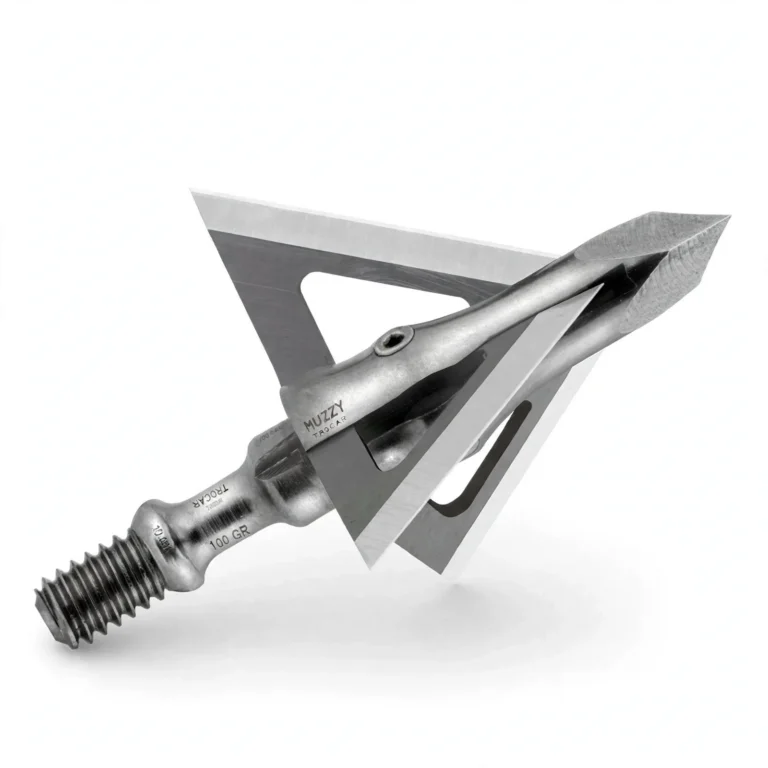
- Type: Fixed blade
- Cutting diameter: 1-3/16 inches
- Blade count: 3, .035 inch stainless steel in a right-helix offset
- Weight: 100 grains (125 grain and crossbow-specific versions also available)
- Construction: One-piece solid steel ferrule, bone-breaking Trocar tip
The Muzzy Trocar is the lowest cost per head in this roundup, and it is a serious head, not a compromise. Three .035-inch stainless blades sit in a right-helix offset around a one-piece solid steel ferrule, tipped with Muzzy’s famous bone-breaking Trocar point. There are no moving parts, which means there is nothing to fail at the moment of truth.
That Trocar tip is the story: it punches through bone and heavy cartilage that stops or deflects lesser heads. For the hunter in thick brush where a quartering shot is likely, or the slower-bow owner who needs every bit of penetration efficiency, a fixed head with a real trocar point is hard to argue with. Replacement blades are cheap and easy to find, so keeping them scary-sharp costs almost nothing.
The trade is cut size. At 1-3/16 inches, the wound channel is modest, so blood trails demand precise shot placement. And like all fixed blades, the Trocar can plane at very high speeds, so tune your setup and verify your zero with the actual heads, not just field points.
It is also my top recommendation if you are shopping for the money across your whole setup: this is premium performance at a working man’s price.
Pros
- Lowest cost per head in this roundup
- Trocar tip punches through bone that stops lesser heads
- No moving parts: nothing to fail
- Cheap, widely available replacement blades
- One-piece solid steel ferrule is bombproof
Cons
- 1-3/16 inch cut is modest; blood trails demand placement
- Fixed blades can plane at very high speeds: tune and verify
- Smaller wound channel than the mechanicals here
Street price is roughly $36 for a 3-pack; prices fluctuate.
Best Accuracy: NAP Spitfire for Crossbow
Cut: 1-1/2 in | Price: ~$37-$45 per 3-pack | Blades: 3
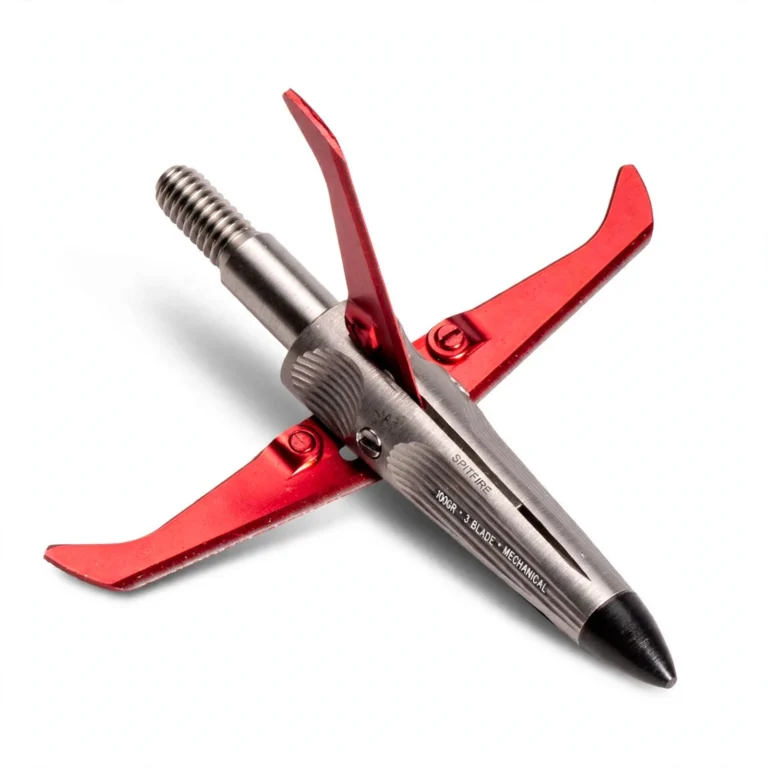
- Type: Mechanical, front-deploying
- Cutting diameter: 1-1/2 inches
- Blade count: 3, Diamize sharpened blades
- Weight: 100 grains
- Blade retention: Spring clip, no O-rings or rubber bands
- Extras: Trophy Tip, replacement blades and practice heads available
The NAP Spitfire has been appearing in best-of lists for decades, and the reason is accuracy. This front-deploying mechanical is legendary for field-point flight, which is why it keeps getting recommended year after year. Screw it on, verify zero, and hunt: for most setups that is genuinely the whole process.
The spring-clip blade retention is dead simple, with no O-rings or rubber bands to age out in storage. The 1-1/2 inch cut is a sweet spot that penetrates well even on mid-speed bows, which makes the Spitfire more forgiving of bow choice than the big 2-inch mechanicals. NAP also makes the DoubleCross variant with a 2-inch main cut plus 1-1/8 inch bleeder blades if you want a wider wound.
The cut is smaller than the Rage, so the blood-trail margin is thinner, and front-deploying heads can lose a touch of energy on the initial push compared to rear-deploying designs. Neither is a dealbreaker; both are worth knowing.
A natural fit if you are still dialing in your setup with our sighting-in guide: the Spitfire rewards good shooting without punishing your wallet or your bow speed.
Pros
- Legendary field-point accuracy, decade after decade
- Spring-clip retention: nothing rubber to age out
- 1-1/2 inch cut penetrates well on mid-speed bows
- Practice heads and replacement blades available
- DoubleCross variant offers a wider-cut option
Cons
- Thinner blood-trail margin than 2-inch heads
- Front-deploying design costs a touch of energy up front
- Blades need replacing after hard bone hits
Street price is roughly $37-45 for a 3-pack; prices fluctuate.
Best Penetration Mechanical: Grim Reaper Razortip
Cut: 1-3/8 in | Price: ~$35-$45 per 3-pack | Blades: 3
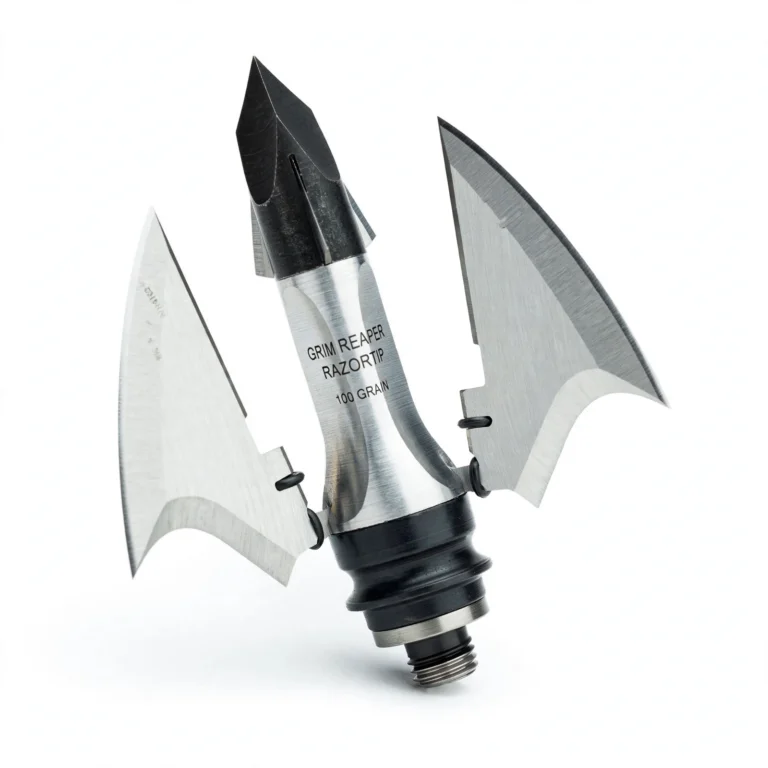
- Type: Mechanical, spring-deployed
- Cutting diameter: 1-3/8 inches
- Blade count: 3, .035 inch 440C stainless steel
- Weight: 100 grains
- Tip: Patented Razortip trocar, razors inside a trocar point
- Extras: No rubber bands or O-rings; made in the USA
The Grim Reaper Razortip is built around a simple idea: a mechanical that punches through bone instead of deflecting off it. The patented Razortip puts actual razors inside a trocar point, so the head starts cutting like a fixed blade and then deploys three .035-inch 440C stainless blades to a 1-3/8 inch cut. In the mechanical world, that bone-first design is rare.
The spring-deployed system uses no rubber bands or O-rings, so there is nothing to dry out and crack in storage, and blades swap in seconds when it is time for fresh edges. It is made in the USA, and the 440C blade steel holds an edge well.
Be clear about what it is: at 1-3/8 inches, this is the smallest mechanical cut in the roundup, so it asks more of your shot placement than the wide-cut heads. It is a penetration-first head, not a blood-trail-first head. If your priority is the shortest possible track on a perfect double-lung hit, the bigger cuts win.
But if your shots tend to come at awkward angles in thick cover and you worry about hitting a shoulder blade, this is the mechanical I would reach for. It is the one most likely to keep driving when things go sideways.
Pros
- Razortip design punches bone rather than deflecting
- No rubber bands or O-rings to fail in storage
- Blades swap in seconds
- Quality 440C stainless blade steel
- Made in the USA
Cons
- 1-3/8 inch cut is the smallest mechanical cut here
- Penetration-first design, not blood-trail-first
- Premium price for the cut size
- Spring system adds parts versus a fixed blade
Street price is roughly $35-45 for a 3-pack; prices fluctuate.
Best Tough Game: QAD Exodus
Cut: 1-1/4 in | Price: ~$45-$48 per 3-pack | Blades: 3
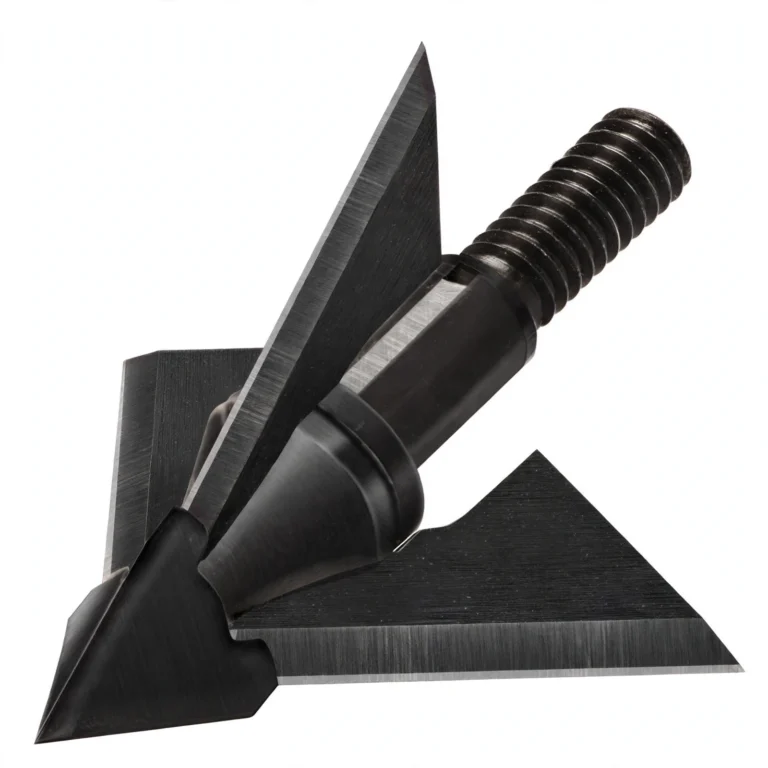
- Type: Fixed blade, cut-on-contact
- Cutting diameter: 1-1/4 inches
- Blade count: 3, .040 inch tempered 400-series stainless steel
- Weight: 100 grains (125 grain also available)
- Construction: Blades-over-shaft design keeps the head the same length as a field point
The QAD Exodus is the fixed blade for hunters who value penetration above all else. Three .040-inch tempered 400-series stainless blades, the thickest fixed blades in this roundup, ride in a blades-over-shaft design that keeps the head the same length as a field point. That short, compact profile is why it flies remarkably close to a field point for a fixed head.
On elk, hogs, and big-bodied northern whitetails, the Exodus is superb: the cut-on-contact design starts slicing immediately instead of punching first, and the thick blades survive bone impacts that fold thinner heads. Pairs well with the setups on our best crossbow for elk page.
This is also the reliability-first whitetail hunter’s head: no mechanism, no retention system, nothing to wonder about after the shot. Screw it on, verify zero, and trust it completely.
The price is premium for a fixed head, and the 1-1/4 inch cut is modest, so this head rewards good shot placement rather than covering for it. That is the fixed-blade bargain in a sentence, and the Exodus is one of the best versions of it ever made.
Pros
- .040 inch blades: thickest fixed blades in this roundup
- Compact profile flies close to a field point
- Superb penetration on elk, hogs, and big whitetails
- Cut-on-contact starts cutting immediately
- Blades-over-shaft design is exceptionally strong
Cons
- Premium price for a fixed head
- Modest 1-1/4 inch cut rewards placement over forgiveness
- Heavier feel in flight than mechanicals
Street price is roughly $45-48 for a 3-pack; prices fluctuate.
Best Fast Bows: Slick Trick ViperTrick
Cut: 1-15/16 in total | Price: ~$45-$50 per 4-pack | Blades: 4
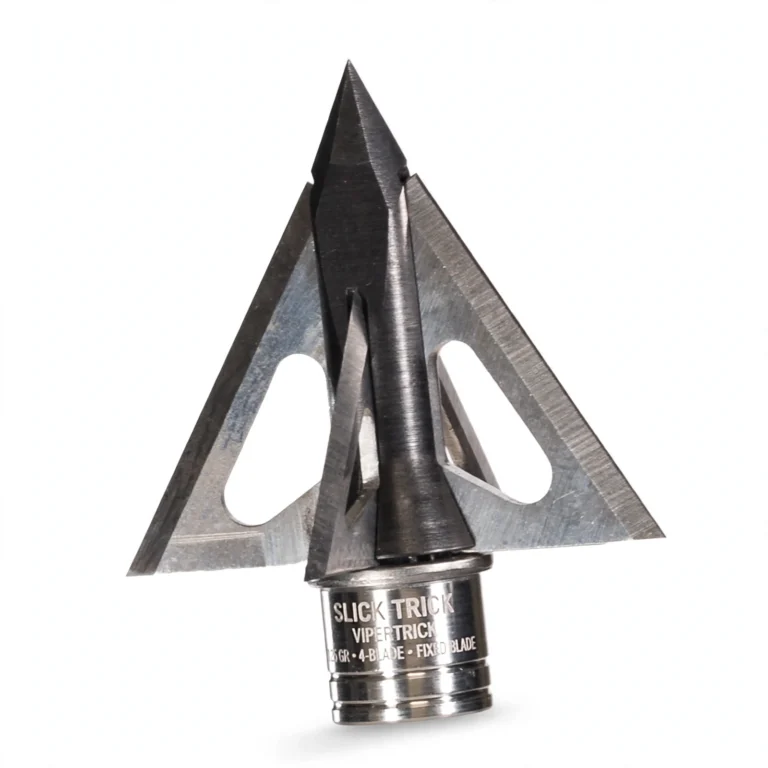
- Type: Fixed blade, cut-on-contact
- Cutting diameter: 1-1/16 inch main blades plus 7/8 inch bleeders, 1-15/16 inch total cut
- Blade count: 4 (2 main + 2 bleeder), .035 inch Lutz stainless steel
- Weight: 100 grains (125 grain also available)
- Construction: All stainless steel, Alcatraz BladeLock system, replaceable blades
The Slick Trick ViperTrick answers a specific question: what if you want a mechanical-sized cut with fixed-blade certainty? Two main blades at 1-1/16 inches plus 7/8-inch bleeder blades deliver a 1-15/16 inch total cut, the widest of any fixed blade here, with zero moving parts and nothing to deploy.
The cut-on-contact tip starts cutting immediately instead of punching first, and the super-short profile handles the blistering speeds of modern crossbows without planing. If your bow shoots 400+ fps and you have watched mechanicals do their work but want fixed-blade reliability, this head was designed for you.
All stainless steel construction with the Alcatraz BladeLock system means the blades lock in solidly and are replaceable when dull. Four blades means four edges to keep sharp, and like all fixed blades, the ViperTrick will expose any tuning flaws in your setup, so do your homework at the range.
For the fast-bow hunter who loves what mechanicals do but wants fixed-blade certainty, this head gives you a wide cut with nothing to deploy and nothing to fail.
Pros
- Widest total cut of any fixed blade here, nearly 2 inches
- Zero moving parts: nothing to deploy or fail
- Super-short profile stays stable at 400+ fps
- Cut-on-contact tip starts the wound immediately
- Alcatraz BladeLock with replaceable blades
Cons
- Four blades means four edges to keep sharp
- Premium 4-pack price
- Exposes tuning flaws: verify zero with actual heads
- Bleeder blades add drag on lighter, slower bows
Street price is roughly $45-50 for a 4-pack; prices fluctuate.
How to Match the Head to Your Bow
Walk through this in order and you will land on the right head the first time:
- Know your speed. Above 400 fps, the mechanicals on this list shine. Between 350 and 400, pick by confidence. Below 350, stay fixed blade.
- Know your game. Whitetail deer: anything here works. Elk, moose, big hogs: lean fixed (Exodus, ViperTrick, Trocar).
- Pick your weight and commit. Buy the practice heads or field points in the same grain weight, and do your final sight-in with the real thing. Our cocking guide matters here too: an uncocked or dry-fired bow is a safety issue long before broadhead choice matters.
- Verify zero with hunting heads. Field-point groups do not count. Shoot at least one of each head you will hunt with to confirm point of impact.
- Store mechanicals right. Retention collars and O-rings age. If your mechanicals have been sitting in a tackle box for two seasons, replace the retention parts before you trust them.
If you are still choosing the bow itself, our crossbow buying guide and the best crossbows under $500 roundup will get you sorted, and a good case keeps those razor edges safe in transit.
Frequently Asked Questions
Are mechanical broadheads reliable for crossbows?
Quality mechanicals from established brands are very reliable on deer when the setup is right. Almost every failure I have heard about traces to one of three things: a bow too slow to drive the head through, a bad shot angle, or dull blades. The design itself is proven. The key is matching the head to your bow’s speed, which is why this guide keeps coming back to that 400 fps line.
Should I use 100 or 125 grain broadheads?
Either works. 100 grain is the standard for most crossbow hunters and flies flatter; 125 grain adds momentum, penetrates a bit better, and slightly quiets the shot. The weight itself matters less than consistency: practice with the exact weight you will hunt with, because point of impact shifts between them.
Fixed or mechanical for a bow under 350 fps?
Fixed blade, no contest. Below roughly 350 fps, or below about 65 foot-pounds of kinetic energy, mechanicals may not open fully or drive through reliably. A Muzzy Trocar or QAD Exodus on a slower bow will out-penetrate any wide-cut mechanical. Save the mechanicals for when you upgrade to a faster bow.
Can I reuse a broadhead after a kill?
Sometimes. Inspect it carefully: spin-test for wobble, check every blade for sharpness, and check the ferrule for straightness. With mechanicals, plan on fresh blades after a kill; with fixed blades, you can often resharpen and keep hunting. A $15 head is never worth a wounded deer, so when in doubt, retire it.
Do broadheads fly the same as field points?
Mechanicals usually fly very close to field points, which is their big selling point. Fixed blades can differ, especially at high speed, which is why you must confirm your zero with the actual hunting heads before the season. Never assume the field-point group transfers.
Are mechanical broadheads legal where I hunt?
It depends on your state, and sometimes on the season or species. Most states set a minimum cutting diameter, commonly 7/8 to 1 inch, and a handful restrict or ban expandable heads for certain hunts. Check your current state wildlife agency regulations before buying any electronic scope, and verify before every season since rules change.
How often should I replace mechanical blades and retention parts?
Blades: inspect before every season and replace anything dull, nicked, or bent; plan on fresh blades after any kill. Retention parts (O-rings, collars, bands): these dry out and crack with age, roughly 18 months in storage is a common rule of thumb, so replace them if your heads have been sitting. When in doubt, fresh parts are cheap insurance.
What cutting diameter do I need for elk?
For elk, penetration beats diameter. Most experienced elk hunters choose a tough fixed blade in the 1 to 1-1/4 inch range, like the QAD Exodus, and put the emphasis on where to put the shot on a deer and a heavy, well-tuned bolt. A wide mechanical on an elk shoulder is how animals get lost. Save the 2 inch cuts for deer.