Best Pistol Crossbow 2026: 8 Mini Crossbows Compared With Honest KE Math
As an affiliate site, ProCrossbow earns from qualifying purchases made through links on this page. That never changes what I recommend: every pick below is one I would hand to a friend, with its flaws stated up front. See our full affiliate disclosure and how we test.
The Short Answer
The best pistol crossbow for most shooters is the EK Archery Cobra System RX Adder: the only repeater in this class that combines 130-lb draw weight, a real magazine, and honest 240 fps performance for around $200. For raw speed in the smallest package, the Ballista BAT Rev hits 340 fps. For simple, cheap backyard fun, the PSE Viper SS is the accuracy pick and the M48 Hell Hawk at $69.99 is the budget pick.
And the ethics one-liner you will not find on most lists: no pistol crossbow on this page is a deer-hunting tool. The most powerful model here delivers roughly 40 ft-lbs of kinetic energy at best, and most deliver well under 25. If your goal is a whitetail, read my best hunting crossbow guide instead. Pistol crossbows are for targets, plinking, and small game where legal. Full stop.
Read This First: What a Pistol Crossbow Can and Cannot Do
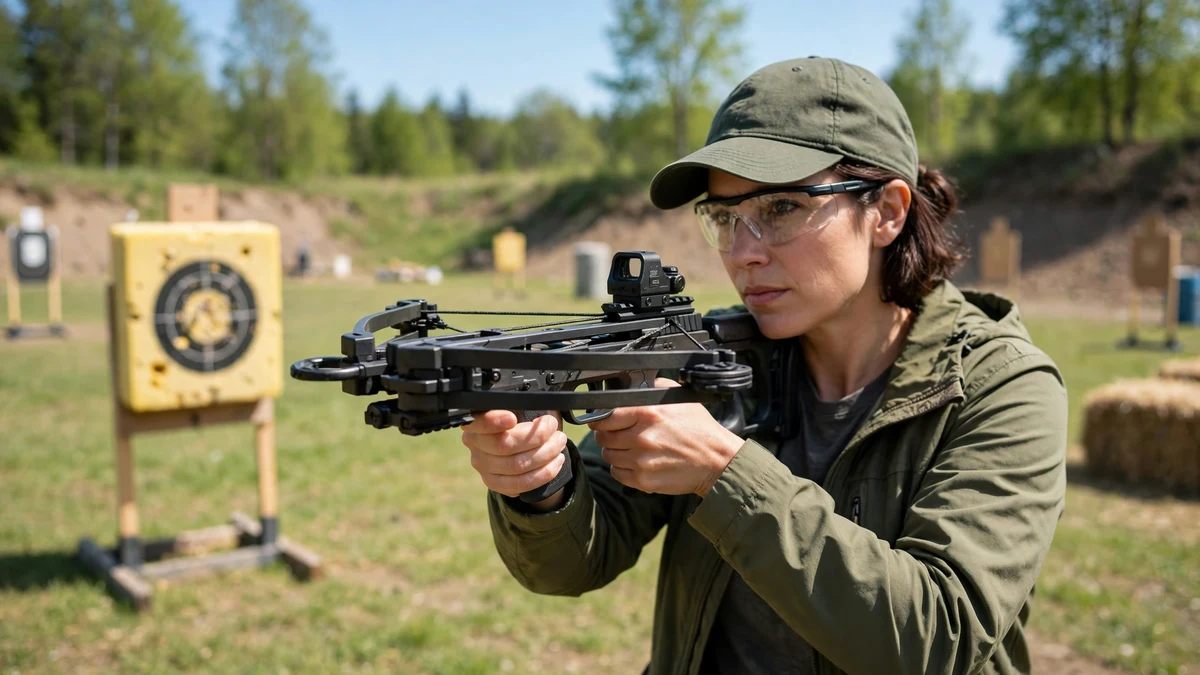
I have been shooting crossbows for eight years, and I own the full-size bows that kill deer cleanly. So let me be direct: a pistol crossbow is a compact bow with 50 to 150 lbs of draw weight, shooting bolts 150 to 340 fps. That sounds fast. But speed without weight behind it is just a number, and the number that matters in hunting is kinetic energy.
The kinetic energy math, in plain English
Kinetic energy is what does the work on an animal: KE (ft-lbs) = bolt weight in grains × speed in fps squared ÷ 450240. An ethical whitetail shot needs roughly 40+ ft-lbs. The EK Cobra RX Adder (205-grain bolt at 240 fps) lands at about 26 ft-lbs. The Snake Eye lands around 14, the PSE around 12, the Bear around 8. Even the 340 fps Ballista BAT Rev sits around 38. Every one falls short of the ethical floor for deer.
So what are they good for? Backyard targets, stump shooting, training kids (under adult supervision) on form and safety, and small game like rabbits, squirrels, and (where legal) turkey. A 25 ft-lb bolt is plenty for a foam target or an ethical close-range small-game shot. Match the tool to the job and you will love these little bows. New to crossbows? Start with my beginner’s guide and the safety guide first.
One warning about other “best pistol crossbow” lists
Scan any ranking for basic sense first. If a “pistol crossbow” list shows you a 415 fps full-size hunting bow, close the tab. Some roundups pad their “mini crossbow” articles with full-size models because they have never touched the category. A real pistol crossbow fits in a backpack. The eight bows below are all genuinely pistol-size.
The Best Pistol Crossbows Compared
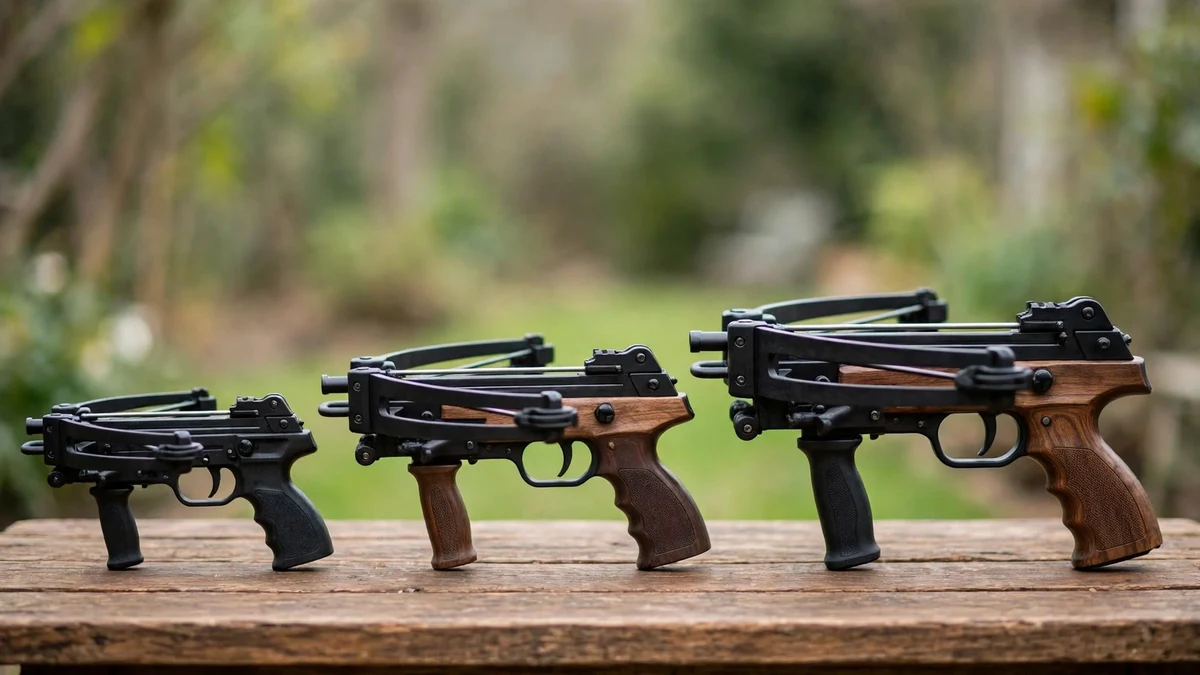
KE figures are estimates computed from published speeds and typical bolt weights, except where the manufacturer publishes them. Prices are street prices and move.
| Model | Type | Draw Weight | Speed | Est. KE | Price | Best For |
|---|---|---|---|---|---|---|
| EK Cobra RX Adder | Repeating recurve | 130 lbs | 240 fps | ~26 ft-lbs* | ~$200 | Best overall |
| Ballista BAT Rev | Compound reverse-draw | 150 lbs | 340 fps | ~38 ft-lbs | ~$450 | Fastest |
| WT Striker | Repeating, magazine-fed | 125 lbs | 300 fps | ~25 ft-lbs* | ~$300 | High-power repeater |
| Steambow AR-6 Stinger II Tactical | Semi-auto repeater | 55 lbs (90-lb option) | 180-190 fps | ~10 ft-lbs | ~$275-300 | Carbine-style semi-auto |
| PSE Viper SS | Single-shot, self-cocking | 50 lbs | 215 fps | ~12 ft-lbs | ~$30-40 | Accuracy pick |
| Snake Eye Tactical Cobra | Single-shot, self-cocking | 80 lbs | 225 fps | ~14 ft-lbs | ~$50-70 | Best self-cocking under $75 |
| Bear X Desire XL | Single-shot, self-cocking | 60 lbs | 175 fps | ~8 ft-lbs | ~$75 | Backyard fun |
| M48 Hell Hawk | Single-shot, self-cocking | 80 lbs | 185 fps | ~9 ft-lbs | ~$70 | Budget pick |
* KE figures marked with an asterisk are manufacturer-published: EK lists 26.23 ft-lbs for the RX Adder and 25.25 ft-lbs for the WT Striker. My computed estimates agree with both.
Best Overall: EK Archery Cobra System RX Adder
Speed: 240 fps | Price: ~$200 | Draw Weight: 130 lbs
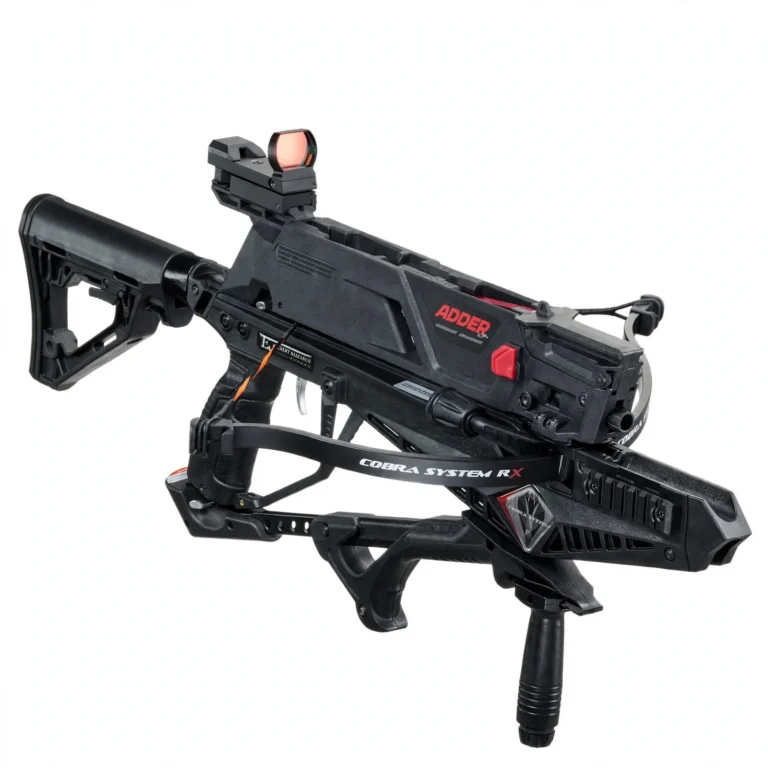
- Draw weight: 130 lbs (180-lb limb available)
- Speed: 240 fps with 205-grain bolts
- Kinetic energy: 26.23 ft-lbs (manufacturer figure)
- Magazine: 5-bolt top-loading (7-bolt on the Version 2.0)
- Weight: 5.2 lbs
- Price: around $200
The Adder is the repeating pistol crossbow done right: a modern take on the classic repeating design with a 130-lb recurve limb, an under-lever cocking system that roughly halves the cocking effort, and a top-loading magazine that sends five bolts downrange in seconds (seven on the newer 2.0 version). At 240 fps it is the most powerful practical repeater you can buy, and EK publishes real kinetic energy numbers, 26.23 ft-lbs, instead of fantasy specs. That honesty is rare in this category and worth rewarding.
In the hand, the lever system is the difference between a novelty and a shooter. Cocking 130 lbs shot after shot by hand gets old fast; the lever makes sustained shooting sessions genuinely fun. The 205-grain carbon bolts fly flat enough for satisfying target work out to 30 yards, and the whole system feels engineered rather than assembled.
The trade-offs are logistics and weight. No major US retailer stocks it, so you order from an EK dealer and wait on overseas shipping, and warranty claims go through the same channel. There is no integrated cocking rope, so bring a strap for long sessions. At 5.2 lbs it is the heaviest bow on this list. And the ethics note I put on every pistol bow: this is a backyard and target tool, not a big-game bow. For a repeater that actually works instead of jamming, it is still the best pistol crossbow you can buy.
Pros
- real 130-lb power with honest published KE
- 5 to 7-shot magazine that actually works
- lever cocking halves the effort
- engineered feel, not a toy
Cons
- no US retailers, order from EK dealers with overseas shipping
- no integrated cocking aid at 130 lbs
- heaviest bow on this list at 5.2 lbs
- not a hunting bow
Bottom line: The best repeating pistol crossbow made. Maximum rate of fire with real power behind each shot, if you can handle the import logistics.
Fastest: Ballista BAT Rev
Speed: 340 fps | Price: ~$450 | Draw Weight: 150 lbs
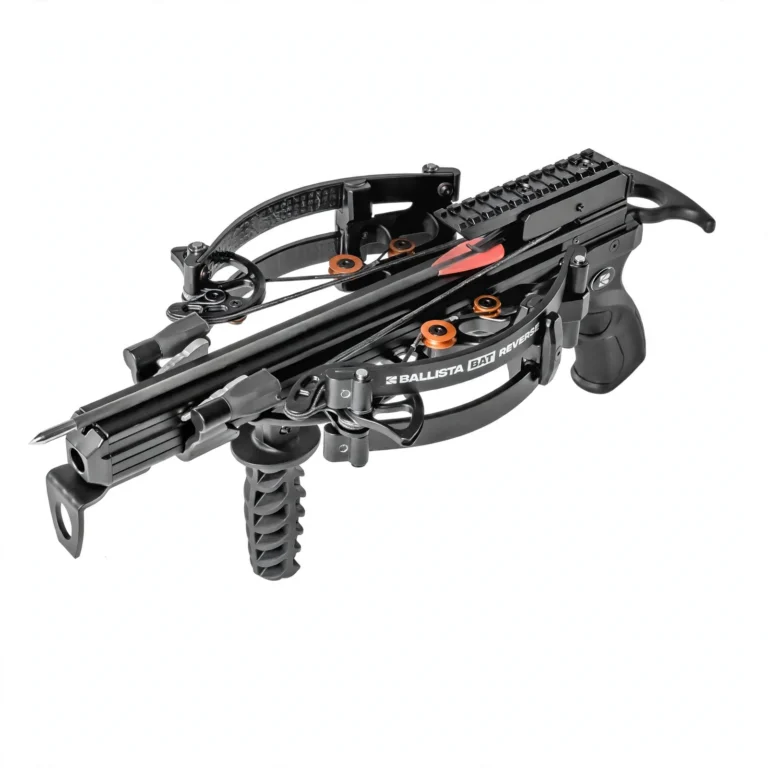
- Draw weight: 150 lbs (cocks at ~50 lbs via built-in self-retracting rope)
- Speed: 340 fps
- Kinetic energy: ~38 ft-lbs (estimated)
- Weight: 3 lbs
- Power stroke: 8.5 inches
- Price: around $450
The BAT Rev is the engineering standout of this category: a reverse-draw compound whose limbs face backward to stretch the power stroke to 8.5 inches, which is how it hits 340 fps from a bow that fits in a backpack. That is nearly double the speed of most pistol crossbows, and you feel it in the flat trajectory and hard target impacts. The built-in self-retracting cocking rope drops cocking effort to about 50 lbs, and Picatinny rails top and bottom accept any red dot or foregrip.
Build quality is a clear step above the budget pistols. The machining is clean, the compound system feels robust, and everything locks up without rattle. For target shooting it is genuinely impressive: quiet for its speed, consistent, and capable of groups that embarrass bows costing the same.
The honest part, and I will not soften it: even at 340 fps, this is not a deer bow. The estimated 38 ft-lbs still sits below the 40 ft-lbs ethical floor, and a short 13-inch bolt bleeds energy fast past 25 yards. It is also the priciest bow here at around $450, with the most moving parts, which means more to maintain. What it is: the best target and small-game pistol crossbow money can buy. Pair it with a proper crossbow target rated for the speed, because cheap foam will not stop it.
If you go this route, budget for the ecosystem: quality bolts, a rated target, and a red dot if you want to exploit the accuracy. The bow itself is the expensive part, but the shooting experience is complete once the supporting gear is in place.
Pros
- 340 fps, fastest in the class by far
- built-in cocking rope, ~50-lb cocking effort
- Picatinny rails for optics
- excellent build quality
Cons
- $450, the priciest pick here
- still not a deer bow despite the speed
- compound complexity in a tiny package
- short bolts lose energy quickly
Bottom line: Maximum speed and build quality at full-size money. The finest pistol crossbow for targets, with honest limits.
Best High-Power Repeater: WT Striker
Speed: 300 fps | Price: ~$300 | Draw Weight: 125 lbs
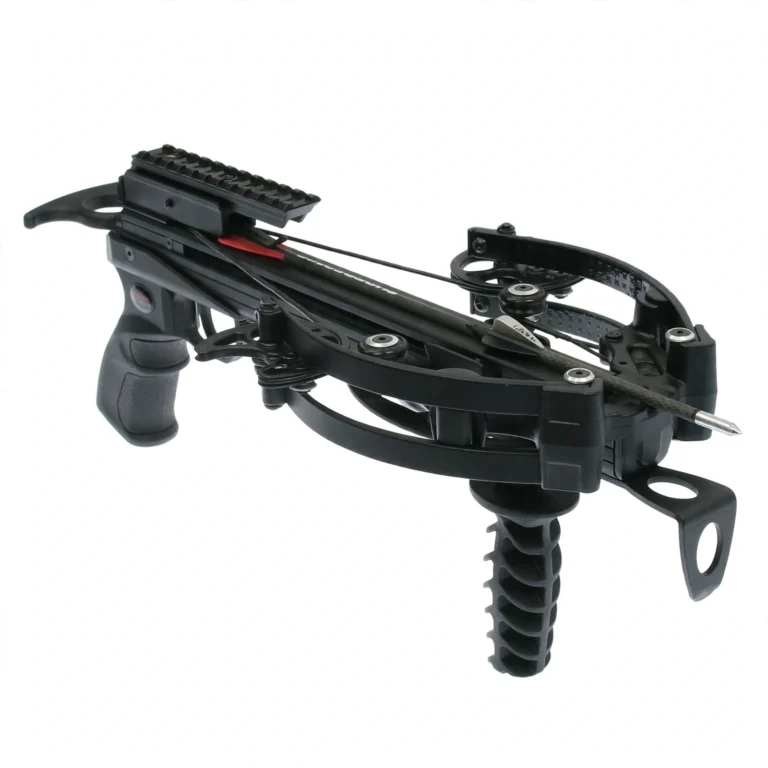
- Draw weight: 125 lbs (crank cocking, ~40-lb effort)
- Speed: up to 300 fps
- Kinetic energy: 25.25 ft-lbs (manufacturer figure)
- Magazine: 6-bolt
- Weight: 2.75 lbs
- Price: ~$300
The WT Striker is the sleeper pick of this list: a 125-lb draw, a 6-bolt magazine, a built-in crank that drops cocking effort to around 40 lbs, and a red/green dot sight in the box. At 25.25 ft-lbs of kinetic energy and up to 300 fps, it sits right behind the EK Adder on power, and unlike the Adder you can order it domestically. The crank is the standout feature; it turns a 125-lb bow into something anyone can shoot all afternoon.
The magazine system works well enough to be fun, which is more than I can say for some repeaters. The included dot sight is genuinely useful, not a throwaway, and at 2.75 lbs the bow handles easily. For backyard courses and target leagues, it delivers a lot of entertainment per dollar.
The catch is brand recognition. William Tell lacks the reach of the big names, so if something breaks you are leaning on the retailer rather than a deep parts network. And ~$300 buys a lot of full-size crossbow, as my under $500 guide shows, so be sure you want a pistol bow specifically. The magazine is also the mechanical weak link; keep it clean and do not force it. As a pistol bow, though, it is a lot of performance for the price, and the same ethics note applies: targets and small game, not big game.
Storage and transport are easy: at 2.75 lbs it rides in a backpack, and the built-in crank means no separate cocking rope to forget. It is the kind of bow that gets shot often because it asks so little to get shooting.
Pros
- 125-lb power with 6-shot magazine
- crank cocking, only ~40-lb effort
- red/green dot sight included
- domestic ordering
Cons
- smaller brand, thinner parts support
- ~$300 competes with budget full-size bows
- magazine reliability is the weak link
- not a big-game bow
Bottom line: Repeater fun at near-Adder power, ordered domestically. The crank alone justifies a hard look.
Best Carbine-Style Semi-Auto: Steambow AR-6 Stinger II Tactical
Speed: 180-190 fps | Price: ~$275-$300 | Draw Weight: 55 lbs (90-lb option)
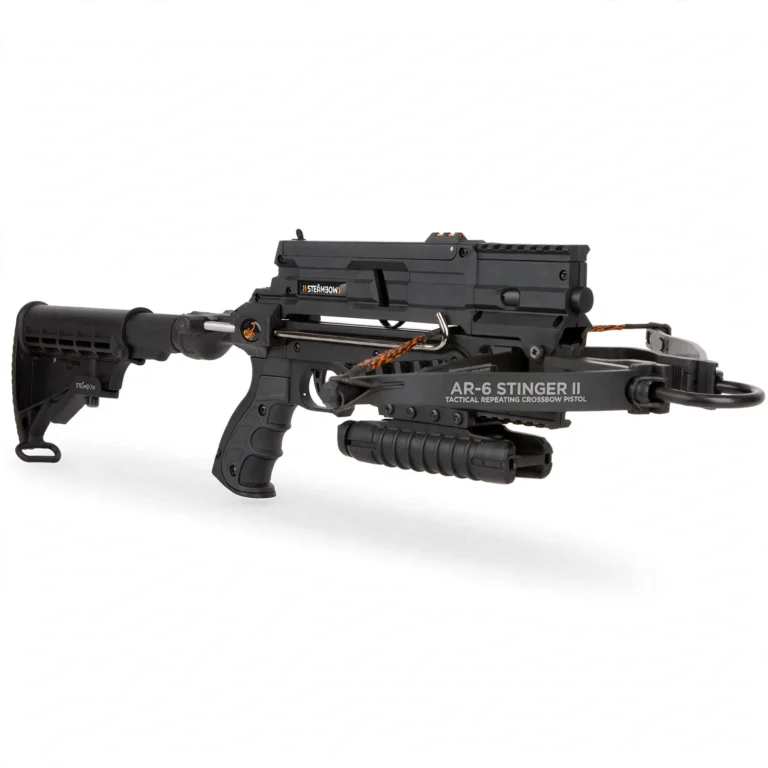
- Draw weight: 55 lbs stock (90-lb Pro limbs available)
- Speed: 180-190 fps stock, up to 220 fps with 90-lb limbs
- Kinetic energy: ~10 ft-lbs stock, up to ~15 ft-lbs with Pro limbs
- Magazine: 6-arrow internal polymer magazine
- Weight: 2.5-2.6 lbs
- Price: around $275-300
The Stinger II Tactical is the only serious semi-auto pistol crossbow on the market, and that one feature changes everything about how it shoots. Six arrows sit in an internal polymer magazine, and one lever motion chambers the next, so you can run a full magazine in seconds without ever breaking your stance. The Tactical version wraps that action in an AR-style package with an adjustable stock, a vertical foregrip, and rails for a red dot. Shouldered properly, it points and swings like a carbine, which is exactly why it is the most fun you can have at a backyard target.
The catch is power, and you need to go in with honest expectations. The stock 55-lb limbs produce around 10 ft-lbs of kinetic energy, which Steambow itself frames as indoor-training power. At that level this is strictly a target and plinking bow, not a hunting tool, and I would not stretch it past 20 yards even on foam. I consider the roughly $80 90-lb Pro limb upgrade mandatory for any serious outdoor use: it pushes speed to about 220 fps and energy toward 15 ft-lbs, which makes the bow genuinely useful at backyard distances. Budget for the limbs on day one, because your real cost is closer to $380, not $300.
What keeps the Stinger II at the top of the fun-per-dollar ranking is the build quality. The polymer body feels engineered, not toy-like, the lever action is smooth and positive, and the magazine feeds reliably once you learn the rhythm. It is also one of the few pistol crossbows an adult can shoot for an hour without fatigue, since the lever does the work your arms would otherwise do. Just remember the ethics line that applies to this whole category: even with Pro limbs, this is a target bow. My guide to choosing a crossbow covers draw weight and kinetic energy honestly.
Pros
- True semi-auto action, 6 shots with one lever motion
- AR-style stock and foregrip shoulder properly
- Excellent polymer build quality, engineered feel
- 90-lb Pro limb upgrade available for outdoor use
- Low fatigue, shoot all afternoon
Cons
- Stock 55-lb limbs too weak for outdoor use
- Pro limb upgrade adds ~$80, real cost near $380
- ~10 ft-lbs stock KE is strictly a target bow
- Even upgraded, not a hunting bow
Bottom line: the most fun semi-auto in the class, but budget the Pro limbs from day one.
Best Accuracy: PSE Viper SS
Speed: 215 fps | Price: ~$30-$40 | Draw Weight: 50 lbs
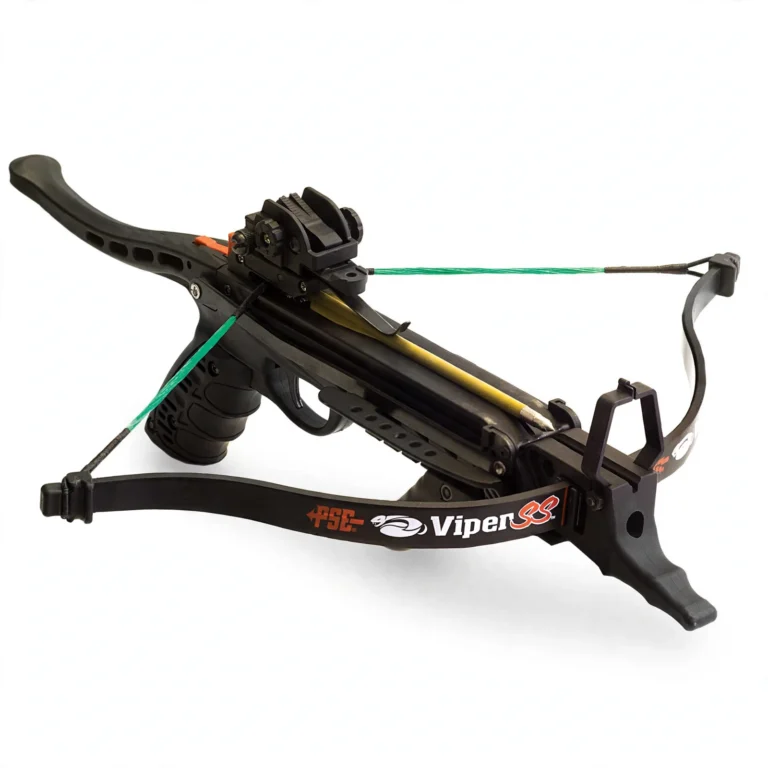
- Draw weight: 50 lbs
- Speed: 215 fps
- Kinetic energy: ~12 ft-lbs (estimated)
- Weight: 1.6 lbs
- Cocking: integrated self-cocking lever with safety lock
- Sights: adjustable open sights
- Price: around $30-40
The Viper SS is the old reliable of pistol crossbows and my accuracy pick. The integrated self-cocking lever doubles as a safety and anti-dry-fire device, which is clever engineering at this price. The track-style rail keeps bolts consistent shot to shot, and the adjustable open sights beat the fixed sights on most budget pistols. At 215 fps from 50 lbs of draw it punches above its weight, and PSE is a real archery company that will answer the phone.
This is the bow I recommend to anyone who wants to learn pistol-crossbow fundamentals cheaply. The manual of arms is simple: lever, load, aim, shoot. There is almost nothing to break and nothing to tune. Groups at 20 yards will surprise you.
The limitations are the category’s, sharpened by the price. Fifty pounds and roughly 12 ft-lbs of kinetic energy means targets only, full stop. It is single-shot, so the rate of fire is whatever your hands can manage. Only three bolts come in the box, so buy extra bolts and a proper set of crossbow bolts before your first session. To learn fundamentals cheaply, this is where I would start.
A practical note on bolts: the short pistol bolts are a consumable, and you will lose or damage them while learning. Buy in bulk from the start; a dozen practice bolts costs less than the bow and removes any hesitation about shooting often. Frequency of practice is what builds the consistent form this short power stroke demands.
Pros
- best accuracy of the budget pistols
- self-cocking lever with safety lock
- adjustable open sights
- dead-simple manual of arms
Cons
- single-shot only
- only 3 bolts included
- ~12 ft-lbs, strictly targets
- short power stroke demands consistent form
Bottom line: The cheapest way to learn pistol crossbow shooting properly. Beginners who want the tightest groups for the least money start here.
Best Self-Cocking Under $75: Snake Eye Tactical Cobra
Speed: 225 fps | Price: ~$50-$70 | Draw Weight: 80 lbs
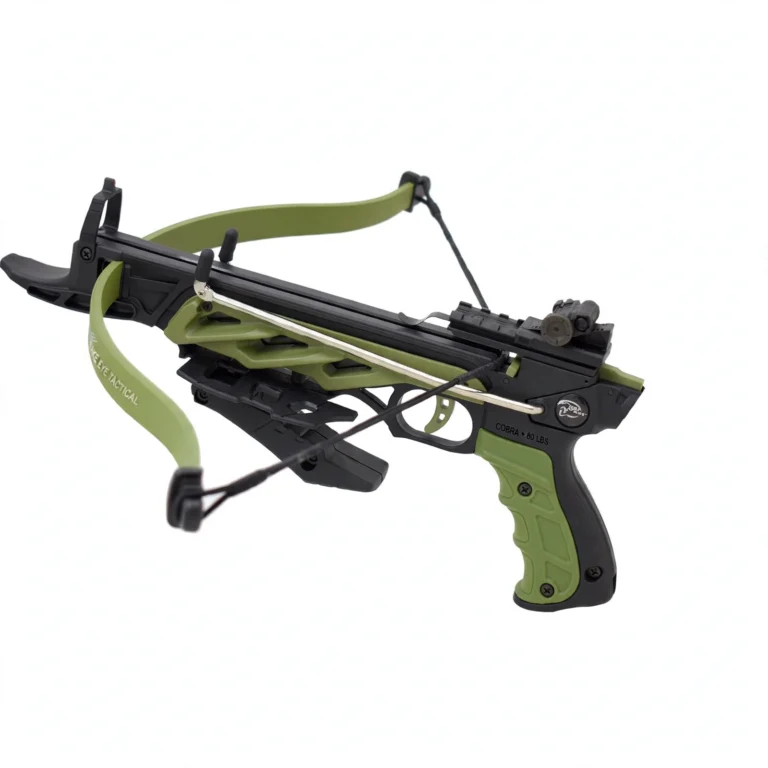
- Draw weight: 80 lbs
- Speed: 225 fps
- Kinetic energy: ~14 ft-lbs (estimated)
- Weight: 2 lbs
- Cocking: self-cocking stock, automatic safety
- Frame: aluminum and fiberglass, adjustable stock
- Price: around $50-70
The Snake Eye Tactical Cobra is what the budget end of this market should look like: an 80-lb self-cocking pistol crossbow with an aluminum and fiberglass frame, adjustable stock, automatic safety, and Weaver rails, for about $60. The self-cocking mechanism is genuinely easy to use, which matters because a pistol bow you dread cocking is a pistol bow that stays in the closet. At 225 fps and roughly 14 ft-lbs it is a credible plinking bow.
The value equation is strong. You get real sights, a real safety, an adjustable stock for different shooters, and rails for a red dot, all for the price of a dinner out. For introducing someone to the category, it removes every financial excuse.
Be realistic about $60. The cocking mechanism uses plastic-assisted components, and that is the part I would watch for wear over time; inspect it regularly and never dry-fire. Some listings market this bow for turkey, which is marketing optimism I do not endorse; this is a target and plinking tool. Quality also varies between sellers, so buy from a reputable listing. For backyard fun with real sights and a real safety at a real price, it is hard to beat.
If you buy one, do the out-of-box check I do with every budget bow: inspect the limb pockets, work the cocking mechanism a dozen times to feel for grittiness, and confirm the safety engages positively every time. Ten minutes of inspection up front prevents nearly every common issue with bows in this class.
Pros
- 80 lbs of draw for $50-70
- easy self-cocking mechanism
- automatic safety and adjustable stock
- Weaver rails for optics
Cons
- plastic cocking components wear over time
- marketing oversells the hunting use
- variable quality between sellers
- strictly a target and plinking bow
Bottom line: The most draw weight per dollar with easy cocking. The budget king, with eyes-open expectations.
Best Backyard Fun: Bear X Desire XL
Speed: 175 fps | Price: ~$75 | Draw Weight: 60 lbs
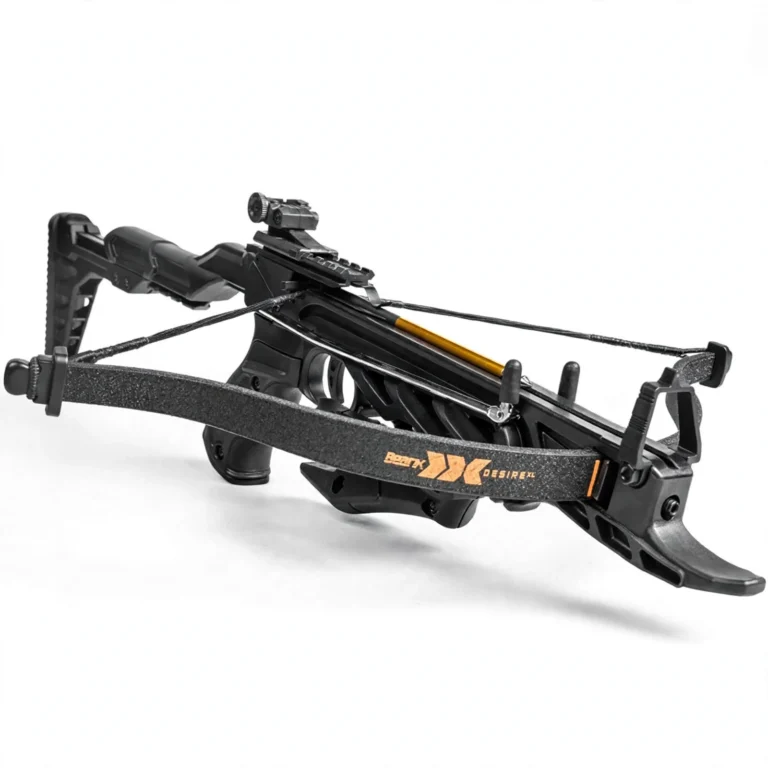
- Draw weight: 60 lbs
- Speed: 175 fps
- Kinetic energy: ~8 ft-lbs (estimated)
- Weight: 1.9 lbs
- Cocking: self-cocking arm
- Features: adjustable stock (extends 2.5 in), 3 premium bolts included
- Price: $74.99 (manufacturer MSRP)
Bear X is a real archery brand and the Desire XL shows it. The self-cocking action is smooth, the stock adjusts 2.5 inches to fit different shooters, and three decent bolts come in the box. Fit and finish are a clear step above the no-name pistols: no sharp edges, no rattle, everything works the first time. At 60 lbs and 175 fps it is modest, around 8 ft-lbs of kinetic energy, but plenty for backyard targets.
What you are buying here is trust. Bear will still exist next year, the warranty means something, and this is a bow I would hand to a youth shooter with confidence, with adult supervision as always. The adjustable stock is genuinely useful for families sharing one bow between shooters of different sizes.
The trade-off is power per dollar. The Snake Eye gives you 80 lbs at a similar price; here you pay a brand premium for 60 lbs. At roughly 8 ft-lbs this is targets only, and I would not let anyone tell you otherwise. For family backyard plinking where quality and safety matter more than raw speed, the Desire XL is the classy choice.
For parents, the use case is specific: supervised backyard sessions where the goal is safe fun and basic marksmanship. Keep sessions short, keep the muzzle pointed downrange, and treat every cocking as a teaching moment. The Desire XL’s easy cocking and adjustable stock make those teaching moments pleasant rather than a wrestling match, which is why it earns its place on this list despite the modest power.
Pros
- reputable brand with real warranty support
- smooth self-cocking and adjustable stock
- good fit and finish
- family-friendly
Cons
- less power per dollar than the Snake Eye
- 60 lbs is modest for the price
- targets only at ~8 ft-lbs
Bottom line: The quality pick for families. Less speed, more trust, and a bow you can hand to a supervised young shooter.
Best Budget: M48 Hell Hawk
Speed: 185 fps | Price: ~$70 | Draw Weight: 80 lbs
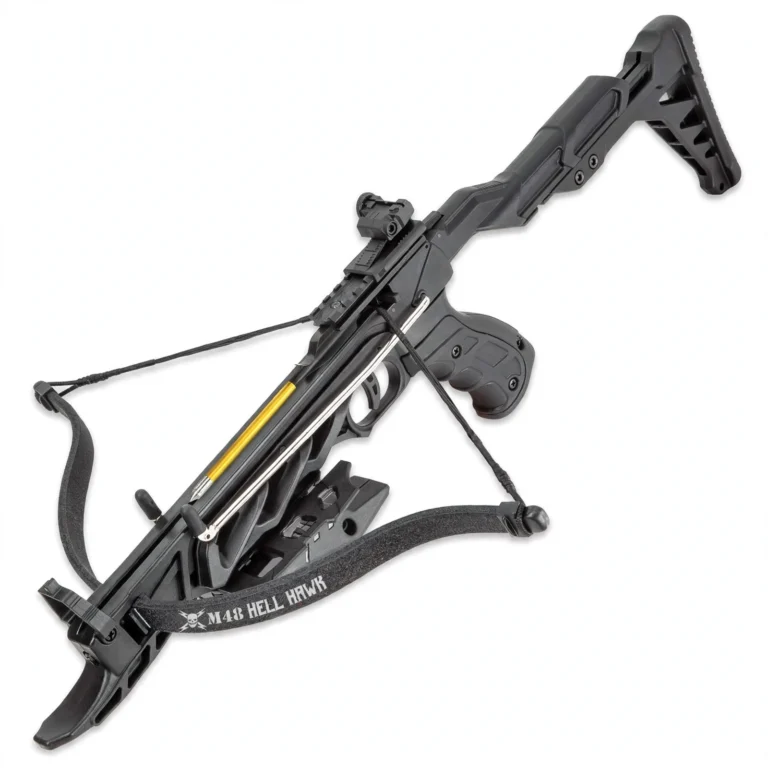
- Draw weight: 80 lbs
- Speed: 185 fps
- Kinetic energy: ~9 ft-lbs (estimated)
- Cocking: self-cocking mechanism
- Features: dual Picatinny rails, fiber-optic front sight, adjustable stock, 3 aluminum bolts included
- Price: $69.99
The Hell Hawk is the cheapest reputable 80-lb pistol crossbow: self-cocking mechanism, dual Picatinny rails, fiber-optic front sight, adjustable stock, and three aluminum bolts, all for $69.99. The fiber-optic sight is a nice touch at this price, gathering enough light for late-afternoon backyard sessions, and the dual rails give you mounting options most budget pistols skip.
It gets you shooting, which is the entire point at $70. The manual of arms is simple, the adjustable stock helps it fit different shooters, and aluminum bolts in the box means you are not making a second purchase before the first shot.
Manage expectations. The cocking mechanism and limb pockets are where the cost was cut, so inspect them regularly and never dry-fire; there is no margin for abuse here. It is also slower than the Snake Eye at the same 80-lb draw weight, 185 fps versus 225, which tells you something about limb efficiency. If $70 is your ceiling, this gets you shooting. If you can stretch to the Snake Eye, do it.
The honest buying advice: this bow exists for one scenario, which is a hard $70 ceiling. At that price it is a legitimate way to try the category and decide whether pistol crossbows are your thing. But the value curve bends sharply just above it; the Snake Eye’s extra speed and better efficiency cost little more. If there is any flex in the budget at all, use it. If not, the Hell Hawk will still put bolts on target and teach you the fundamentals.
Pros
- 80-lb draw at the lowest price on this list
- dual rails, fiber-optic sights, bolts included
- adjustable stock
Cons
- slower than the Snake Eye at the same draw weight
- budget-grade cocking parts need regular checks
- no margin for abuse
- strictly targets
Bottom line: Trying the category for $70. Honest budget shooting, with the Snake Eye as the stretch goal.
Repeating vs Single-Shot: Which System?
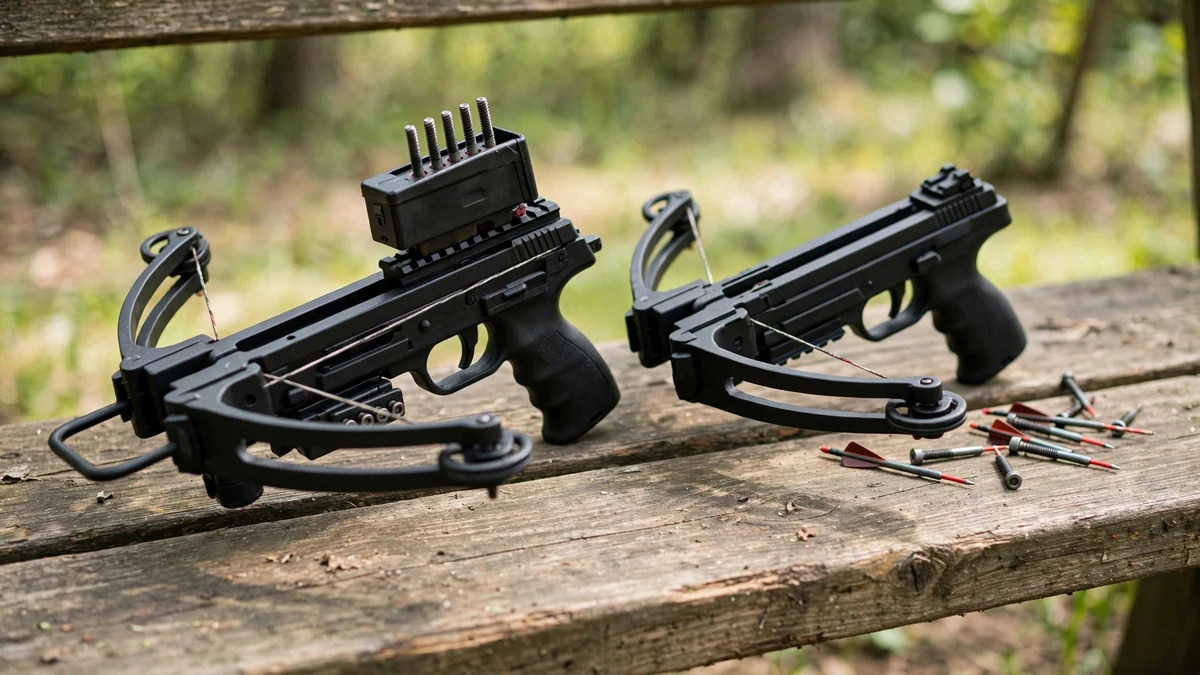
This is the real taxonomy of pistol crossbows, and it matters more than brand, just as the wider family of crossbow designs matters more than any single model. Repeaters (EK Adder, Steambow Stinger II, WT Striker, magazine Ballista BAT) hold 5 to 7 bolts for rapid shooting: the most fun, and the best choice for follow-up shots on pests or stumps. The downside is complexity. Magazines are the single most failure-prone part of any repeater, so keep yours clean, use the manufacturer’s bolts, and test reliability before you trust it beyond the range.
Single-shots (PSE Viper SS, Snake Eye Cobra, Bear Desire XL, M48 Hell Hawk) load one bolt at a time. They are simpler, cheaper, lighter, and usually more accurate at the same price, because every shot is identical and nothing can misfeed. For learning fundamentals or a kid’s first bow under supervision, single-shot is the right answer. My rule: buy a repeater for fun, a single-shot for learning. My cocking guide and sighting-in guide apply to pistols too.
Range Honesty: How Far Can You Actually Shoot?
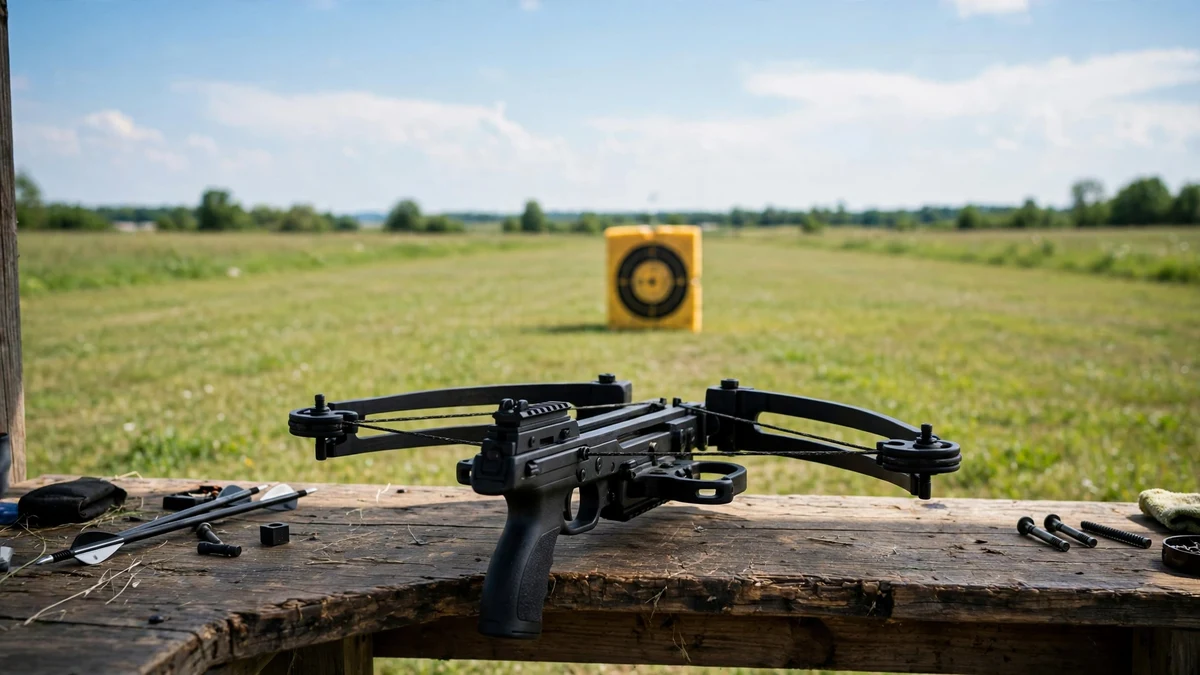
Twenty to thirty yards is the honest answer, and most of these bows are at their best inside 20. A pistol bolt is short and light, so it loses speed fast, and the short power stroke means any inconsistency in your form shows up on the target. Inside 20 yards a good pistol bow is accurate and satisfying. Past 30, groups open up and KE falls off a cliff, which is exactly why the deer conversation above is non-negotiable.
Two practical tips. First, shoot only manufacturer-spec bolts: the wrong bolt wrecks accuracy and can damage the bow. Second, sight in at 20 yards before you trust any other distance. If someone tells you their pistol crossbow is a 50-yard tool, they are selling you something.
Legality: Check Before You Buy
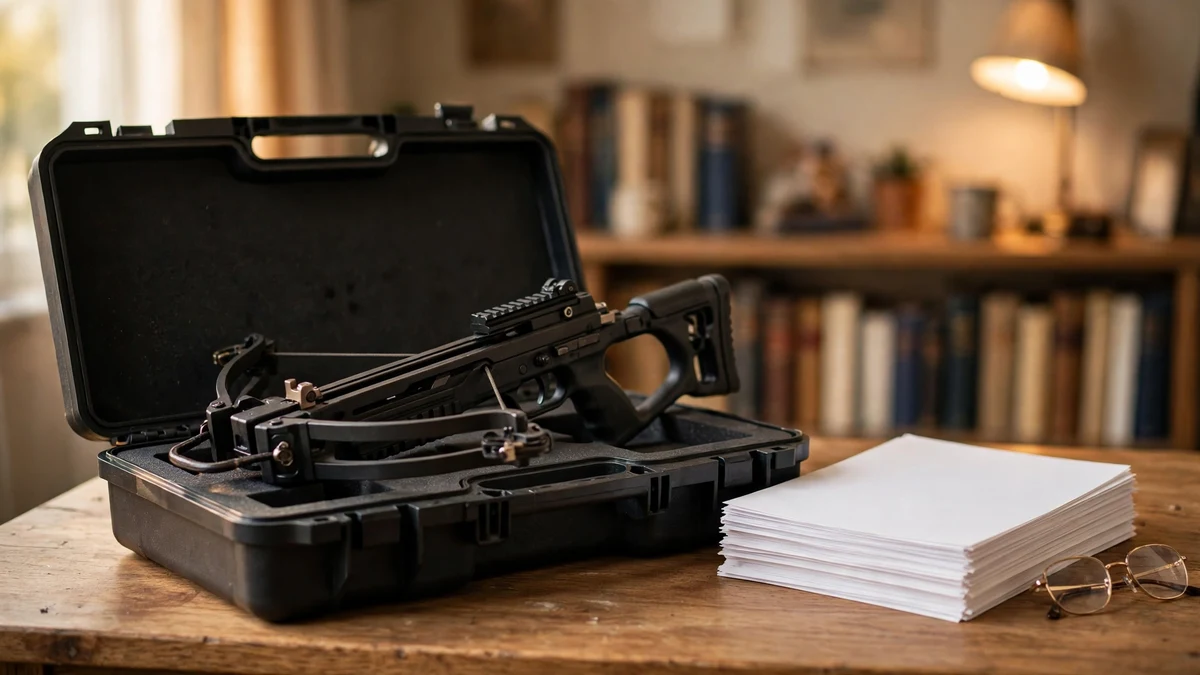
Pistol crossbows live in a legal gray zone that full-size bows do not. In most of Canada, pistol crossbows are prohibited, full stop. In the United States, rules vary state by state: several states restrict or ban them outright, others limit them during archery seasons, and some regulate how you carry one.
I am not your lawyer and this article cannot track fifty states of changing law, so here is my conservative advice: check your state and local laws before buying. Call your state’s wildlife agency or check its hunting regulations page. Ten minutes of research is the difference between a fun new hobby and a fine.
What Breaks First (Durability)
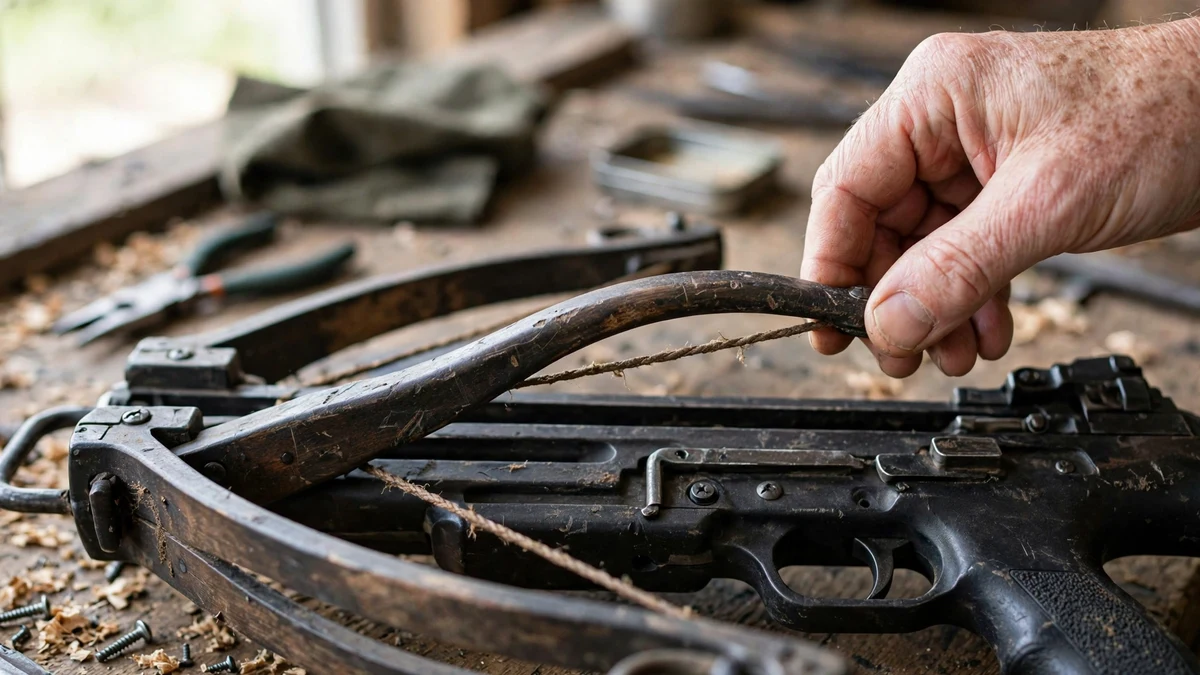
The failure pattern on pistol crossbows is consistent across brands. Here is what breaks, in order.
1. The plastic self-cocking mechanism. The number one failure mode on budget pistols. The lever, catch, and string hooks are usually plastic or plastic-assisted and wear with every cock. If cocking feels gritty or the catch does not snap crisply, stop and inspect it. A worn catch can release the string with your fingers in the wrong place.
2. Magazine feed reliability on repeaters. The Adder, Stinger, Striker, and magazine BAT depend on bolts feeding cleanly. Bent vanes, wrong-length bolts, or debris in the feed channel cause misfeeds, and a misfed bolt is a dry-fire risk. Use the maker’s bolts and keep the channel clean.
3. Strings and cables. Short power strokes cycle the string hard. Wax it regularly, watch for serving separation at the rail, and replace on schedule. My maintenance guide covers the routine.
4. Limbs on the cheapest bows. Fiberglass limbs on $70 pistols can delaminate if dry-fired or left cocked in heat. Never dry-fire, never leave the bow cocked when you are not shooting, and store it uncocked.
Every one of these failure modes is preventable with basic care. Treat a pistol bow with the same respect as a full-size one and it lasts for years.
Frequently Asked Questions
Can I hunt deer with a pistol crossbow?
No. An ethical whitetail shot requires roughly 40+ ft-lbs of kinetic energy. The Ballista BAT Rev, the most powerful pistol crossbow here, delivers around 38 ft-lbs by my estimate, and every other model lands between 8 and 26. Shooting a deer with one of these risks wounding an animal you cannot recover. For deer, buy a full-size bow from my hunting guide. Pistol crossbows are target and small-game tools.
Are pistol crossbows legal in my state?
It depends. In most of Canada they are prohibited. In the US, several states restrict or ban them. Check your state wildlife agency’s regulations before you buy, not after.
What is the effective range of a pistol crossbow?
Twenty to thirty yards at most, with most bows at their best inside 20. Short, light bolts lose speed quickly, and the short power stroke punishes inconsistent form. Past 30 yards, groups open up and energy drops off fast.
Should I get a repeating or single-shot pistol crossbow?
Repeaters (Adder, Stinger II, Striker) for fun and fast shooting. Single-shots (Viper SS, Cobra, Desire XL, Hell Hawk) for learning, simplicity, and accuracy per dollar.
What bolts do pistol crossbows use?
Short, model-specific ones: 7.5-inch carbon for the Adder, 6.5-inch aluminum for the PSE and budget pistols, 13-inch for the Ballista, 6-inch arrows for the Steambow. Always shoot the maker’s spec bolts.
Are pistol crossbows safe for beginners or kids?
They are good teaching tools under strict adult supervision, with eye protection, a safe backstop, and the safety rules followed every time. A 50-lb bow like the PSE Viper SS is the right starting point for a younger shooter. Never leave a cocked bow unattended, and never dry-fire.
Can I upgrade a pistol crossbow for more power?
Sometimes. The EK Adder accepts a 180-lb limb upgrade, and the Steambow AR-6 has 90-lb Pro limbs. Worthwhile for target shooting, but no upgrade turns a pistol crossbow into a deer bow. Buy the power you need at purchase instead of chasing it later.
Why is my pistol crossbow inaccurate?
The usual suspects, in order: shooting past 25 yards, using the wrong bolts, inconsistent cocking, a dirty magazine feed channel, and sights that were never zeroed. Fix them in that order. Sight in at 20 yards with a dot sight before you blame the bow.
The Bottom Line
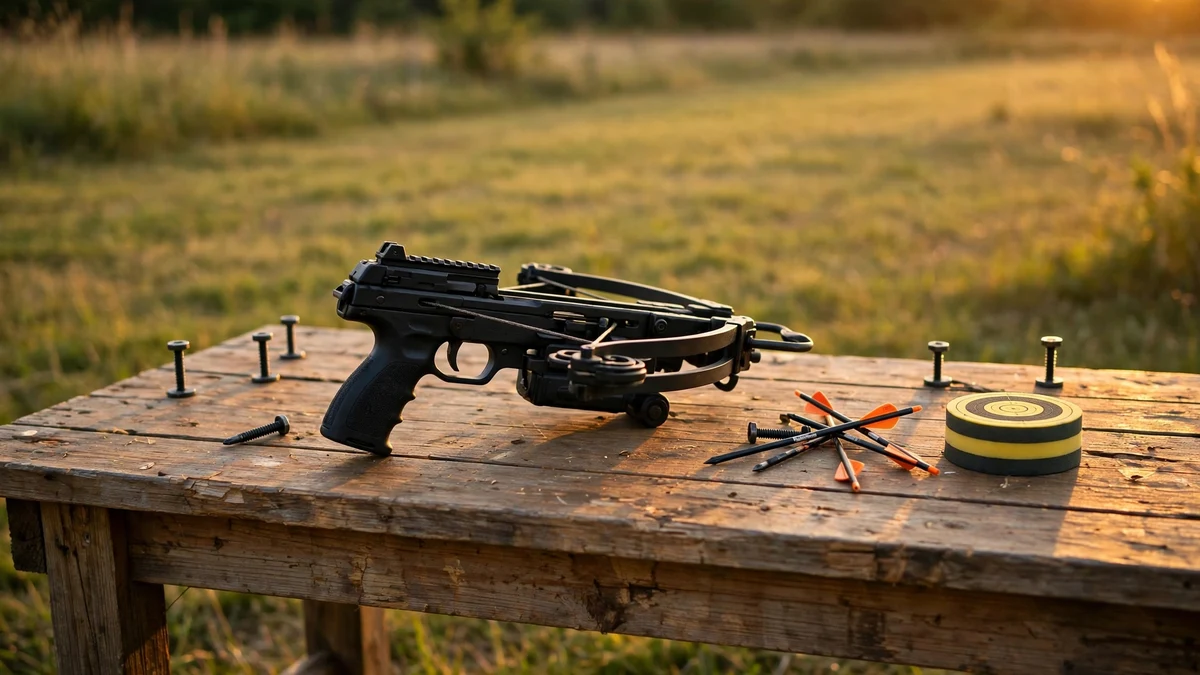
The short version: EK Cobra RX Adder for the best repeater, Ballista BAT Rev for maximum speed, Steambow AR-6 Stinger II Tactical (with the Pro limb upgrade) for semi-auto fun, WT Striker for high-power repeating on a domestic order, PSE Viper SS for accuracy on a budget, Snake Eye Tactical Cobra for the most draw weight under $75, Bear X Desire XL for quality backyard plinking, or the M48 Hell Hawk if $70 is the ceiling.
Keep them to targets and small game where legal, stay inside 30 yards, and check your local laws before you buy. For everything beyond that, the full-size best crossbows guide is where the real hunting conversation starts.
ProCrossbow is reader-supported. When you buy through links on this page, we may earn an affiliate commission at no extra cost to you. It keeps the lights on and the testing honest. Full details in our affiliate disclosure.
A red dot can speed up target acquisition in low light. See the best crossbow red dots.
Keep Learning
- How to Sight In a Crossbow in 5 Steps
- Best Hunting Crossbow 2026: 7 Picks for the Treestand and Beyond
- Crossbow Safety Guide: How to Handle Every Bow Safely
- Best Crossbow for Beginners: 5 Picks to Start Hunting Right
- Best Crossbows Under $500: 6 Picks That Actually Kill Deer
- How to Choose a Crossbow: A Beginner’s Buying Guide
- PSE Crossbow Reviews 2026: The Legacy Lineup at Clearance Prices