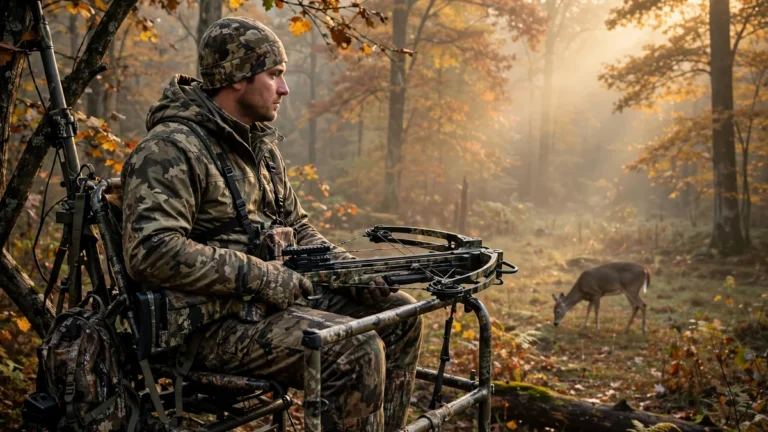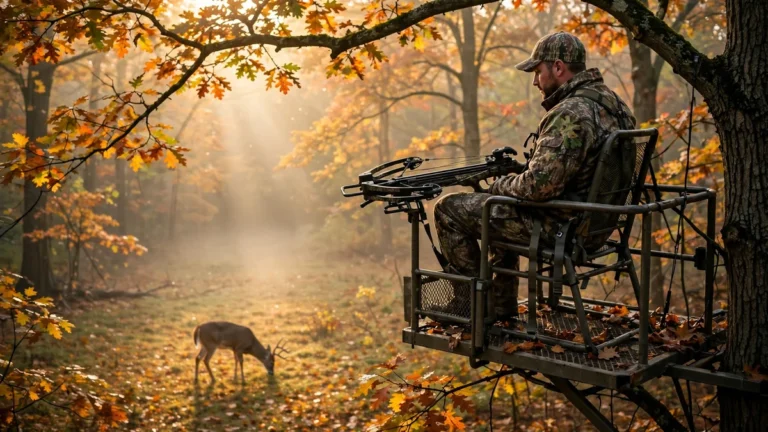
Best Crossbow for Saddle Hunting
The Short Answer
The best crossbow for saddle hunting is the Excalibur Micro MAG 340 at about $800. It is the lightest bow in this roundup at 5.5 lbs bare, it is a simple recurve with no cams to time and nothing to go wrong twenty feet up a tree, and it advertises 340 fps, which is plenty at the 20 to 40 yard shots a saddle hunt usually produces. It wins on weight, and I rank this list by bare weight first, because a saddle hunter climbs with everything on his back and holds the bow at ready while leaning out on a bridge, so every pound punishes the climb and the shot.
That win comes with a plain trade off, and I will not hide it. The Micro MAG 340 is also the widest bow here at 22 inches cocked, measured tip to tip, so it needs more tree clearance than any other pick, and it has no safe de-cocking system in the box. If width and quiet de-cocking matter more to you than weight, the Ravin R26X at about $2,000 is 26 inches long and 5.75 inches wide when cocked, and the TenPoint TX 28 at about $1,500 street is 28 inches long and 6.5 inches wide when cocked with silent cocking and safe de-cocking built in. The cheapest way into a saddle setup is the Barnett Whitetail Hunter II at about $370. For the full picture across every use case, see our full crossbow roundup, and for the shooting procedure itself, read our treestand tips guide.
One honest note before the picks. No source in my research states that any of these bows is operable one handed while tethered, so I do not claim that for any pick. I describe handling only in terms of weight, length, cocked width, and cocking system, all of which are sourced. Speeds are advertised unless a tested figure is named with its publisher and date, and weights are bare weight, the bow without accessories, unless I say otherwise. Ready to hunt weight runs about 1.5 to 2 lbs heavier once the scope, quiver, and arrows are on the bow.
Best Crossbows for Saddle Hunting: Comparison Table
| Crossbow | Price | Weight, bare | Length | Width, cocked | Speed, advertised | Cocking and de-cocking |
|---|---|---|---|---|---|---|
| Excalibur Micro MAG 340 | About $800 | 5.5 lbs (some listings 6.0 lbs) | Not settled, see note | 22 in, tip to tip | 340 fps | Rope cocker included, no safe de-cock |
| Barnett Whitetail Hunter II | About $370 | 6.4 lbs | Not verified | Not verified | 350 fps, 380 grain arrow | Rope cocker, no safe de-cock |
| Ravin R26X | About $2,000 | 6.5 lbs | 26 in | 5.75 in | 400 fps | Built-in silent cocking, 12 lb effort, de-cock with the system |
| TenPoint TX 28 | About $1,500 street | 7.2 lbs advertised, 7.84 lbs tested (Bowhunter) | 28 in | 6.5 in | 410 fps, 410 grain arrow | ACUslide MAXX, silent cocking and safe de-cocking |
| TenPoint TRX 26 | About $2,500 street | 7.3 lbs | 26.5 in | 5.75 in | 460 fps, 410 grain arrow | ACUslide MAXX, silent cocking and safe de-cocking |
| TenPoint Titan X De-Cock | About $800 | 7.3 lbs | 33 in | 9.75 in | 400 fps advertised, 400 fps tested (Outdoor Life, 2026, 410 grain arrow) | ACUdraw De-Cock, 5 lb effort, safe de-cocking |
Two notes on the table. The Micro MAG 340 width is a tip to tip measurement, not the axle to axle figure the compound bows use, so do not compare 22 inches directly against 5.75 inches without that label. Its length is also unsettled, with listings giving 31.4 inches and 34.5 inches, so I assert neither and say so in the pick. Where a cell reads not verified, it means no manufacturer or retailer figure for that exact model could be confirmed at writing time, so I left the cell honest rather than copying a figure from a different model. Bare weight is the bow without accessories. Rigged weight runs about 1.5 to 2 lbs heavier.
Best Overall for Saddle Hunting: Excalibur Micro MAG 340
Speed: 340 fps advertised | Price: About $800 | Weight, bare: 5.5 lbs, some listings 6.0 lbs | Width cocked: 22 in, tip to tip
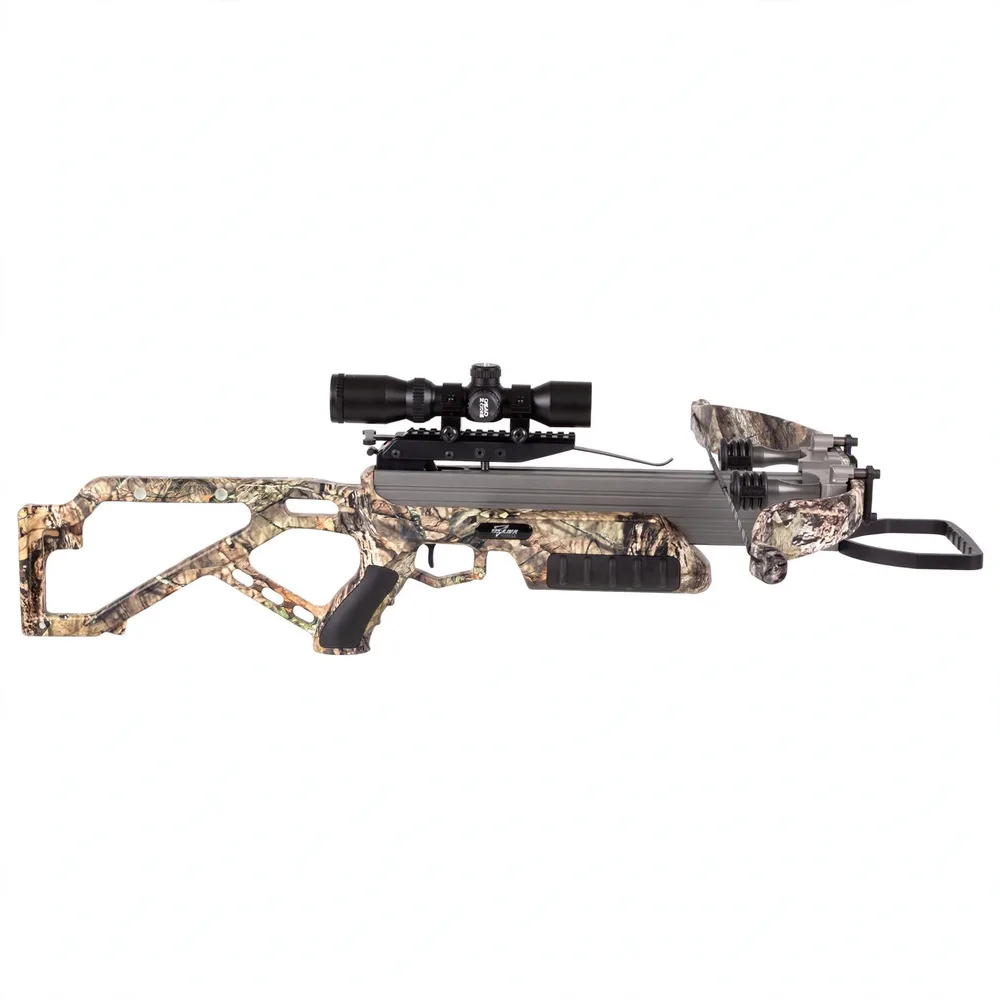
This is the lightest bow in the roundup, and in a saddle that is the first thing that matters. The Micro MAG 340 weighs 5.5 lbs bare on the manufacturer figure, and that is the figure I lead with. Some retailer listings show 6.0 lbs, so I name the conflict rather than pretending it does not exist. Either way, it is a full pound lighter than the next pick, and on a long walk in with a saddle, a platform, climbing sticks, and a pack, a pound is a pound. It is a recurve, so there are no cams to time, no cables to stretch out of sync, and very little that can go wrong at height. The package includes the Dead Zone scope, the Guardian Anti-Dry Fire system, a four arrow quiver, three Quill arrows, and a rope cocking aid. It advertises 340 fps with a 13 inch power stroke and a 270 lb draw weight, and I stress the draw weight because older listings and even the site’s own Excalibur hub have printed 135 lbs for this bow, which is wrong. The correct figure is 270 lbs. It is also not a takedown bow, whatever some roundups imply.
Now the honest part, because this bow fails the narrowness test even though it wins the weight test. At 22 inches wide when cocked, tip to tip, and 25 inches uncocked, it is by far the widest pick here, and a wide recurve needs more tree clearance than a 5.75 inch compound on every shot. Lean forward past the trunk so the limbs clear, and pick trees with clear limbs, because a limb tip kissing bark on the shot is a miss at best. The 270 lb draw also means the rope cocker is a ground job, not a tether job. A rope cocker roughly halves the draw weight, so about 135 lb of pull by arithmetic, and that is not a seated pull from a saddle. Cock on the ground before the climb. There is no safe de-cocking crank in the box, which is a real saddle drawback at dusk, when you are tired, it is getting dark, and there is nowhere safe to put the bow down. The detachable Charger EXT crank, about $85 and 12 lb of effort, fits the Micro series and is the honest answer for a hunter who wants crank cocking on this bow, but it is an accessory, not part of the package, and it is not the Charger X system found on other Excalibur bows. Two more flags. The length is unresolved, 31.4 inches in some listings and 34.5 inches in others, so I do not assert one. And the price is the weakest verification in this article: no clean current in stock US retailer price could be found at writing time, only stale $750 listings from 2024 roundups, so I carry the site verified about $800 and you should recheck the price before you buy. There is no published 50 yard group average for this bow, so I do not invent one. See our Excalibur buying guide for the rest of the lineup.
Pros
- Lightest bow here at 5.5 lbs bare on the manufacturer figure
- Simple recurve, no cams to time, very little to go wrong at height
- Dead Zone scope and Guardian Anti-Dry Fire included in the package
- 340 fps advertised is enough at normal saddle ranges of 20 to 40 yards
Cons
- Widest pick here at 22 inches cocked, tip to tip, needs the most tree clearance
- No safe de-cocking system included
- 270 lb draw weight by rope only in the box, cock on the ground before the climb
- Length unresolved and price is the weakest verification in this article
Bottom line: the best crossbow for saddle hunting if you walk the farthest and want the lightest bow and the simplest recurve, and you accept the width trade off and the lack of a safe de-cock.
Best Budget Saddle Pick: Barnett Whitetail Hunter II
Speed: 350 fps advertised, 380 grain arrow | Price: About $370 | Weight, bare: 6.4 lbs | Width cocked: Not verified
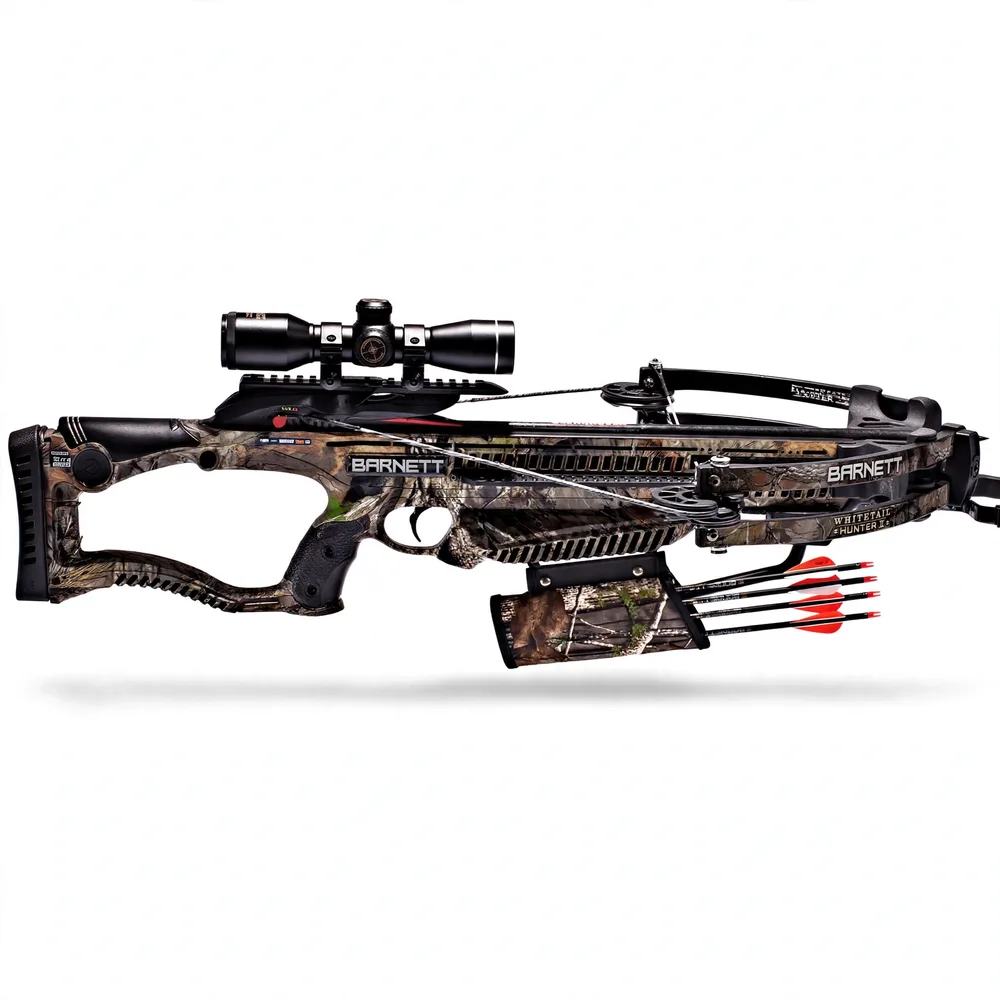
The Whitetail Hunter II is the cheapest way into a saddle setup and the lightest compound pick in this list. It weighs 6.4 lbs bare, it advertises 350 fps with a 380 grain arrow, and it costs about $370 on a fresh retailer price of $369.99 against a $399.99 MSRP. That price replaces an older figure of about $340 that no longer holds. Get the specs right, because secondary roundups get two of them wrong. The draw weight is 150 lbs, not 160 lbs and not 165 lbs, and the power stroke is 12.5 inches. The package includes a 4×32 multi-reticle scope, a rope cocking device, a lightweight side mount quiver, two 20 inch Headhunter arrows, and lube wax, with a TriggerTech trigger and anti-dry-fire protection. At 150 lbs by rope, it is the most manageable rope cocking bow in this roundup, and for a first saddle hunter on a tight budget, that matters as much as the price.
The honest limit is the end of the hunt. This bow has no safe de-cock, which is the biggest saddle drawback on this list, because de-cocking at height without a safe system is a real problem. Once it is cocked, the way down is to fire a bolt into a target or a discharge bolt, in a safe direction, with a bolt loaded. Plan every hunt end accordingly before you climb down, and cock on the ground before the climb, because it is rope cocking only. I also will not call this bow narrow. Its cocked width is unverified, and the 13.25 inch figure that shows up in some listings belongs to the Lady model, not this one, so I do not use it anywhere in this article. Its length is not in the verified set either, so I do not assert one. It is the slowest bow here at 350 fps advertised, but at saddle ranges of 20 to 40 yards that is a capable deer speed, and there is no published 50 yard group average for this bow, so I do not invent one. See our in-depth Barnett reviews for the brand’s other bows.
Pros
- Cheapest pick here at about $370, light at 6.4 lbs bare
- Lightest compound pick, easy to carry on a long walk in
- 150 lb draw weight is manageable by rope for most adults
- TriggerTech trigger and anti-dry-fire protection at this price
Cons
- No safe de-cock, you must fire a bolt to unload it
- Rope cocking only, so cock on the ground before the climb
- Cocked width unverified, so I do not call it narrow
- Slowest bow here at 350 fps advertised
Bottom line: the best budget saddle pick, and the pick for a first saddle hunter who wants the cheapest, lightest compound way into a saddle setup and will plan the end of every hunt around a shoot off unload.
Best Lightweight Premium Pick: Ravin R26X
Speed: 400 fps advertised | Price: About $2,000 | Weight, bare: 6.5 lbs | Width cocked: 5.75 in, 26 in long
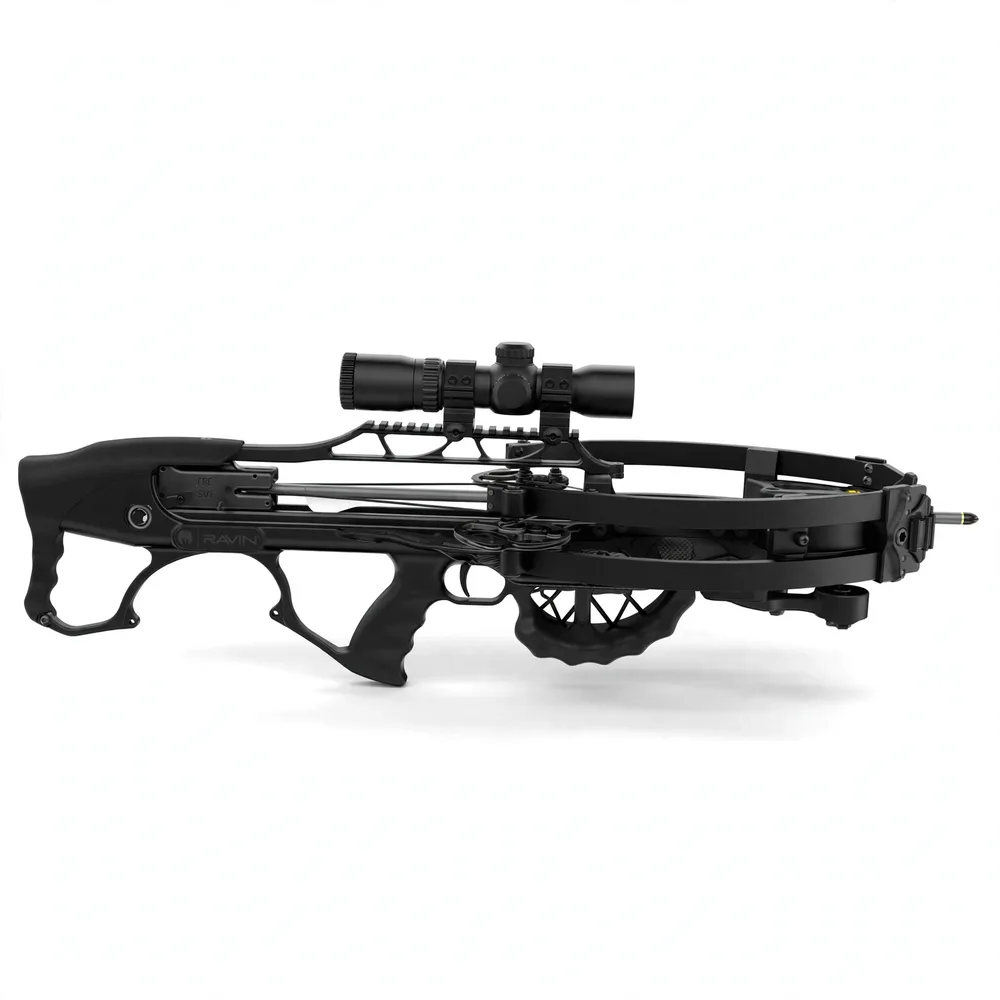
The R26X is the bow I would pick if I wanted the lightest premium bow that is also genuinely narrow and short. It is 26 inches long, 5.75 inches wide when cocked, 9.5 inches uncocked, and 6.5 lbs bare, so it clears the tree, clears the platform, and clears the pack in a way the longer and wider picks here do not. It advertises 400 fps with HeliCoil cams, a 9.5 inch power stroke, 142 ft-lb of energy advertised, and a 340 lb draw weight that you never feel, because the built-in Silent Cocking System cocks it with 12 lbs of effort. That built-in silent cocking is the saddle feature that matters most after weight and width. A crank you have to dig out of a pack and attach at height is a crank you will curse in the dark. A built-in system you can manage at height, quietly, is the difference between a calm cock and a blown setup. On price, it lists at $1,999.99 in stock at one retailer at writing time, with another listing at $2,099.99, so I headline about $2,000 and state the spread. Do not use the $1,599.99 figure that shows up in coupon listings. That is a certified reconditioned bow, not a new bow price.
The trade offs are speed, energy, and fit. At 400 fps advertised it is modest next to the TenPoint picks here, and 142 ft-lb advertised is the lowest energy in this roundup. That is still plenty at saddle ranges, but it is the honest number, and a hunter who shoots past 50 yards should know it. The short 9.5 inch power stroke and the small frame can also feel cramped for a large framed hunter, so shoulder it before you buy if you are broad across the chest. There is no published test group for the R26X that I could locate, so I do not invent one. One naming note: the Ravin cocking system naming is in conflict across sources, with Versa-Draw and VersaDrive both used for this family, so I describe the system by what it does, built-in silent cocking at 12 lbs of effort, and the manufacturer page should be checked before publish to settle the name. See every Ravin bow we tested for the brand’s other bows.
Pros
- 26 inches long and 5.75 inches wide when cocked, the shortest and narrowest premium pick here
- Built-in silent cocking at 12 lbs of effort, manageable at height
- 6.5 lbs bare, only a pound heavier than the lightest pick
- HeliCoil cams and a 5 year limited warranty
Cons
- 400 fps advertised is modest next to the TenPoint picks
- 142 ft-lb advertised is the lowest energy in this roundup
- Short frame can feel cramped for a large framed hunter
- No published test group located, so I do not quote one
Bottom line: the best lightweight premium pick, and the pick if you want a bow that is light, short, and narrow at the same time, with silent built-in cocking you can manage at height.
Best Value TenPoint: TenPoint TX 28
Speed: 410 fps advertised, 410 grain arrow | Price: About $1,500 street | Weight, bare: 7.2 lbs advertised, 7.84 lbs tested (Bowhunter) | Width cocked: 6.5 in, 28 in long
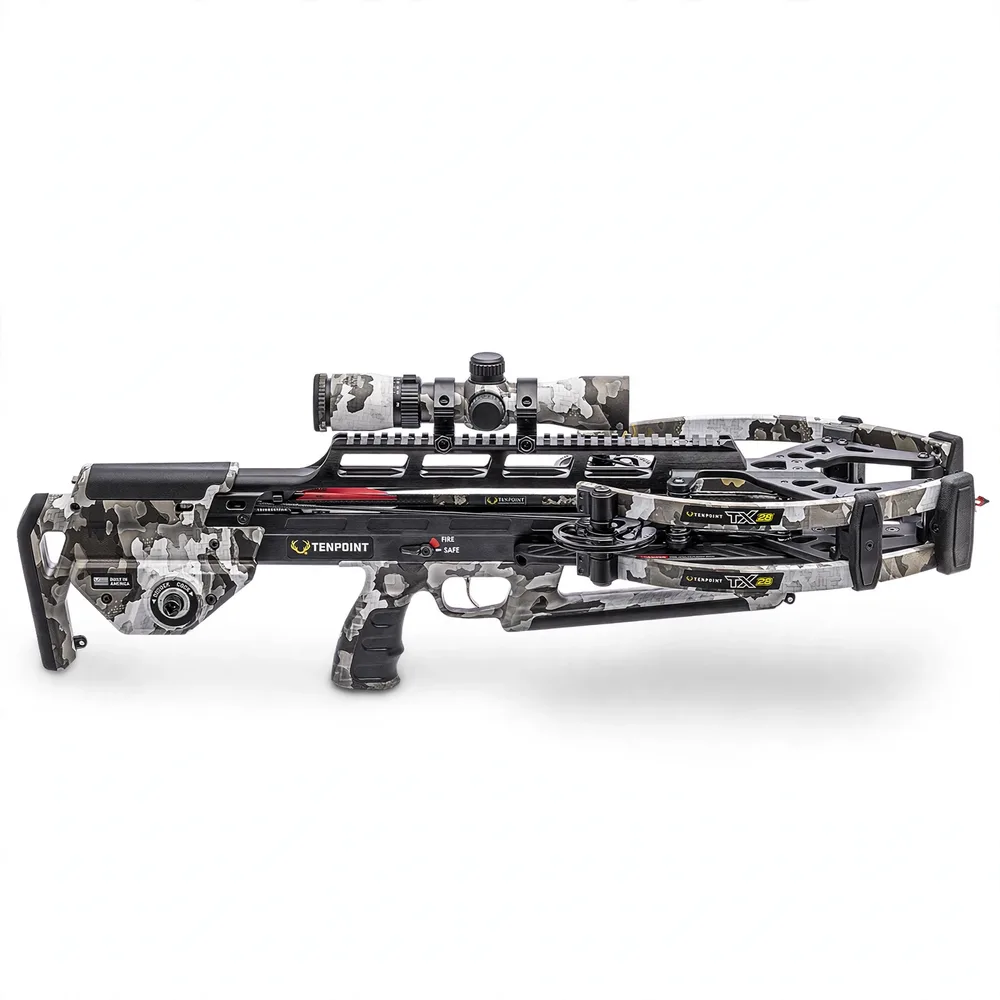
The TX 28 is the value TenPoint in this roundup, and it is the first pick here that gives you everything a saddle hunter actually wants in one package: short, narrow, quiet to cock, and safe to de-cock. It is 28 inches long, 6.5 inches wide when cocked, 11 inches uncocked, and 7.2 lbs bare on the advertised figure, with a tested weight of 7.84 lbs from Bowhunter, which is the rigged reality you should budget for. It is a forward draw bow with the ACUslide MAXX system for silent cocking and safe de-cocking, a TriggerTech trigger, Twin-Riser Technology, and a ZERO-Trac barrel. It advertises 410 fps with a 410 grain arrow, 153 ft-lb of energy advertised, a 12 inch power stroke, and a 250 lb draw weight. The crank is the point. At height, you ratchet it back quietly and you de-cock it safely at dusk, which is exactly the saddle problem the rope-only bows cannot solve. I state no pounds figure for the ACUslide MAXX effort on this bow, because no published figure exists for the TX 28 itself, and the tested 13.3 lb figure that exists belongs to a different TenPoint model and must not be transferred here.
On price, be careful, because the spread is wide and one publication lists higher MSRP figures. The street price I use is about $1,500, from a retailer listing at $1,499.97 for the Vektra Camo package in stock at writing time. Another retailer lists the Moss Green package at $1,699.99, and the site verified MSRP is $1,849.99, so I name the whole spread rather than hiding it. Do not call $1,500 the MSRP. It is a street price. The honest downside is speed. At 410 fps advertised it is modest next to the TRX 26 at 460 fps advertised, and if you shoot past 50 yards that gap shows. It is also worth rechecking availability at publish time, because the TenPoint page showed sold out at an earlier check while retailers showed stock. If safe de-cocking and a narrow frame matter more to you than flagship speed, this is the TenPoint to buy. See our in-depth TenPoint reviews for the brand’s other bows.
Pros
- ACUslide MAXX silent cocking and safe de-cocking built in
- 28 inches long and 6.5 inches wide when cocked, short and narrow
- 410 fps advertised with a 410 grain arrow, 153 ft-lb advertised
- About $1,500 street, well under flagship TenPoint money
Cons
- 410 fps advertised is modest next to the TRX 26
- Street price spread is wide, $1,499.97 to $1,699.99, with an MSRP of $1,849.99
- Tested weight of 7.84 lbs runs heavier than the 7.2 lb advertised figure
- Availability should be rechecked, the manufacturer page showed sold out at an earlier check
Bottom line: the best value TenPoint for saddle hunting, and the pick if you want a narrow, short, quiet cocking bow with safe de-cocking without paying flagship money.
Best Premium Compact: TenPoint TRX 26
Speed: 460 fps advertised, 410 grain arrow | Price: About $2,500 street, MAP about $3,000 | Weight, bare: 7.3 lbs | Width cocked: 5.75 in, 26.5 in long
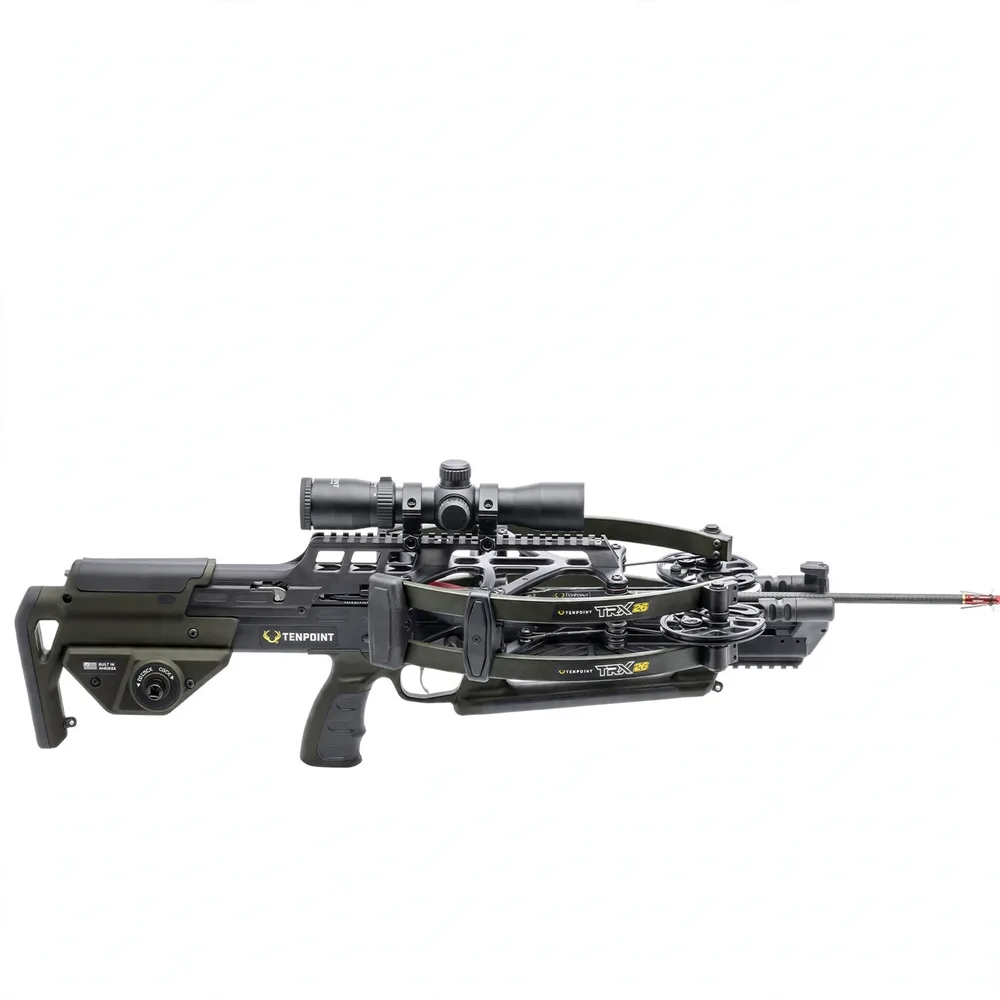
The TRX 26 is the shortest premium bow in this roundup and the fastest pick here, and it is the bow for the mobile hunter who climbs often and wants the most speed in the smallest frame. It is 26.5 inches long, 5.75 inches wide when cocked, 11 inches uncocked, and 7.3 lbs bare. It is a reverse draw bow with the ACUslide MAXX system for silent cocking and safe de-cocking, a 13.6 inch power stroke, 193 ft-lb of energy advertised, and a 300 lb draw weight. It advertises 460 fps with a 410 grain arrow, which is 50 fps ahead of the TX 28 and 60 fps ahead of the R26X, and at saddle ranges that speed buys a flatter trajectory and more energy on the shot. The reverse draw balance feels different from a forward draw bow, with more weight toward the front, so shoulder it before you buy. Do not confuse it with the TX Ultra 26.5, which is a different model, forward draw, 7 inches wide when cocked, and 410 fps advertised. They are not the same bow, and their specs must never be mixed.
On price and availability, read carefully. The headline is about $2,500 street, from a retailer listing at $2,499.99 for the Vektra Camo package with only 1 left in stock at writing time, and $2,999.99 for the Moss Green package, also only 1 left. The MAP is about $3,000, and the manufacturer page listed $3,049.99 and showed sold out at an earlier check, so availability must be rechecked at publish time and you should confirm stock before you plan a hunt around this bow. I state no pounds figure for the ACUslide MAXX effort on the TRX 26, because no pounds figure exists for this model, and no figure from another MAXX bow should be transferred to it. The 300 lb draw weight also means the crank is not optional. This is not a bow you rope cock at height, and it is not a bow you rope cock at all. The crank is the system, and the system is the reason it costs what it costs. See our TenPoint crossbow reviews for the brand’s other bows.
Pros
- Fastest pick here at 460 fps advertised with a 410 grain arrow
- 26.5 inches long and 5.75 inches wide when cocked, the shortest premium TenPoint
- ACUslide MAXX silent cocking and safe de-cocking built in
- 193 ft-lb advertised, the hardest hitting pick here
Cons
- Premium price, about $2,500 street against a MAP of about $3,000
- Manufacturer page showed sold out at an earlier check, retailer stock was down to 1 per color at writing time
- Reverse draw balance feels different from a forward draw bow
- 300 lb draw weight means the crank is not optional
Bottom line: the best premium compact for saddle hunting, and the pick if you climb often, hunt from a small platform, and want the shortest premium bow with silent de-cocking and the most speed in this list.
Best Budget TenPoint: TenPoint Titan X De-Cock
Speed: 400 fps advertised, 400 fps tested (Outdoor Life, 2026, 410 grain arrow) | Price: About $800 | Weight, bare: 7.3 lbs | Width cocked: 9.75 in, 33 in long
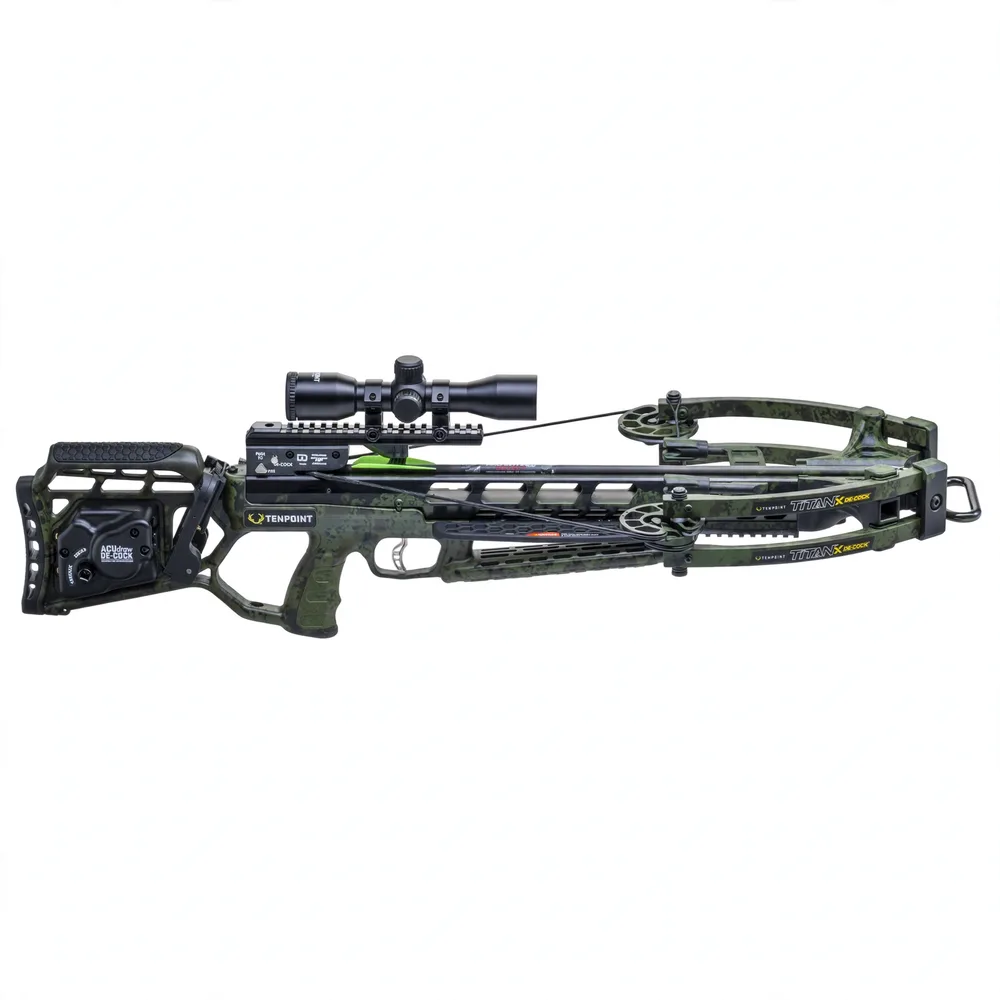
The Titan X is the weakest saddle fit on this list, and I say so plainly, because it is included for one reason only: it is the cheapest safe de-cock TenPoint you can buy. At 33 inches long and 9.75 inches wide when cocked, it is the longest and widest pick here, so it will clip the tree and crowd a small platform more than any other bow in this roundup. Do not buy it expecting a compact bow. It advertises 400 fps with a 410 grain arrow, and the Outdoor Life 2026 test measured 400 fps with a 410 grain arrow, so the advertised speed is honest. It carries 146 ft-lb of energy advertised, a 12.75 inch power stroke, and the ACUdraw De-Cock system, which cocks the bow with 5 lbs of effort and safely de-cocks it. Note the name carefully. It is ACUdraw De-Cock, not ACUslide, and the two systems are not the same. The D1 trigger is listed at 3.5 lbs and tested at 4.4 lbs by Outdoor Life in 2026, so I state both figures, labelled. On price, it lists at $799.99 for the Moss Green package with 8 left in stock at writing time, and $899.99 for Vektra Camo, against an MSRP of $849 named in a review from August 24, 2026. I headline about $800 and state the Vektra price separately.
Who is this bow actually for? A budget hunter who values safe de-cocking above compactness, and who hunts from a larger platform or a tree with clear limbs. If you hunt from a small platform, pick the TX 28 or the Whitetail Hunter II instead, because width matters more than de-cocking on a platform the size of a dinner plate. The Titan X still earns its place, because a hunter who has ever tried to unload a cocked bow at dusk with nowhere safe to put it down knows what a safe de-cock is worth, and this is the cheapest TenPoint that offers one. It is a value and de-cock choice, not a compactness choice, and the article would be dishonest if it presented it any other way. See the TenPoint collection reviewed for the brand’s other bows.
Pros
- Cheapest safe de-cock TenPoint, about $800
- ACUdraw De-Cock cocks at 5 lbs of effort and de-cocks safely
- Tested speed of 400 fps matches the advertised figure (Outdoor Life, 2026, 410 grain arrow)
- 3.5 lb listed trigger, a clean break for a budget bow
Cons
- Weakest saddle fit here, 33 inches long and 9.75 inches wide when cocked
- Will clip the tree and crowd a small platform more than any other pick
- ACUdraw De-Cock is not ACUslide, so do not expect the MAXX system
- Trigger tested at 4.4 lbs against a 3.5 lb listed figure (Outdoor Life, 2026)
Bottom line: the best budget TenPoint for saddle hunting, and the pick only if safe de-cocking matters more to you than compactness, and you hunt from a larger platform with clear limbs.
Will It Fit Your Platform?
Measure your platform before you buy the bow, not after. A saddle platform is small by design, often no bigger than a dinner plate, and a 33 inch bow needs more platform than a 26 inch bow even at the same weight, because the swing is what eats space, not the carry. The contrast pair in this list is the Titan X at 33 inches and the R26X at 26 inches. Same weight class, 7.3 lbs against 6.5 lbs, but a very different swing. On a small platform, the R26X turns inside the tree. The Titan X wants room the platform does not have. Practice the swing at home before the climb. Hang the saddle at ground level, step onto the platform, and swing the bow to your strong side and your weak side, past the trunk, with the tether and bridge in place. If the limbs or the cams touch the tree at ground level, they will touch it at twenty feet too, and you will find out at the worst possible moment.
Platform size is also a tree choice. A straight, limbless trunk with a clear shooting lane is worth more than any bow feature, and a bow that is 5.75 inches wide when cocked forgives a tree that a 22 inch recurve will not. If your spots are mostly tight, limby trees, buy narrow first and light second. If your spots are open hardwoods with clear trunks, the light recurve earns its place. Either way, the platform, the tree, and the bow are one system, and the bow is the part you can still change.
Weight vs Length vs Width: What Matters Most in a Saddle
Weight is first, because the climb is the tax every saddle hunt pays. You carry the saddle, the platform, the climbing sticks, the pack, the arrows, and the bow, all on your back, and a heavy bow punishes the climb before the hunt starts. A useful rule of thumb is under 30 inches long and under 7 lbs bare, which four of the six picks here meet on length and five meet on weight. The Micro MAG 340 at 5.5 lbs and the Whitetail Hunter II at 6.4 lbs are the only picks under 6.5 lbs, and you feel that difference on the third climb of the morning. But weight is not the whole test. A bow that is light and wide, like the Micro MAG 340, still punishes the shot, because the limbs need tree clearance. A bow that is heavy and narrow still punishes the climb, which is why the 8.0 lb and heavier bows in the wider market did not make this list at all. Length is the third leg. A long bow swings wide on a small platform, and a short bow turns inside the tree. Rank them in this order: weight first, then length plus cocked width together, then quiet cocking. That is the order this roundup uses, and it is why the lightest bow leads even though it is the widest.
Bare weight is also not carry weight, and the gap matters. The scope, the quiver, the arrows, and the cocking system add about 1.5 to 2 lbs to every bow here. The TX 28 is the honest example: 7.2 lbs bare advertised, 7.84 lbs tested by Bowhunter. Budget the rigged weight, not the advertised weight, when you judge whether a bow is light enough for your climb.
The Tether and the Bridge: Shooting Around Your Own Gear
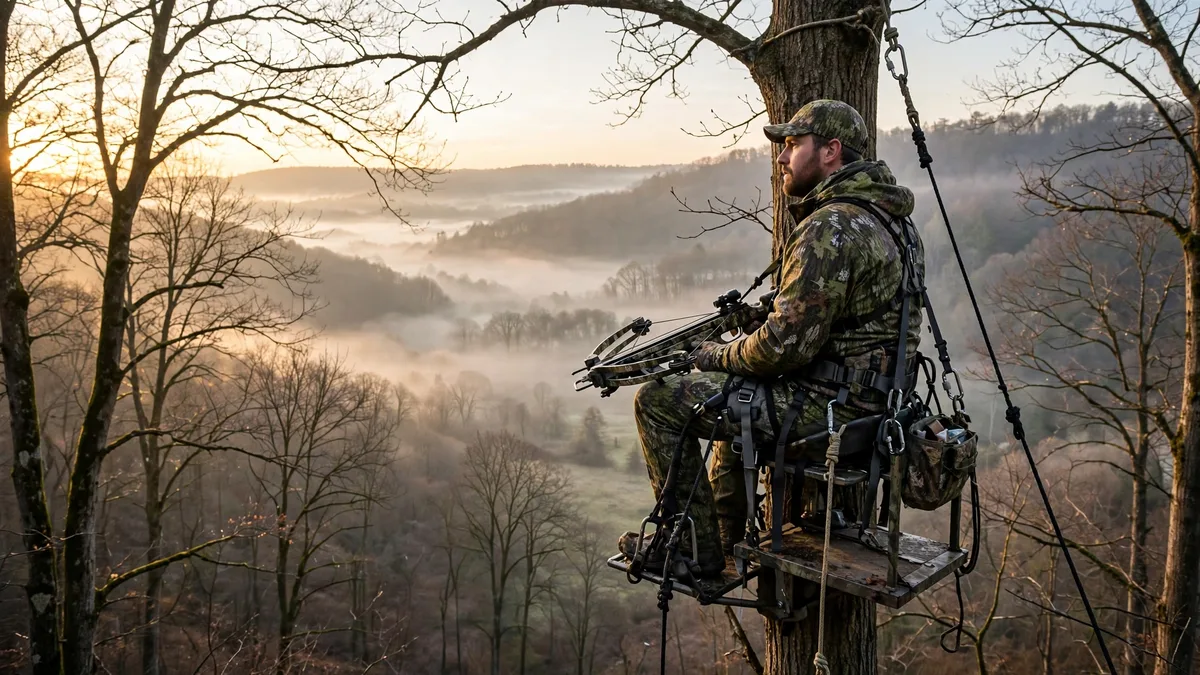
A saddle hunt is the only hunt where your own safety gear is in the way of the shot, so buy a bow that works with the tether and the bridge, not against them. Hang the bow on the strong side of the tree with the broadhead pointed up, lift it off the gear hook by the fore-end, and lean forward past the trunk so the limbs clear the tree before you settle into the shot. On strong side shots, rest your fore-end arm on the bridge of the saddle for stability, and place your strong side knee into the tree. On weak side shots, position the bow over the bridge. That is the shot sequence, and it is why cocked width matters as a buying filter, not just a spec line. A wide recurve like the Micro MAG 340 needs more tree clearance than a 5.75 inch Ravin on every one of those moves, even though it is lighter, and a 9.75 inch Titan X needs more room than a 6.5 inch TX 28. The tether can also cross the rail or the scope if you let it, so check the tether line before you raise the bow, not after. For the full shooting procedure, read our treestand tips guide, and read our safety essentials before your first climb.
Haul line discipline is part of the same system. Tow the bow up only after you are hooked to the tether, never loaded, and never aimed up at the hunter. The bow goes up on a haul line, unloaded, and it comes down the same way. A bow that is light and short is easier to haul and easier to control on the line, which is one more reason weight and length sit at the top of this ranking.
Seated Cocking: Cock on the Ground or Crank at Height
Here is the rule this article enforces: use a crank for any bow over 160 lbs of draw weight, and do not rope cock seated. A rope cocker roughly halves the draw weight, so a 270 lb bow still needs about 135 lb of pull by arithmetic, and that is a standing, braced pull, not a seated pull from a saddle with your feet on a small platform and a tether across your chest. The Micro MAG 340 at 270 lbs and the Whitetail Hunter II at 150 lbs are both rope cocking bows in the box, so both mean cocking on the ground before the climb. That is not a flaw in either bow. It is a procedure, and it works, as long as you accept it before you buy. Cock on the ground, climb with the bow cocked and on safe, and hunt. The cost is that you cannot re-cock at height if you need a second shot after a shoot off unload, and you cannot de-cock at height at all without a safe system.
The crank bows solve that problem, and they solve it quietly. The TX 28 and the TRX 26 carry the ACUslide MAXX system, which cocks silently and de-cocks safely, and the R26X carries a built-in silent cocking system at 12 lbs of effort. Those three can be managed at height, which is the single biggest practical difference in this roundup after weight. The Titan X carries the ACUdraw De-Cock system at 5 lbs of effort, which also de-cocks safely. I do not claim any of these is operable one handed while tethered, because no source in my research says so. I claim only what the systems do: quiet cocking and safe de-cocking at height, which is enough to change how a saddle hunt ends.
Pack In and Pack Out: Bare Weight Is Not Carry Weight
Bare weight is not carry weight, and a saddle hunt is the worst place to learn that. The scope, the quiver, the arrows, the saddle, the platform, the sticks, and the pack all add up, and a bow that does not fit in or on the pack is a bow that gets carried at port arms through brush for a mile. Packability is a real saddle criterion, and the benchmark in this roundup is not a pick. It is the Ravin R18, covered in the alternates section below, whose stock removes and reattaches quickly without tools, shrinking the bow from 25 inches to 18 inches so it fits in a pack. That is the standard the picks are judged against, and none of them packs down that small. What they do offer is short overall length, with the R26X at 26 inches and the TRX 26 at 26.5 inches, which ride on a pack far better than the 33 inch Titan X. For carry and haul context, see our best sling roundup. A good sling does not make a heavy bow light, but it does make a long walk bearable, and on a saddle hunt the walk is half the hunt.
Pack out is the same problem in reverse, with a deer on the ground and a cocked bow in your hands. The bows with safe de-cocking, the TX 28, the TRX 26, and the Titan X, unload quietly at the tree and pack out clean. The rope-only bows, the Micro MAG 340 and the Whitetail Hunter II, need a shot into a target or a discharge bolt before they pack out, which means carrying a target or planning the last shot. That is not a reason to reject them. It is a reason to plan for them.
Quiet Cocking Matters More Than Shot Noise
At saddle ranges of 20 to 40 yards, the deer hears the crank before the shot, so quiet cocking matters more than shot noise. A loud ratchet at height is a blown setup, and a silent crank is a second chance. That is why this roundup treats the cocking system as a buying criterion of its own, separate from speed. The TX 28 and the TRX 26 carry the ACUslide MAXX silent cocking system. The R26X carries a built-in silent cocking system. The Titan X carries the ACUdraw De-Cock crank. The Micro MAG 340 and the Whitetail Hunter II carry a rope cocker, which is silent enough on the ground but is not a height system at all. I give no decibel figures anywhere in this article, because no published decibel figure was located for any pick, and I do not invent numbers to fill the gap. Judge noise by the system: a built-in silent crank you can work at height, a detachable crank you have to fit first, or a rope you can only use on the ground.
What You Give Up vs a Treestand Setup
A saddle gives you mobility and 360 degree shooting, and it takes away the things a treestand gives you for free: a flat shooting rail, a stable seated rest, and easy gear access. A heavier, longer bow that is fine in a box blind is a liability in a saddle, because there is no rail to rest it on and no floor to set it down on. You hold the bow, or it hangs on a hook, and that is the whole system. The trade is worth it for a mobile hunter, because you can hunt any tree, move when the wind changes, and shoot in any direction, but it means the bow has to be light enough to hold at ready while leaning out on the bridge, short enough to swing on a small platform, and narrow enough to clear the tree. If you hunt mostly from a fixed stand, read our crossbow treestand tips guide, where a longer and heavier bow is a fair trade for a stable rest. And remember that a 330 to 400 fps bow is already enough at saddle ranges, which are usually 20 to 40 yards. The extra 60 fps on the TRX 26 buys flat trajectory and energy, not a different hunt.
Alternates and Near Misses
The first alternate is the Ravin R18, and it is the most obvious missing pick in a saddle roundup, so I will say plainly why it is an alternate and not a pick. It weighs 6 lbs bare, it is 25 inches long and 18 inches without the stock, it is 4.75 inches wide when uncocked, it advertises 330 fps, and it tested at 328.7 fps with Outdoor Life in August 2024, with 1.25 inch groups at 30 yards reported by American Hunter. It lists at $1,999.99 in stock at one retailer at writing time, against an MSRP of $2,024.99 to $2,049.99. Its stock removes and reattaches quickly without tools, which makes it the best packing bow in this whole conversation, and its vertical limb design is a different category from every pick here. It was not picked because its cocked width in the usual axle to axle sense is not a clean comparable figure, its vertical limb design is a different category, and its 330 fps advertised speed is the lowest in the verified set. If it were swapped in, it would replace the Titan X, not the Micro MAG 340, because the Titan X is the weakest saddle fit and the R18 is the best packing bow. Do not trust listings that show 410 fps for the R18. That figure is wrong. The advertised speed is 330 fps.
The second alternate is the TenPoint TX Ultra 26.5, a forward draw bow at 26.5 inches long, 7 inches wide when cocked, 7.7 lbs bare, advertising 410 fps, with a MAP of $1,999.99 to $2,099.99 and a street price of $1,949.99 at one retailer. It was named for saddle hunting in a 2026 new models roundup, and it is a good bow, but at 7 inches cocked it is wider than the narrower picks here and at 7.7 lbs it is heavier than the top four picks, so it sits just outside the list. Do not confuse it with the TRX 26. It is a different model, forward draw, and it must never inherit TRX 26 specs.
The budget alternate is the CenterPoint Sniper G4D at about $480, advertising 400 fps, with tested speeds of 404.5 fps from one 2026 test and 397 fps from another, at 8.0 lbs bare, 6.75 inches wide when cocked, and 27.8 inches long. It is short and narrow and cheap, and it has a verified safe de-cocking crank, but at 8.0 lbs bare it fails the weight first ranking, so it is an alternate here, not a pick. Two near misses were cut on weight alone. The Ravin R10X Pro is 7.95 lbs bare and 32.5 inches long at about $1,850, and the Ravin R470 is 8.4 lbs bare, the heaviest candidate. Both are narrow, at 6.5 inches and 4.3 inches cocked, but weight beat width in this ranking, and that is the decision. The Ravin R500 was not considered at all. It is 8.4 lbs on retailer listings only, and it carries the March 2024 recall of about 13,300 units in the US plus about 425 in Canada, serials R050 to R057, with a free repair available.
Which Pick for Which Hunter
Buy the Micro MAG 340 if you walk the farthest and want the lightest bow and the simplest recurve, and you accept the width trade off and the lack of a safe de-cock. Buy the Whitetail Hunter II if you are a first saddle hunter on a tight budget and you want the cheapest, lightest compound way in, and you will plan every hunt end around a shoot off unload. Buy the R26X if you want the lightest premium bow that is also genuinely narrow and short, with silent built-in cocking you can manage at height. Buy the TX 28 if you want a narrow, short, quiet cocking TenPoint with safe de-cocking, without paying flagship money. Buy the TRX 26 if you climb often and want the shortest premium bow with silent de-cocking and the most speed in this list, and you will confirm stock before you plan a hunt around it. Buy the Titan X only if safe de-cocking matters more to you than compactness and you hunt from a larger platform with clear limbs. If you want the best packing bow of all, look at the R18 alternate, and if you want the full picture across every price band, see our best crossbows roundup.
Frequently Asked Questions
What is the best crossbow for saddle hunting?
The Excalibur Micro MAG 340 at about $800. It is the lightest bow in this roundup at 5.5 lbs bare on the manufacturer figure, it is a simple recurve with no cams to time, and it advertises 340 fps, which is plenty at saddle ranges of 20 to 40 yards. Its trade off is width: at 22 inches cocked, tip to tip, it is the widest pick here and needs the most tree clearance, and it has no safe de-cocking system in the box.
How light should a saddle hunting crossbow be?
A useful rule of thumb is under 30 inches long and under 7 lbs bare. Four of the six picks here meet the length rule and five meet the weight rule. The lightest is the Micro MAG 340 at 5.5 lbs bare, followed by the Whitetail Hunter II at 6.4 lbs and the R26X at 6.5 lbs. Remember that bare weight is not carry weight: the scope, quiver, and arrows add about 1.5 to 2 lbs, so judge a bow on its rigged weight, not just its advertised weight.
Can I cock a crossbow while sitting in a saddle?
It depends on the cocking system. Use a crank for any bow over 160 lbs of draw weight, and do not rope cock seated. The TX 28, the TRX 26, and the R26X carry built-in silent cocking systems that can be managed at height. The Micro MAG 340 and the Whitetail Hunter II are rope cocking bows in the box, so they mean cocking on the ground before the climb. No source in my research states that any pick is operable one handed while tethered, so I do not claim that for any bow.
Can I de-cock a crossbow in a saddle?
Yes, if the bow has a safe de-cocking system. The TX 28 and the TRX 26 have ACUslide MAXX safe de-cocking, and the Titan X has ACUdraw De-Cock, so all three unload safely at height. The Micro MAG 340 and the Whitetail Hunter II have no safe de-cock, so you unload them by firing a bolt into a target or a discharge bolt, in a safe direction, with a bolt loaded. The R26X de-cocks with its built-in system. Plan the end of every hunt around the system your bow actually has.
Is the Micro MAG 340 too wide for saddle hunting?
It is the widest pick here, at 22 inches cocked measured tip to tip, and 25 inches uncocked, so it needs the most tree clearance of any bow in this roundup. It is not too wide for saddle hunting in open hardwoods with clear trunks, but it is the wrong pick for tight, limby trees. Lean forward past the trunk so the limbs clear, pick trees with clear limbs, and practice the swing at ground level before the climb. If your trees are tight, buy the R26X or the TRX 26 at 5.75 inches cocked instead.
What is the best budget crossbow for saddle hunting?
The Barnett Whitetail Hunter II at about $370, on a fresh retailer price of $369.99 against a $399.99 MSRP. It weighs 6.4 lbs bare, it advertises 350 fps with a 380 grain arrow, and its 150 lb draw weight is manageable by rope for most adults. Its limit is the lack of a safe de-cock, so you must fire a bolt to unload it. If safe de-cocking matters more than price, the cheapest safe de-cock bow here is the TenPoint Titan X at about $800.
Is the Ravin R18 a good saddle hunting crossbow?
Yes, and it is the first alternate in this roundup. It weighs 6 lbs bare, it is 25 inches long and 18 inches without the stock, it advertises 330 fps, and it tested at 328.7 fps with Outdoor Life in August 2024. Its stock removes without tools, so it packs smaller than any pick here. It was not picked because its cocked width is not a clean comparable figure, its vertical limb design is a different category, and 330 fps advertised is the lowest speed in the verified set. If it were swapped in, it would replace the Titan X, not the Micro MAG 340. Do not trust listings that show 410 fps for the R18. The advertised speed is 330 fps.
Do I need 400 fps for saddle hunting?
No. Saddle shots are usually 20 to 40 yards, and a 330 to 400 fps bow is already enough at those ranges. The Micro MAG 340 advertises 340 fps and the Whitetail Hunter II advertises 350 fps, and both are capable deer bows inside 40 yards. The extra speed on the TRX 26 at 460 fps advertised buys a flatter trajectory and more energy, which matters past 50 yards, but it does not change whether a well placed shot at normal saddle range works. Accuracy, a clean trigger, and knowing your range matter more than the speed number.
What size platform do I need for a crossbow in a saddle?
There is no single size, because the bow decides it as much as your boots do. Measure your platform, then practice the swing at home at ground level with the tether and bridge in place. A 26 inch bow like the R26X turns inside the tree on a small platform. A 33 inch bow like the Titan X needs more platform and more tree clearance for the same swing. If the limbs or cams touch the tree at ground level, they will touch it at twenty feet too, so sort it out before the climb.
Keep reading: our treestand tips guide covers shooting from a stand, our safety checklist for hunters covers haul lines and tether discipline, and our hunting sling roundup covers the carry. For the full price ladder, see our top-rated crossbow roundup.
Keep Learning
- Best Crossbow for Ground Blind Hunting
- Best Crossbow for Coyote Hunting
- Best Crossbow for Moose Hunting
- Best Crossbow for Turkey Hunting 2026: 6 Picks for the Blind and the Field
- Crossbow Treestand Tips: Width, Haul Lines & Shot Angles
- Best Crossbows Under $1000 in 2026: 9 Picks Across 3 Price Tiers