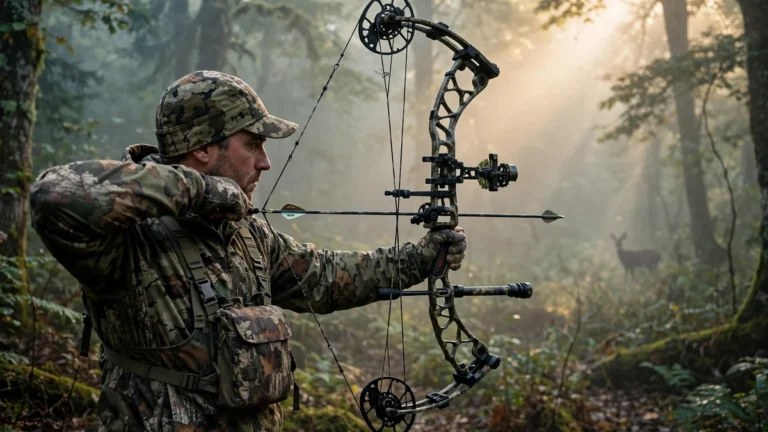
Crossbow vs Longbow: Which One Should You Hunt With?
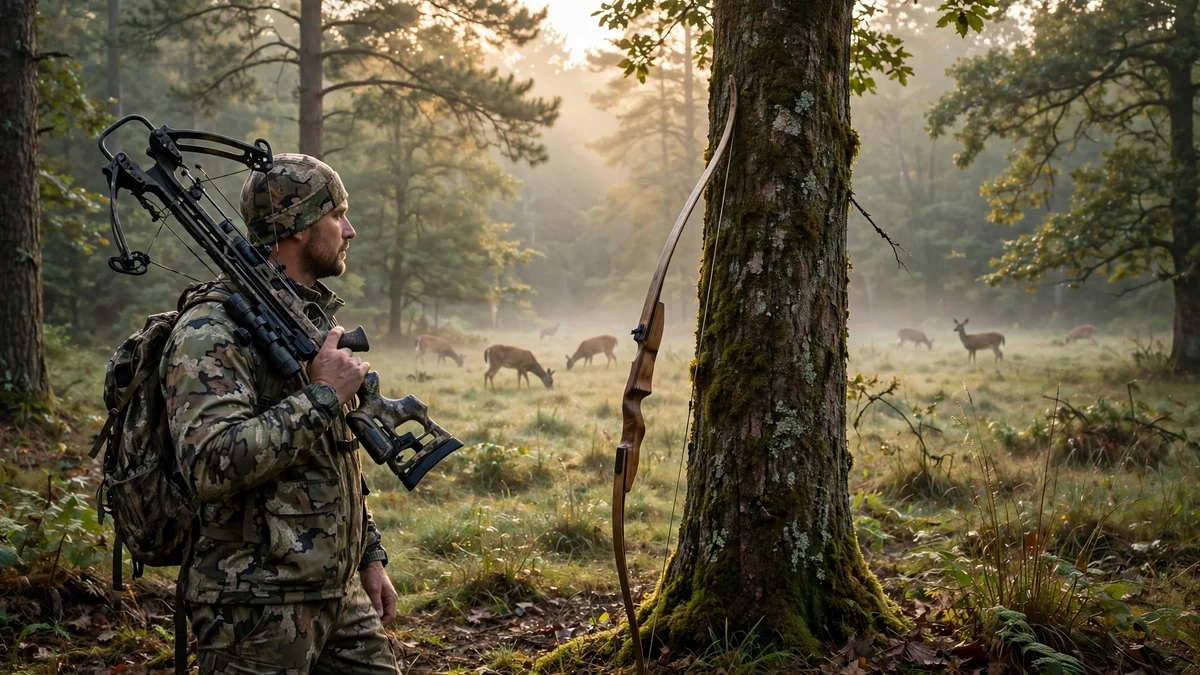
Crossbow vs Longbow: Which One Should You Hunt With?
I have hunted with a crossbow for years, and I have spent enough range days with a longbow to know exactly what it asks of you. The two weapons look like they belong to different centuries, and in a way they do, but the question most hunters ask is a modern one: which one puts meat in the freezer this season, and which one is worth the long road to learn? The honest answer is that a crossbow is the better hunting tool for most hunters, because it is faster, far more powerful, scoped, and it can be held cocked and ready while you wait. A longbow is the better choice for a hunter who loves the craft itself, hunts close, and is willing to spend months earning the shot. This comparison gives you the numbers with the bolt and arrow weights stated every time, separates maximum flight from accurate target range from ethical hunting range, covers legality and real starter kit costs, and ends with a verdict by use case, not a tie.
The Short Answer
For most hunters, pick the crossbow. A hunting crossbow shoots 350 to 500 fps with 100 to 220 ft-lb of kinetic energy, depending on the model and the bolt weight, and it can be held cocked on a trigger with no holding weight while you aim through a scope. A hunting longbow shoots about 150 to 200 fps with about 30 to 40 ft-lb of kinetic energy from a 500 to 600 grain arrow, and you must draw and hold the full 40 to 60 lb yourself, with no let off and no sight. That gap in speed and energy is why the crossbow gives you a 40 yard ethical range for most hunters, while the longbow gives you 15 to 25 yards.
Pick the longbow if the bow itself is the point. It is light, near silent, simple enough that a spare string is the whole field repair kit, and legal wherever archery hunting is allowed, subject to a minimum draw weight in the states that set one. It also asks for 3 to 6 months of regular practice to reach basic proficiency, and 6 to 12 months to reach reliable hunting accuracy. A complete beginner should not plan a first season hunt with a longbow.
One warning belongs at the top, before any number below. Neither weapon makes you ethical at a distance you have not practiced. Your ethical range is the distance at which you can put every practice shot into a 6 inch vital circle from a hunting stance, under pressure, with the broadhead you will hunt with. If you cannot do that at 40 yards with a crossbow or at 20 yards with a longbow, your range is shorter, whatever the spec sheet says. If you are still choosing a crossbow, start with our tested picks for every budget guide, and if you are new to the weapon, read the easy-to-learn starter picks guide before you spend anything.
Crossbow vs Longbow at a Glance
Every speed and energy figure in this table states its bolt or arrow weight. A bare fps or ft-lb number means nothing without it, because a lighter arrow goes faster and a heavier arrow keeps more energy. Crossbow figures are labelled advertised or tested. Longbow figures are a typical range for a 40 to 60 lb hunting bow, not a tested figure for one named bow.
| Feature | Crossbow | Longbow |
|---|---|---|
| How it works | Short prod mounted horizontally on a stock, drawn with a rope or crank, locked on a trigger, aimed with a scope | Tall single bow, about as tall as the archer, drawn by hand, held at full draw by the archer, aimed by instinct and form, no sight |
| Typical length | 26 to 32.5 in for the site verified models, for example the Ravin R500 at 28 in and the Ravin R10X Pro at 32.5 in | 60 to 68 in, for example the Bear Montana at 64 in |
| Weight | About 7 to 8 lb bare for most hunting models, for example the TenPoint Titan X at 7.3 lb and the Ravin R10X Pro at 7.95 lb bare | Light to carry, commonly described as about 1 to 2 lb, though no named model spec sheet was checked for a bare weight figure, so treat that as a typical figure, not a verified spec |
| Draw weight, peak | 150 to 400 plus lb, for example the Barnett Whitetail Hunter II at 150 lb and the Barnett Boss 405 at 220 lb | 40 to 60 lb for most hunting longbows |
| Holding weight at full draw | Nothing, the trigger holds the draw while you aim | The full peak weight, for example about 50 lb on a 50 lb longbow, with no let off |
| Power stroke | About 11 to 14 in on most hunting models | About 22 in at a 28 in draw length |
| Speed | 350 to 500 fps, with bolt weight stated, for example the Whitetail Hunter II at 350 fps advertised and the Ravin R500 at 500 fps advertised with a 400 grain bolt | About 150 to 200 fps, with arrow weight stated, for example about 170 fps with a 600 grain arrow |
| Kinetic energy | 100 to 220 ft-lb, with bolt weight stated, for example 149 ft-lb for a 400 grain bolt at 410 fps, and about 222 ft-lb for a 400 grain bolt at 500 fps | About 30 to 40 ft-lb, with arrow weight stated, for example 38.5 ft-lb for a 600 grain arrow at 170 fps, and 34 ft-lb for a 500 grain arrow at 175 fps |
| Ethical hunting range | 40 yards or less for most hunters, most shots at 20 to 40 yards | 15 to 25 yards for most hunters, most traditional hunters self limit to 20 to 25 yards |
| Accurate target range | About 50 to 60 yards for a practiced shooter, up to 80 or 100 yards for an expert on a target, not a hunting claim | Target accuracy is a different skill from hunting accuracy, and no single verified hunting accuracy figure exists beyond the ethical range above |
| Maximum flight | Roughly 300 to 500 yards for a bolt fired at an elevated angle, not aimed at game | Several hundred yards for an arrow fired at an elevated angle, not aimed at game |
| Learning time to hunt ready | Days to a few range sessions | 3 to 6 months for basic proficiency, 6 to 12 months for reliable hunting accuracy, years to master |
| Noise | Markedly louder, reported figures range from 79 dB to 120 dB across sources, with no standard measurement method, so treat the range as reported, not measured fact | Near silent, reported at 68 to 75 dB from a single source, so treat that as a reported range, not a measured fact |
| Reload and second shot | Slow to reload, the first shot is the one that decides the hunt | Faster second shot, though the arrow is slower in flight |
| Maintenance | More to maintain and more to fail: string and cables, rail lube, screws and scope mounts, trigger and safety checks, usually a bow press or a shop for a string change | Radically simple: spare string, string wax, unstring for storage, no cams, no cables, no trigger, no scope, no bow press needed |
| Entry cost, bow only | About $300 to $400, for example the Boss 405 at about $330 and the Whitetail Hunter II at about $370 | About $150 to $300 for a mid range longbow, though a quality longbow can cost more than an entry crossbow, for example the Bear Montana at $519.99 |
| Legality in archery season | Varies by state: full inclusion in many eastern and Plains states, restricted to disability permits or firearms season in several western states | Legal wherever archery hunting is allowed, subject to a minimum draw weight of 30 to 40 lb in the states that set one |
The kinetic energy formula used for every worked example in this article is KE in ft-lb equals arrow weight in grains times velocity in fps squared, divided by 450240. Always state the arrow or bolt weight with the result. A crossbow that advertises 500 fps with a 400 grain bolt makes about 222 ft-lb, while the same bow with a heavier bolt would be slower and would make a different energy figure. A longbow that shoots a 600 grain arrow at 170 fps makes 38.5 ft-lb, while the same bow with a 400 grain arrow would be faster, at about 192 fps, and would still make only about 33 ft-lb. Speed rises with a lighter arrow, but energy stays near the mid 30s for a longbow. That is the honest energy story, and it is why the longbow needs a heavy arrow and close range to do its work.
How Each Weapon Actually Works
The longbow: one stick, one string, your strength
A longbow is a tall, simple bow, about as tall as the archer, with a D shape when drawn. There is no let off, no trigger, no mechanical lock, no sight, and no scope. Peak draw weight and holding weight are the same number, so a 50 lb longbow asks you to hold about 50 lb at anchor with your fingers, for as long as you hold the shot. A typical hunting longbow is 60 to 68 in long, with a power stroke of about 22 in at a 28 in draw length. That long stroke is the longbow’s secret: it does a lot of work over a long distance, so it needs only 40 to 60 lb of draw weight to make about 30 to 40 ft-lb of energy. The cost is that your body does all of it, every shot, and your form is the sight. If your form breaks down when you are tired, cold, or excited, the arrow goes where your form sends it, not where you meant it to go.
The crossbow: a short prod on a stock, locked on a trigger
A crossbow mounts a short, stiff prod horizontally on a stock, draws with a rope cocker or a crank, and locks the string on a trigger so you hold no draw weight while aiming. You aim through a scope, the way you would aim a rifle, and you can wait cocked and ready for as long as the deer takes to step into your lane. Its power stroke is short, about 11 to 14 in on most hunting models, and 9.5 to 12.5 in on the site verified Ravin models. That short stroke is why a crossbow needs 150 to 400 plus lb of draw weight to match or beat the energy of a 40 to 60 lb longbow. It is also why a crossbow is louder and heavier, and why it can be held cocked and aimed like a rifle. The trade is simple: the machine does the holding, and you do the aiming. If you want the full mechanics, read our how a crossbow stacks up against a compound bow comparison, which covers the three bow types side by side.
Why the power stroke explains the power gap
Power stroke is the distance the string pushes the bolt or arrow, from rest to full draw. A longbow pushes its arrow for about 22 in. A crossbow pushes its bolt for about 11 to 14 in. To do the same work in half the distance, the crossbow needs far more force, which is why its draw weight is measured in the hundreds of pounds while the longbow’s is measured in the tens. That one idea explains most of the differences in this article: the crossbow’s noise, its weight, its energy, and its need for a cocking device all follow from a short stroke with a heavy draw. The longbow’s silence, its light weight, and its low energy all follow from a long stroke with a light draw. Neither design is wrong. They solve the same problem in opposite ways, and the right choice depends on which set of trade offs you want to live with in the woods.
Speed and Power: The Numbers That Matter
Speed alone misleads, so here are worked examples with the arrow weight stated every time. A 400 grain bolt at 350 fps makes 108.7 ft-lb, which is the entry level crossbow figure, for example the Whitetail Hunter II at 350 fps advertised. A 400 grain bolt at 400 fps makes 142 ft-lb, which is the mid range figure, for example the Titan X, tested at 400 fps with a 410 grain bolt, which makes about 145.5 ft-lb. A 400 grain bolt at 410 fps makes 149.2 ft-lb. A 400 grain bolt at 500 fps makes about 221.8 ft-lb, which is the top of the range, for example the Ravin R500 at 500 fps advertised with a 400 grain bolt. Do not quote a single flagship energy figure as typical for crossbows. Use the range, 100 to 220 ft-lb, and label advertised against tested.
The longbow numbers are smaller, and they need the same honesty. A 600 grain arrow at 170 fps makes 38.5 ft-lb. A 500 grain arrow at 175 fps makes 34 ft-lb. A 400 grain arrow at about 192 fps makes about 33 ft-lb. The usable range for a 40 to 60 lb hunting longbow with a 500 to 600 grain arrow is about 150 to 200 fps and about 30 to 40 ft-lb. One outlier source puts longbow speed at 300 to 340 fps, which is far above every other source and is almost certainly a compound bow figure copied in error. I do not use it anywhere in this article. Do not plan a hunt around it.
What do those energy numbers mean for game? The widely cited Archery Trade Association guidance, as reported in published summaries and not checked against the original ATA source, puts small game at up to 25 ft-lb, medium game such as whitetail deer at 25 to 41 ft-lb, large game such as elk at 42 to 65 ft-lb, and the toughest game at 66 ft-lb and above. Label those bands as reported ATA bands, because the original ATA source was not checked for this article. On those reported bands, a hunting longbow at 33 to 40 ft-lb sits inside the whitetail band and below the elk band. A hunting crossbow at 100 ft-lb and above clears the deer band by a wide margin and clears the elk band at the muzzle. That is the honest energy story: a longbow is enough for deer at close range with a heavy arrow and good placement, and it is marginal or insufficient for elk at the same setup. A crossbow is not marginal for either at normal hunting ranges. Do not claim a longbow is more powerful than a crossbow. It is not, in energy terms. What a longbow offers instead is silence, light weight, and simplicity, which are real advantages, just not power advantages.
Momentum and penetration matter too, especially for a longbow. A heavy arrow keeps its energy better downrange than a light arrow, and it drives deeper through muscle and bone. That is why traditional hunters shoot heavy arrows, 500 to 600 grains, even though a lighter arrow would be faster on the chronograph. A crossbow hunter gets the same lesson in reverse: a heavier bolt costs a little speed and keeps more energy at 40 yards, which is where the shot actually happens. Pick your bolt or arrow weight for the shot you will take, not for the number on the box.
Named crossbow examples, with advertised against tested labels, show how the range works in practice. The Boss 405 costs about $330, shoots 405 fps advertised, and draws 220 lb. The Whitetail Hunter II costs about $370, shoots 350 fps advertised, and draws 150 lb. The Titan X costs about $800, tested at 400 fps with a 410 grain bolt, weighs 7.3 lb, and its trigger is listed at 3.5 lb against a tested 4.4 lb, so I label both. The Barnett T-Rex costs about $1,200, shoots 440 fps advertised, and weighs 8.2 lb bare (9.2 lb as tested). The Ravin R10X Pro costs about $1,850, shoots 420 fps advertised, weighs 7.95 lb bare, and measures 6.5 in wide when cocked. The TenPoint TX Ultra costs about $2,300 as a Pyramyd sale price, not the manufacturer list price, shoots 460 fps advertised, and its ACUslide MAXX cocking effort tested at 13.3 lb. The Ravin R500 costs about $2,650, shoots 500 fps advertised with a 400 grain bolt, and measures 3.6 in wide when cocked. Note: Ravin recalled the R500 in March 2024 (about 13,300 in the US plus 425 in Canada, serials R050-R057); Ravin offers a free repair, 888-769-7287. The TenPoint TRX Ultra costs about $3,500 and shoots 515 fps advertised. That last figure is the top of the advertised range, not a typical crossbow speed, and I do not present it as one.
Effective Range: Maximum Flight Is Not Hunting Range
Most of the bad advice about these two weapons comes from blurring three different numbers. This section keeps them apart, for both weapons, in one place.
| Range type | Crossbow | Longbow |
|---|---|---|
| Maximum flight | Roughly 300 to 500 yards for a bolt fired at an elevated angle, not aimed at game | Several hundred yards for an arrow fired at an elevated angle, not aimed at game, about 383 yards for a modern target archer at 350 metres |
| Accurate target range | About 50 to 60 yards for a practiced shooter, up to 80 or 100 yards for an expert on a target, not a hunting claim | Skilled archers group at longer target distances, but target accuracy and hunting accuracy are different things, and no single verified hunting accuracy figure exists |
| Ethical hunting range | 40 yards or less for most hunters, most shots at 20 to 40 yards | 15 to 25 yards for most hunters, most traditional hunters self limit to 20 to 25 yards, beginners should start closer |
Maximum flight
Maximum flight is how far a bolt or arrow travels when fired at an elevated angle, with no target in mind. A crossbow bolt travels roughly 300 to 500 yards before it lands. A longbow arrow travels several hundred yards at an elevated angle, and modern target archers reach about 350 metres, about 383 yards. Neither number is a hunting number, and neither one tells you how far you should shoot at a deer. The old live article on this site said a crossbow shoots up to 600 feet, which is 200 yards, presented without context. That understates maximum bolt travel and reads as if 200 yards were a shooting distance, which it is not for hunting. The same article said a longbow can fly 400 yards and shoot 200 yards accurately. The 400 yard figure is in the ballpark for maximum flight of a heavy warbow at an elevated angle, but the 200 yard accuracy claim is wrong as a hunting claim, and both numbers are gone from this rewrite. If you see a 250 yard longbow accuracy claim anywhere else, it is a target or volley claim dressed up as a hunting claim. Correct it the same way: ask whether the number is maximum flight, target accuracy, or ethical hunting range, and do not let one stand in for another.
Accurate target range
Accurate target range is what a practiced shooter can do at a known distance, from a rest or a stable stance, at a target that does not move. A crossbow shooter can group at 50 to 60 yards, and an expert can stretch to 80 or 100 yards on a target. A longbow archer can group at longer target distances too, with enough practice, but that skill does not transfer to hunting at the same distance, because a deer moves, the wind blows, brush blocks the lane, and your heart is pounding. Target accuracy is a practice number. Hunting accuracy is a field number, and it is always shorter.
Ethical hunting range
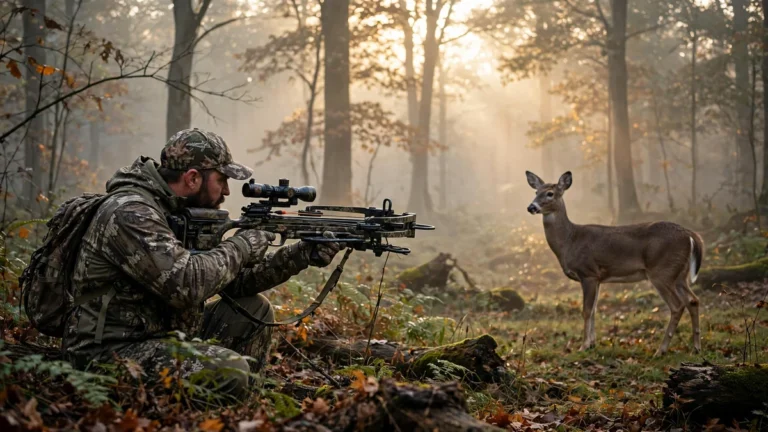
Ethical hunting range is the number that matters, and I define it the same way for both weapons: the distance at which you can put every shot into a 6 inch vital circle, with enough retained energy, from a hunting stance, under pressure. For a crossbow, that is 40 yards or less for most hunters, with most ethical shots at 20 to 40 yards. Practice at 60 yards to make 40 yard shots feel easy, but do not take a hunting shot beyond the distance you have mastered in practice. For a longbow, that is 15 to 25 yards for most hunters, with most traditional hunters self limiting to 20 to 25 yards, and a beginner should start closer still. The gap is not a judgment on longbow hunters. It is physics: a slower arrow drops more, drifts more in wind, and gives the deer more time to move.
Why range collapses in the woods
Three things shrink your range once you leave the range. First, drop. A 400 grain bolt at 400 fps drops over 7 inches between 40 and 50 yards, so a 5 yard ranging error at 40 yards can miss the vitals. A longbow arrow drops far more over the same distance, which is why its ethical range is so short. Second, wind and brush. A crossbow bolt is short and heavy, a longbow arrow is long and light, and both drift, but the slower arrow drifts longer because it spends more time in the air. Third, the deer itself. Sound travels at about 1,125 fps, faster than any bolt at 350 to 500 fps or any arrow at 150 to 200 fps, so the deer hears the shot before the projectile arrives, and it can drop before the bolt or arrow gets there. That is the string jump problem, and it gets worse with distance, which is why the ethical range is a hard ceiling, not a suggestion. Our where to aim on a deer covers the aim point and the wait after the shot in full, and it is worth reading before you hunt with either weapon.
Learning Curve and Physical Demands
How long until you are hunt ready
A crossbow takes days to a few range sessions to sight in and become hunt ready. Sight it in, learn the cocking and safety routine, practice at 20, 30, and 40 yards, and a new hunter can be ready for a first season hunt. There is no anchor point to learn, no instinctive aiming to build, and no holding weight while you aim. Read five-step sighting-in walkthrough and practice from the position you will hunt from, not only from a bench. A longbow takes 3 to 6 months of regular practice for basic proficiency and consistent accuracy to 20 yards, 6 to 12 months for reliable hunting accuracy, and years to master. Form decays after a break of a couple of months, so a longbow rewards a hunter who practices year round. A complete beginner should not plan a first season hunt with a longbow, and no honest writer should promise one. The decision this creates is simple: hunt this season, or enjoy the craft. If you want to hunt this season, pick the crossbow. If you enjoy the craft itself enough to spend a year getting good at it, pick the longbow and accept the wait.
What your body has to do
A longbow asks you to draw and hold 40 to 60 lb with no let off, and to do it with clean form when you are tired, cold, or excited. Beginners should start at 25 to 35 lb for target shooting, and 35 to 45 lb if they plan to hunt eventually, then work up to a hunting weight they can draw and hold steadily. Strength, form, and endurance all matter, and fatigue after a day of tracking or sitting hurts accuracy. A crossbow asks far less of your shoulders at the moment of the shot, because the trigger holds the draw. What it asks instead is cocking effort, and the site verified figures show how light that can be: the Titan X cocks at 5 lb of effort, the Ravin R10X Pro at 12 lb with its Versa-Draw system, the TenPoint TX Ultra at 13.3 lb tested with ACUslide MAXX, and the Ravin R500 at 17 lb with its VersaDrive screw drive system. Read the rope vs crank vs built-in cocking options compared guide and step-by-step cocking walkthrough before your first hunt, because safe cocking is a skill, not a guess.
Who struggles with which
Shoulder, back, and strength limits favour a crossbow, clearly. If you cannot draw and hold 40 to 60 lb steadily, you cannot hunt ethically with a longbow, and no amount of enthusiasm changes that. A crossbow lets you cock with 5 to 17 lb of effort, depending on the system, and then hold nothing while you aim, which is why it suits an older hunter, a hunter with a shoulder problem, or a hunter who wants to wait at full readiness in a stand. A longbow rewards a hunter who practices year round, stays strong, and accepts that a break costs form. It also punishes a hunter who only practices in September. Know which hunter you are before you buy, not after.
Noise, and Why Deer Jump the String
A crossbow is markedly louder than a longbow, and a longbow release is near silent. That direction is settled. The numbers are not, so I give them only as reported ranges, never as a single measured fact. Reported crossbow figures range from 79 dB to 120 dB across sources, which is a wide spread, and it proves the measurement distance and method are not standardised across sources. Reported longbow figures sit at 68 to 75 dB from a single source. The honest summary is that reported crossbow figures cluster around 90 to 108 dB at the shooter, longbow figures around 68 to 75 dB, and the gap is real even if no single number is authoritative. Do not write, and do not believe, a page that states one decibel figure for a crossbow as if it were a lab measurement.
The practical consequence is the string jump. Sound travels at about 1,125 fps, while a bolt travels at 350 to 500 fps and an arrow at 150 to 200 fps. At 40 yards, sound reaches the deer in about 0.1 seconds and the bolt arrives in about 0.3 seconds, which is the window in which a deer can drop 6 to 8 inches. That is why crossbow hunters aim for the lower third of the chest, to allow for the drop. A longbow is quieter, but its arrow is slower, so flight time still gives the deer a chance to move. Neither weapon removes the problem. The crossbow gives the deer less time to move but more warning, the longbow gives the deer less warning but more time. Say that plainly, and keep your shots close with either weapon, because distance is what makes the string jump worse.
One shot reality follows from the noise and the reload. A crossbow is slow to reload, so the first shot is the one that decides the hunt, and a loud first shot that misses usually ends the opportunity. A longbow is faster for a second shot, but the second shot still needs a clean draw, a steady hold, and a deer that has not already left. Do not buy either weapon for its second shot. Buy it for its first shot, and practice until the first shot is the one you can trust.
Size, Weight, and Hunting From a Stand or on Foot
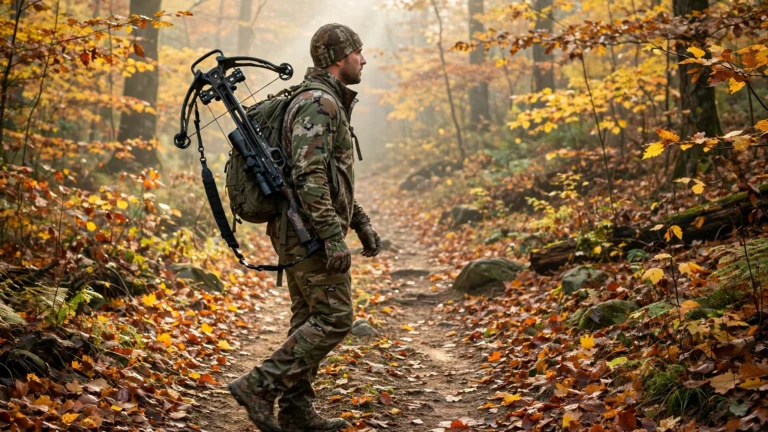
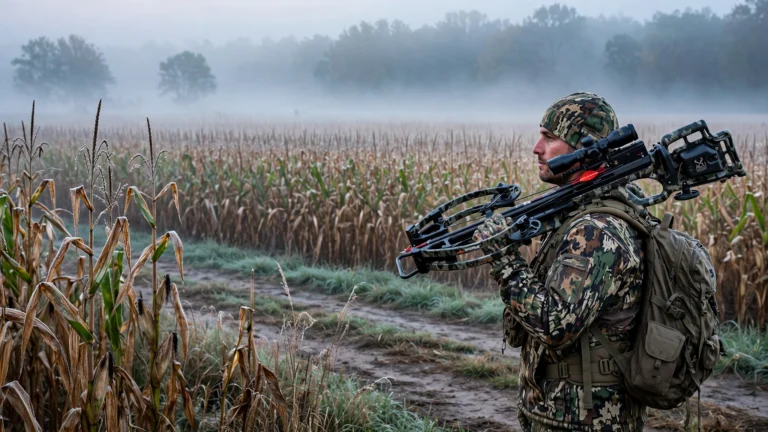
A crossbow is short, wide, and heavy. The site verified models run 26 to 32.5 in long, 3.6 to 9.5 in wide when cocked, and about 7 to 8 lb bare, before accessories. That short length is a real advantage in a treestand or a ground blind, where a long weapon is hard to swing, and the 3.6 in cocked width of the Ravin R500 is the narrowest package in this class. The weight is the cost: about 7 to 8 lb gets heavier by the end of a long sit, and the width catches on brush when you carry it through thick cover. A crossbow is short enough to maneuver in a blind or a stand, and awkward to carry through brush.
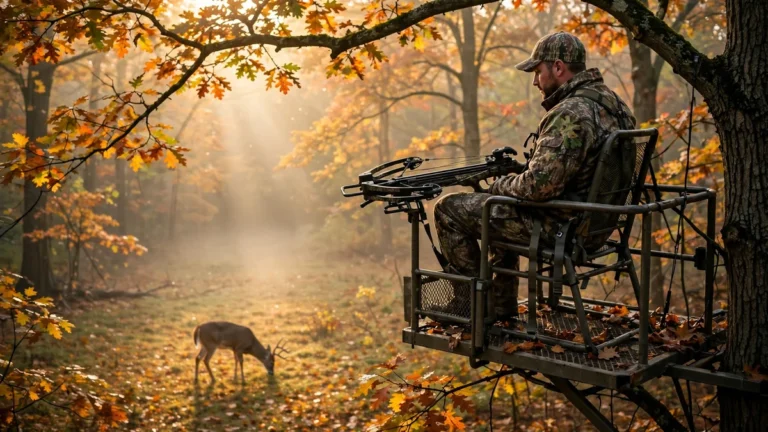
A longbow is long, light, and simple to carry. A typical hunting longbow is 60 to 68 in long and light to carry all day on a sling, which makes it a natural still hunting and stalking weapon. Its length is the cost: drawing a 64 in bow needs vertical clearance, which a tight blind or a small treestand does not always give you, and the long limbs catch on branches when you move through cover. Do not claim a longbow is easier to carry without the blind and treestand qualifier, and do not claim a crossbow is lighter. The crossbow is shorter, the longbow is lighter, and which one matters more depends on how you hunt. Still hunting and stalking favour the longbow’s weight and silence. Treestand and blind hunting favour the crossbow’s short length and cocked readiness.
Cost: What a Starter Kit Really Costs
Compare starter kits, not bow only prices, because neither weapon is ready to hunt straight out of the box at the price on the tag. The figures below use site verified bow prices and typical accessory ranges, labelled as estimates where they are estimates, because accessory prices change and vary by brand.
Entry crossbow kit
An entry crossbow costs about $300 to $400 for the bow itself. The Barnett Boss 405 costs about $330, shoots 405 fps advertised, and draws 220 lb. The Barnett Whitetail Hunter II costs about $370, shoots 350 fps advertised, and draws 150 lb. Both are packaged bows, so a scope is usually included, which is a real cost advantage. You still need bolts, broadheads, a case, a target rated for your speed, rail lube, and a cocking aid if one is not included. A realistic starter kit for an entry crossbow runs roughly $450 to $650 all in, as an estimate, depending on how many bolts and broadheads you buy and whether you need a case and a target. If your budget is tight, read the best crossbows under 500 dollars guide and the best crossbow under 300 dollars guide, and read buying advice for first-time buyers before you buy, because a cheap bow that does not fit your hunting is not a bargain.
Entry longbow kit
An entry longbow costs about $150 to $300 for a mid range bow from a known brand, with budget bows from about $80 to $150 and premium bows from $300 to $600 and above, as reported in published buying guides, which are weak authority, so treat the tiers as a guide, not a price list. You still need arrows, and a dozen typically costs $30 to $150 depending on material and quality, plus a quiver, an arm guard, a finger tab or glove, a bow stringer, a spare string and string wax, and a case at $50 to $200. A realistic starter kit for a mid range longbow runs roughly $250 to $500 before broadheads and practice targets, as an estimate. At the entry tier, a longbow is cheaper to start with than a crossbow. That is true, and it is the whole truth only at the entry tier.
Where the money goes next
A quality longbow costs more than an entry crossbow, so do not claim a longbow is always cheaper. The Bear Montana longbow, 64 in, 30 to 60 lb, costs $519.99 from the manufacturer, which is more than the Boss 405 at about $330 or the Whitetail Hunter II at about $370, and more than some mid range crossbows. A crossbow’s scope is usually included, while a longbow needs no sight but needs far more practice to shoot without one, and practice costs arrows, targets, and time. Mid range and high end crossbow prices climb fast: the Titan X at about $800, the T-Rex at about $1,200, the Ravin R10X Pro at about $1,850, the TenPoint TX Ultra at about $2,300 as a sale price, not the manufacturer list price, the Ravin R500 at about $2,650, and the TenPoint TRX Ultra at about $3,500. Prices change, so check the current price before you buy, and buy the bow that fits your hunting and your shoulder, not the fastest bow on the page.
Legality: Check Your State Before You Buy
Regulations change every year, and this section is a starting point, not the law. Check the current year regulations from your state wildlife agency before you hunt, and do not rely on this article or any list for the current law.
Crossbows in archery season
Crossbow legality is decided state by state, with no federal rule, and it changes almost every legislative session. States fall into three broad categories in published summaries. Full inclusion states allow crossbows for all licensed hunters during the full archery season, and examples include Arkansas, Florida, Georgia, Kansas, Louisiana, Maryland, Mississippi, Missouri, Nebraska, New Jersey, North Carolina, Ohio, Oklahoma, Pennsylvania, South Carolina, Tennessee, Texas, Virginia, Wisconsin, Alabama, Connecticut, Indiana, and Kentucky. Restricted states limit crossbows in archery season to disabled hunters with a permit, or to firearms season, and examples in the summaries checked include Oregon, Washington, California, Colorado, Idaho, Montana, Wyoming, Alaska, Nevada, New Mexico, Utah, and New Hampshire. Oregon is the strictest example cited: crossbows are banned from archery season except for disabled hunters. Partial access states sit in between, for example Michigan, with different rules in parts of the Upper Peninsula, and Iowa, where archery season crossbow use is limited to hunters over 70 or with a disability permit.
Two recent changes are worth naming because earlier guides get them wrong. In Illinois, the old rule that limited crossbows to hunters age 62 and older or with a disability permit is dead: the crossbow permit sections of the Illinois Administrative Code were repealed effective November 2, 2022, and the current equipment rule lists a crossbow as legal archery equipment with no age limit and no disability limit, with a minimum peak draw weight of 125 lb, a minimum overall length of 24 in, a working safety, fletched bolts at least 14 in long not counting the point, and broadheads at least 7/8 in in diameter when fully opened. There is no maximum draw weight in Illinois. In Minnesota, the expansion of crossbow access is now permanent: HF 1531 and SF 1251 removed the expiry date, the governor signed the change into law on May 5, 2026, and the 2026 statute has no expiry date and no age limit. Guides that still warn about a June 30, 2026 sunset in Minnesota are stale. In New York, crossbows became legal for the entire big game archery season from August 27, 2025, except in three downstate counties, under S6360A and A8330A. Reports about other states, including Arizona, conflict across sources, and I do not state any Arizona change as fact here: check the Arizona Game and Fish Department directly before you hunt there.
Longbows in archery season
A longbow is legal wherever archery hunting is allowed, subject to the state’s minimum draw weight and broadhead rules. There is no state that bans longbows from archery season while allowing other vertical bows. Do not repeat the claim, found in some guides, that not all states allow you to use a longbow. That claim is misleading, and it gets the direction of the law backwards: it is the crossbow that is restricted in several states, not the longbow.
Minimum draw weight for a longbow is a state question. Published summaries report that 32 states set a legal minimum for deer, from 30 to 40 lb at peak draw, and 18 set none, but that count comes from a secondary summary, so treat it as reported, not as a verified count. Those summaries do not break the bands out by bow type, so do not read them as longbow-specific minimums: North Carolina sets 40 lb for a longbow, and Oklahoma sets 40 lb for traditional bows. Two primary sources were checked for named examples: Ohio sets a longbow minimum of 40 lb and a crossbow minimum of 75 lb, and Oklahoma sets 40 lb or more for any recurve, longbow, or self bow, 30 lb or more for any compound, and a crossbow minimum of 100 lb with bolts at least 14 in long. North Carolina sets 40 lb for a longbow and recurve. Check your own state, because a 50 state table printed here would go stale within a year.
Crossbow minimums also vary
Crossbow minimum draw weight varies by state too: Ohio at 75 lb, Oklahoma and Arkansas at 100 lb, New York at 100 lb in published summaries. Bolt minimums vary as well, for example 14 in in Oklahoma. The lesson is the same in every paragraph of this section: the state wildlife agency is the only authority, and the current year regulations document is the only version that matters. If you hunt in more than one state, the rules change at the border, and a bow that is legal at home can be illegal an hour down the road.
Maintenance and Reliability
A longbow is radically simple. No cams, no cables, no trigger, no scope to fog or lose zero. Field repair is a spare string and a stringer. Care is string wax, keeping the bow unstrung when stored, and protecting wood or laminated limbs from heat and moisture. A fiberglass laminated longbow is more resistant to warping and moisture than a wood self bow. No bow press is needed, and there is almost nothing to fail in the field.
A crossbow has more to maintain and more to fail. The string and cables wear, the rail needs lube, screws and scope mounts need checking, and the trigger and safety need inspection before every hunt. A string change usually needs a bow press or a shop. A crossbow also sits cocked under full limb load for hours, while a longbow is only drawn for the shot, so the longbow has no cocked limb fatigue and nothing to de-cock at the end of the sit. Safe de-cocking matters for a crossbow: name the system you own, whether it is an ACUdraw De-Cock system, an ACUslide system, or a discharge target, and learn it before the season. Read five safe ways to uncock your bow, the season-ready maintenance checklist, and the safety rules for handling every bow, and never dry fire a crossbow. A dry fire sends the energy nowhere, and the bow pays for it.
A Short History, Kept Short
Both weapons are old, and their history explains why they exist, not which one you should hunt with today. The crossbow appeared in China from the 5th century BC, and reached Europe centuries later, where it became the weapon of the soldier who needed power without years of training. The longbow became the weapon of England, where boys trained with it from childhood, and it won its fame in the Hundred Years War. At the Battle of Sluice in 1340, and then at Crecy in 1346 and Agincourt in 1415, English longbowmen broke French charges with massed arrows, and those three battles still dominate every history of the bow. The rate of fire tells the story of the two weapons as battlefield tools: a skilled longbowman could loose 10 to 12 arrows per minute in a volley, while a crossbowman managed about 2 to 3 bolts per minute, because spanning and loading a crossbow took far longer than drawing a bow. That is a battlefield volley rate, not a hunting number, and it says nothing about aimed accuracy at a deer. The longbow demanded a lifetime of training, the crossbow demanded little, and that trade shaped armies for centuries. It also shaped the modern choice: the crossbow still asks less of the shooter, and the longbow still asks for the craft. History ends here, because the hunting comparison is the part that matters, and it is the part the rest of this article covers.
Crossbow Pros and Cons
Pros
- Hunt ready in days to a few range sessions, not months
- Scoped, rifle like aiming, with no anchor point or instinctive aiming to learn
- Held cocked with no holding weight while you wait for the shot
- 350 to 500 fps and 100 to 220 ft-lb of kinetic energy, with bolt weight stated
- 40 yard ethical range for most hunters, most shots at 20 to 40 yards
- Short enough for a blind or a treestand, for example the Ravin R500 at 28 in long and 3.6 in wide when cocked
- Suits a weaker shoulder: cocking effort of 5 to 17 lb on the site verified systems, then nothing to hold
Cons
- Heavy, about 7 to 8 lb bare, before accessories
- Loud, with a real string jump risk, especially beyond 30 yards
- Slow to reload, so the first shot is the one that decides the hunt
- More to maintain and more to fail: string, cables, rail, trigger, safety, scope mounts
- Needs a cocking device or crank for high draw weights
- Restricted in archery season in several western states
- Costs more at the mid range and high end, up to about $3,500 for a flagship
Longbow Pros and Cons
Pros
- Light to carry all day, commonly described as about 1 to 2 lb, though no named model spec sheet was checked for that figure
- Near silent release, reported at 68 to 75 dB from a single source
- Fast second shot, with no cocking device or crank to work
- Simplest possible weapon, almost nothing to fail in the field
- Field repair is a spare string and a stringer, no bow press needed
- Legal wherever archery hunting is allowed, subject to a minimum draw weight in the states that set one
- The craft itself is the reward for many hunters
Cons
- Months to a year to become hunt ready: 3 to 6 months basic, 6 to 12 months hunting accuracy
- Must draw and hold 40 to 60 lb with no let off, every shot
- About 150 to 200 fps and about 30 to 40 ft-lb of kinetic energy with a 500 to 600 grain arrow
- Ethical range of 15 to 25 yards for most hunters
- Long, 60 to 68 in, and hard to draw in a tight blind or a small treestand
- No sight, so accuracy depends entirely on form and instinctive aiming
- Marginal for elk sized game at the same setup, below the reported 42 to 65 ft-lb elk band
Bottom line: Which One Should You Pick?
Bottom line: there is no single winner, there is a right weapon for your season, your shoulder, your state, and your patience. Use the table below, and be honest with yourself about which row you are really in.
| If you are | Pick | Why |
|---|---|---|
| A new hunter who wants to hunt this season | Crossbow | Hunt ready in days, scoped aiming, 40 yard ethical range, no holding weight |
| An older hunter, or a hunter with a weaker shoulder | Crossbow | Cocking effort of 5 to 17 lb on the site verified systems, then nothing to hold while aiming |
| A treestand or blind hunter | Crossbow | Short length, for example 28 in for the R500, and cocked readiness while you wait |
| A still hunter or stalker who hunts close | Longbow | Light to carry, near silent, fast second shot, and you are already inside 25 yards |
| A traditionalist who enjoys the craft | Longbow | The bow itself is the reward, and you accept the 20 yard limit and the months of practice |
| A budget buyer at the entry tier | Longbow to start, crossbow to shoot well quickly | A mid range longbow kit runs roughly $250 to $500, an entry crossbow kit roughly $450 to $650, but the crossbow gets you hunt ready far sooner |
| A hunter in a western state that restricts crossbows in archery season | Longbow, after checking the current regulations | A longbow is legal wherever archery is allowed, subject to a minimum draw weight, while a crossbow may be limited to a disability permit or firearms season |
If the goal is meat in the freezer this season, pick the crossbow, practice to 40 yards from the position you will hunt from, and take only the shot you have already made a hundred times on the range. If the goal is the bow itself, pick the longbow, accept the 20 yard limit, and enjoy the long road to getting good, because the road is the point. If you have not checked your state regulations, or you cannot yet put every practice shot into a 6 inch circle at the distance you plan to hunt, pick neither yet. That applies to both weapons, and it is the most honest advice in this article. If you have picked the crossbow, the hunting-ready bows for the treestand and beyond guide is the next step, and the buying advice for first-time buyers guide will help you buy once, not twice.
Frequently Asked Questions
Which is better for hunting, a crossbow or a longbow?
For most hunters, a crossbow. It is faster, 350 to 500 fps against about 150 to 200 fps, far more powerful, 100 to 220 ft-lb against about 30 to 40 ft-lb, scoped, and it can be held cocked and ready with no holding weight. A longbow is better only if you want the traditional craft itself and accept a 15 to 25 yard ethical range and months of practice to get hunt ready.
How far can you ethically shoot a deer with a crossbow vs a longbow?
A crossbow, 40 yards or less for most hunters, with most shots at 20 to 40 yards. A longbow, 15 to 25 yards for most hunters, with most traditional hunters self limiting to 20 to 25 yards. Maximum flight, roughly 300 to 500 yards for a bolt and several hundred yards for an arrow, is not a hunting range.
Is a longbow more powerful than a crossbow?
No. A hunting longbow at 40 to 60 lb with a 500 to 600 grain arrow makes about 30 to 40 ft-lb of kinetic energy. A hunting crossbow makes 100 to 220 ft-lb. A longbow is enough for deer at close range with a heavy arrow and good placement, and it is marginal for elk. A crossbow clears the deer and elk energy bands by a wide margin at the muzzle.
How long does it take to learn each one?
A crossbow takes days to a few range sessions to sight in and become hunt ready. A longbow takes 3 to 6 months for basic proficiency and consistent accuracy to 20 yards, 6 to 12 months for reliable hunting accuracy, and years to master. A complete beginner should not plan a first season hunt with a longbow.
Is a crossbow legal during archery season?
It depends on your state. Many eastern and Plains states allow crossbows for all hunters during the full archery season. Several western states restrict crossbows in archery season to disabled hunters or to firearms season. Longbows are legal wherever archery is allowed, subject to a minimum draw weight of 30 to 40 lb in the states that set one. Check your current year state regulations before hunting.
What draw weight do I need for a longbow to hunt deer?
Most states that set a minimum set 30 to 40 lb for deer, and several set 40 lb specifically for traditional bows, for example Ohio at 40 lb and Oklahoma at 40 lb for recurve and longbow. Many traditional hunters prefer 50 to 60 lb for better penetration. Start lighter, at 25 to 35 lb, to learn form, then work up to a hunting weight you can draw and hold steadily.
Why is a crossbow so much louder than a longbow?
A crossbow dumps far more energy through a short power stroke with a mechanical trigger, which makes a sharp snap. Reported figures cluster around 90 to 108 dB at the shooter for a crossbow against 68 to 75 dB for a longbow, but no single number is authoritative because measurement methods differ across sources. The practical result is that a deer is more likely to hear a crossbow and drop before the bolt arrives, especially beyond 30 yards.
Which is cheaper to start with?
At the entry tier, a longbow. A mid range longbow costs about $150 to $300, plus arrows and a few accessories, for a starter kit of roughly $250 to $500. An entry crossbow costs about $330 to $370 for the site verified Boss 405 and Whitetail Hunter II, plus bolts and accessories, for a starter kit of roughly $450 to $650. A quality longbow such as the Bear Montana at $519.99 costs more than an entry crossbow, so compare starter kits, not bow only prices.
Can I hunt with a longbow if I have a weak shoulder?
Probably not with a hunting weight longbow, because you must draw and hold the full 40 to 60 lb with no let off. A crossbow is the better choice here: cocking effort with a rope or crank is 5 to 17 lb on the site verified models, and you hold nothing while aiming. If a shoulder problem is the reason you are choosing, check your state’s crossbow rules first, because several western states restrict crossbows in archery season to disabled hunters.
Sources
- Manufacturer pages for the crossbow models named in this article: Ravin for the R500 and R10X Pro, TenPoint for the TX Ultra, Titan X, and TRX Ultra, Barnett for the T-Rex, Whitetail Hunter II, and Boss 405, Excalibur for the Rev X TD, and Bear Archery for the Montana Longbow at $519.99, 64 in, 30 to 60 lb
- Ohio Administrative Code 1501:31-15-11, longbow minimum 40 lb and crossbow minimum 75 lb, a primary state source
- Oklahoma eRegulations, big game hunting regulations: recurve and longbow 40 lb or more, compound 30 lb or more, crossbow minimum 100 lb, bolts minimum 14 in, a primary state source
- Illinois Administrative Code, crossbow equipment rule: 125 lb minimum peak draw weight, no maximum, 24 in minimum length, bolts at least 14 in, broadheads at least 7/8 in, with the old crossbow permit sections repealed effective November 2, 2022
- Minnesota Statutes 2026, section 97B.037, and Minnesota Legislature HF 1531 and SF 1251, signed May 5, 2026, removing the crossbow expiry date, with no expiry and no age limit in the current statute
- New York S6360A and A8330A, effective August 27, 2025, crossbows legal for the full big game archery season except in three downstate counties
- Published traditional archery guides for longbow speed, learning curve, and practice timelines, including the 150 to 200 fps range, the 3 to 6 month basic and 6 to 12 month hunting accuracy timelines, and the 20 to 25 yard self imposed limit
- Published crossbow hunting guides for ethical range, bolt drop, and string jump figures, including the 40 yard ceiling for most hunters and the 6 to 8 inch deer drop at 40 yards
- Published state summaries for crossbow archery season access by category and for longbow minimum draw weights by state, used as reported summaries, not as primary law, with the reader directed to the state wildlife agency for the current rules
- Published archery physics references for the kinetic energy formula, KE equals grains times fps squared divided by 450240, and for the Archery Trade Association energy bands as reported, with the original ATA source not checked for this article
- Published medieval history references for Crecy, Agincourt, Sluice, and battlefield rates of fire, used only for the short history section
Disclaimer: Hunting regulations change every year and vary by state, county, and season. This article is a comparison and a starting point, not legal advice. Check the current year regulations from your state wildlife agency before you buy a bow or hunt with one, and follow your bow manufacturer’s manual for cocking, loading, and de-cocking. Prices in this article were checked on November 8, 2026 and will change, so check the current price before you buy.
Keep reading: the other guides in this series cover the rest of the hunt. Learn shooting a crossbow from a saddle, read the full complete hunting walkthrough for newcomers, learn how the limbs, string and trigger work together, compare the guide to recurve, compound and reverse-draw designs, study the where to aim on a deer, and finish with six practical tips for first-time hunters. If you have picked the crossbow, start with our tested picks for every budget guide, then read the safety rules for handling every bow before your first hunt.